
Writer by sanjoy gorh 22.02.2026 time 10.00 AM Published
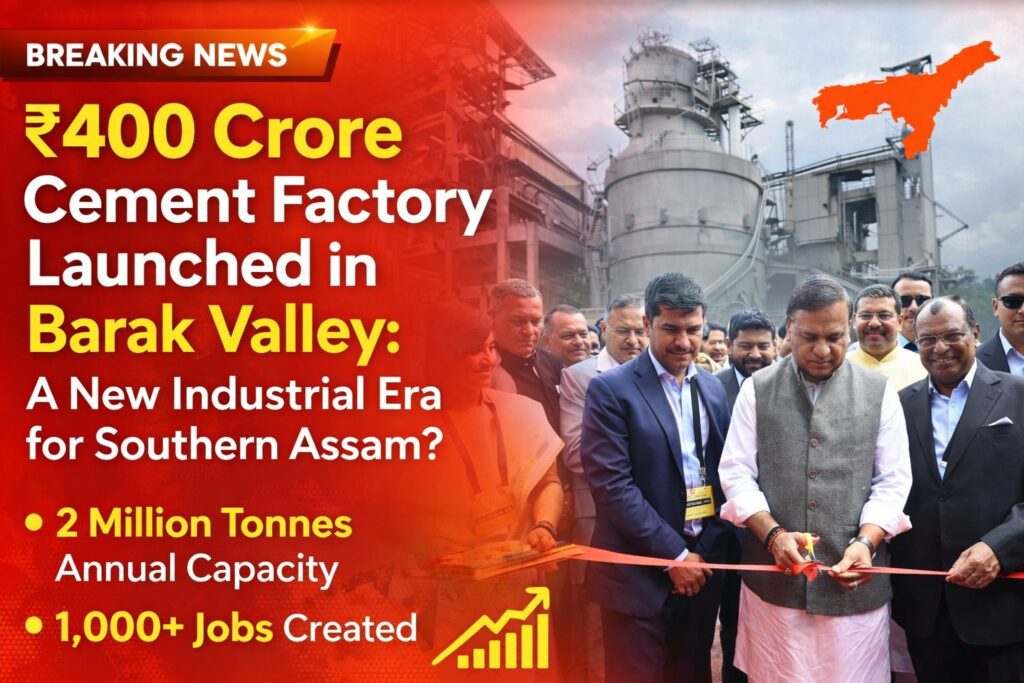
On February 20, 2026, Assam Chief Minister Himanta Biswa Sarma inaugurated Star Cement Ltd.’s new ₹400 crore grinding unit at Bihara (Hilara area) in Cachar district, marking a historic milestone for industrial development in the Barak Valley. This state-of-the-art facility, with an annual production capacity of 2 million tonnes per annum (2 MTPA), is the first major private-sector cement plant in the region and is expected to significantly reduce dependence on imported cement while creating over 1,000 direct and indirect jobs.
For the three districts of Barak Valley Cachar, Karimganj, and Hailakandi this project represents more than just a factory. It signals the beginning of balanced regional industrial growth, lower construction costs, and new economic opportunities in an area long dominated by agriculture, tea gardens, and small trade.
A Strategic Push for Industrialisation in Southern Assam
The Barak Valley has historically lagged behind Upper Assam in large-scale industrial presence. Most cement demand was met through supplies from distant plants, leading to high transportation costs, delays during monsoons, and supply chain disruptions. The new Star Cement unit changes this equation by bringing production closer to the point of consumption.
Chief Minister Himanta Biswa Sarma described the plant as “the face of a new Assam where industrialisation is laying the foundation of prosperity and growth.” He highlighted how the project will strengthen local infrastructure development, generate employment, and reduce outward migration by offering stable livelihood opportunities to the youth of the region.
Equipped with modern German technology, the greenfield grinding unit also features its own railway siding a first for private cement plants in Barak Valley which will improve logistics efficiency and lower freight costs by an estimated 8–12%.
Key Features and Capacity of the ₹400 Crore Plant
- Investment: Over ₹400 crore
- Annual Capacity: 2 million tonnes (2 MTPA)
- Location: Bihara/Hilara, Cachar district
- Technology: Advanced German machinery with emphasis on environmental compliance, including dust filtration, emissions control, and waste heat recovery systems
- Logistics Advantage: Dedicated railway siding for efficient raw material inflow and finished cement distribution
The plant is designed not only for high-volume production but also for sustainable operations, aligning with Assam’s broader goals of responsible industrial growth.
Massive Employment and Skill Development Opportunities
Officials project that the facility will generate more than 1,000 direct and indirect jobs. These include:
- Technical and engineering roles
- Machine operators and quality control staff
- Logistics, transportation, and supply chain positions
- Ancillary services such as local vendors, security, and maintenance
This employment boost is particularly significant for Barak Valley, where many young people have traditionally migrated to other states in search of better opportunities. Local hiring and skill development programmes during the ramp-up phase are expected to create a trained workforce that can support future industrial expansion in the region.
Economic Impact: Lower Costs, Faster Development, and Regional Balance
Cement is the backbone of infrastructure projects. With rising demand driven by national highway expansions, rural road upgrades, railway modernisation, government housing schemes, and border area development, the new plant will ensure steady and cost-effective supply to southern Assam and neighbouring states like Tripura, Mizoram, and Manipur.
Key benefits include:
- Reduced Construction Costs: Lower freight expenses will make roads, bridges, schools, and homes more affordable to build.
- Faster Project Completion: Reliable local supply minimises delays caused by seasonal disruptions.
- Multiplier Effect: Growth in cement production can attract allied industries, creating an industrial corridor in southern Assam.
- Economic Diversification: Moving beyond agriculture and tea to value-added manufacturing helps build resilience against climate and market fluctuations.
For real estate developers and government contractors working in the Northeast, this development is expected to improve project viability and accelerate the pace of urban and rural infrastructure growth.
Environmental Responsibility and Sustainable Operations
Star Cement has emphasised modern pollution control measures, including advanced dust filtration systems and energy-efficient technologies. The plant aims to meet strict environmental standards while contributing to the region’s development. Long-term success will depend on continued focus on green practices, water management, and community engagement.
Alignment with Assam’s Vision for Balanced Growth
This inauguration fits into Chief Minister Himanta Biswa Sarma’s larger strategy of decentralised industrial development and reducing regional imbalances within Assam. By encouraging private investment in hitherto under-industrialised areas like Barak Valley, the government aims to distribute economic opportunities more evenly across the state.
The project also complements central and state initiatives for Northeast infrastructure, including improved connectivity under schemes like Bharatmala and Act East Policy-related developments.
The first 24 months will be critical as the plant ramps up production, integrates local supply chains, hires and trains workers, and establishes strong distribution networks. If executed smoothly, the Star Cement unit has the potential to become an anchor for further industrial investments in southern Assam.
Residents and local leaders have welcomed the development, viewing it as a concrete step towards self-reliance and prosperity. With stable power supply, continued policy support, and ease of doing business, Barak Valley could witness the emergence of a vibrant industrial ecosystem in the coming years.
This ₹400 crore cement plant is more than a single factory it is a symbol of hope for balanced regional development, job creation, and infrastructure-led growth in one of Assam’s most strategically important regions.
As southern Assam steps into a new industrial era, the Star Cement unit at Bihara stands as a testament to what collaborative efforts between government and private enterprise can achieve for the people of Barak Valley and the entire Northeast.
(FAQ)
Q1: What is the investment size of the project?
The Barak Valley cement factory has been developed at a cost of ₹400 crore.
Q2: What is its annual production capacity?
The plant is expected to produce around 2 million tonnes annually.
Q3: How many jobs will it create?
More than 1,000 direct and indirect employment opportunities are anticipated.
Q4: Which regions will benefit from its supply?
Apart from southern Assam, the plant is expected to supply Tripura, Mizoram, and Manipur.
Q5: Why is this project important now?
Infrastructure demand in the Northeast is rising, and localized cement production strengthens cost stability and supply reliability.
Conclusion
The Barak Valley cement factory marks a significant industrial milestone for southern Assam.Yet its long-term impact will depend not on inauguration optics but on execution, environmental responsibility, local employment integration, and policy support.
For Barak Valley, this is not just a factory opening.It is a test of whether regional industrial ambition can translate into sustained economic transformation.





Leave a Reply