Some deaths close chapters. Others reopen wounds that never healed.
The passing of former Bangladesh Prime Minister Khaleda Zia has done the latter—especially for exiled author Taslima Nasreen, whose life and work were profoundly shaped by censorship, threats, and forced exile during Zia’s rule.Taslima Nasreen on Khaleda Zia death is not a political statement alone; it is a deeply human response rooted in loss, resistance, and unanswered questions about freedom of expression in South Asia.
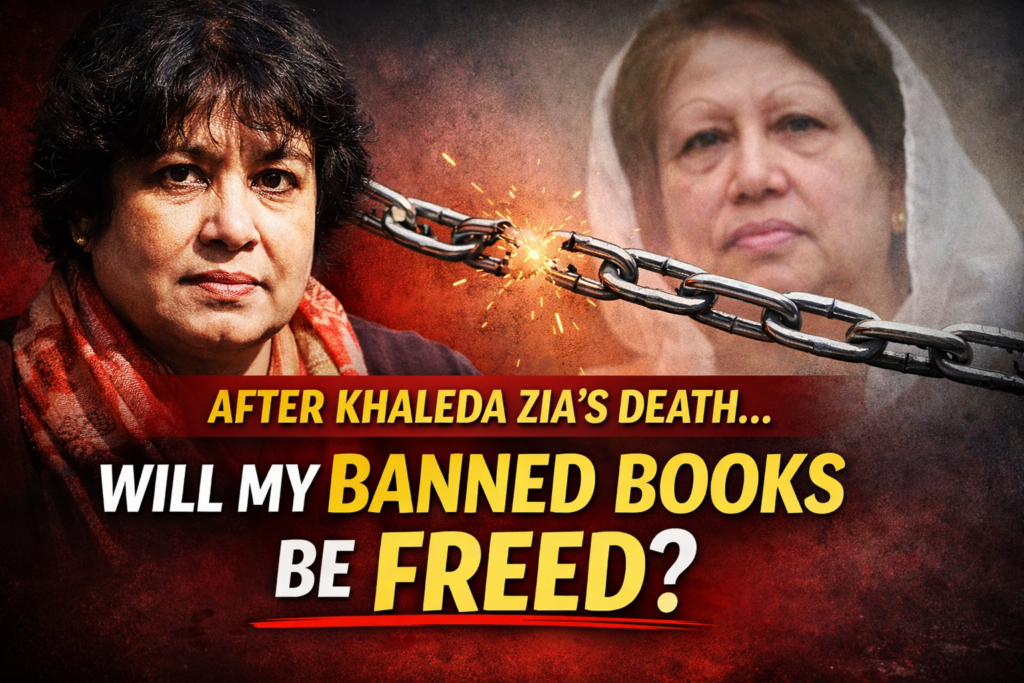
Who Refused to Be Silent
Taslima Nasreen has long stood at the intersection of literature and dissent. A secular, feminist, and humanist voice, she wrote against religious extremism at a time when doing so invited danger. Following Khaleda Zia’s death Nasreen spoke openly on X, recalling how legal cases were filed against her for allegedly hurting religious sentiments.
She accused the former prime minister of siding with fundamentalist forces instead of protecting a writer’s right to think freely. Taslima Nasreen on Khaleda Zia death reflects decades of personal pain—pain that came from being criminalized for words on a page.
The Power of the Ban: When Books Become a Threat
Few moments define state censorship more clearly than the banning of books. During Khaleda Zia’s tenure, several of Nasreen’s works were prohibited:
- Lajja (Shame) – banned in 1993
- Utal Hawa – banned in 2002
- Ka – banned in 2003
- Those Dark Days – banned in 2004
Lajja, perhaps her most well-known novel, addressed violence against Hindus after the Babri Masjid demolition. Its banning sent a chilling message to across Bangladesh.
Taslima Nasreen on Khaleda Zia death now revives the question: should literature ever be silenced for speaking uncomfortable truths
Exile Is Not Freedom
The bans were only the beginning. Nasreen faced death threats and mob violence from fundamentalist groups. In 1994, fearing for her life, she fled Bangladesh for Sweden. A decade later, she moved to India, where she continues to live in exile.
Exile is often described as safety—but it is also permanent displacement. Taslima Nasreen on Khaleda Zia death reminds readers that losing one’s homeland is not an abstract political outcome; it is a lifelong emotional cost
Will Her Death Restore What Was Taken ?
In her reaction, Nasreen did not express hatred. Instead, she asked a difficult but necessary question: will Khaleda Zia’s death finally lead to the lifting of bans on her books?
She noted that while Zia was alive, no effort was made to restore freedom of expression. If change comes now, Nasreen believes it should be welcomed. Taslima Nasreen on Khaleda Zia death thus becomes a moment of moral reflection rather than celebration.
Khaleda Zia: A Complex Political Legacy
Khaleda Zia’s political journey was undeniably historic. Rising from domestic life to lead the Bangladesh Nationalist Party, she served as prime minister for nearly a decade. Even after losing power in 2006 and spending years in jail under Sheikh Hasina’s government, her influence remained strong.
She passed away at the age of 80 after prolonged illness involving pneumonia and heart-lung complications. As Bangladesh prepares for upcoming elections, her party continues to command wide support.Yet Taslima Nasreen on Khaleda Zia death adds a crucial layer to Zia’s legacy—how power was used to silence dissent
Why This Moment Matters Beyond Bangladesh
This is not just a Bangladeshi story. Across the world, writers face increasing pressure from politics, religion, and nationalism. The debate raised by Taslima Nasreen on Khaleda Zia death speaks to a universal truth: when governments fear books, societies lose their moral compass.
Freedom of expression is not protected by silence—it survives through courage.
(FAQs)
1. What did Taslima Nasreen say after Khaleda Zia’s death?
Taslima Nasreen reacted by recalling how several of her books were banned during Khaleda Zia’s rule and how legal cases forced her into exile. She questioned whether Zia’s death would finally lead to the lifting of bans on her works and restoration of freedom of expression in Bangladesh.
2. Why were Taslima Nasreen’s books banned in Bangladesh?
Nasreen’s books were banned on the grounds of allegedly hurting religious sentiments and threatening public order. Her writings criticized religious extremism, highlighted minority persecution, and promoted secular and feminist values, which triggered protests from fundamentalist groups.
3. Which books of Taslima Nasreen were banned?
Some of the major banned books include:
- Lajja (1993)
- Utal Hawa (2002)
- Ka (2003)
- Those Dark Days (2004)
These bans became symbols of state censorship in Bangladesh.
4. Why did Taslima Nasreen leave Bangladesh?
Taslima Nasreen left Bangladesh in 1994 after receiving repeated death threats and facing mob violence from extremist groups. An arrest warrant and lack of state protection made it unsafe for her to remain in the country.
5. Where does Taslima Nasreen live now?
After initially taking refuge in Sweden, Taslima Nasreen later moved to India, where she continues to live in exile. Despite multiple appeals, she has not been allowed to return permanently to Bangladesh.Taslima Nasreen on Khaleda Zia Death
conclusion
Khaleda Zia’s death may mark the end of a political era, but for Taslima Nasreen, the story is incomplete. The bans remain. The exile continues. The questions are unanswered.Taslima Nasreen on Khaleda Zia death stands as a reminder that true closure will come only when words are no longer treated as crimes—are allowed to return home and more trending news visit our site