Why Artificial Intelligence Is Increasing Pressure Not Free Time By Staff Writer | Work, Technology & Society
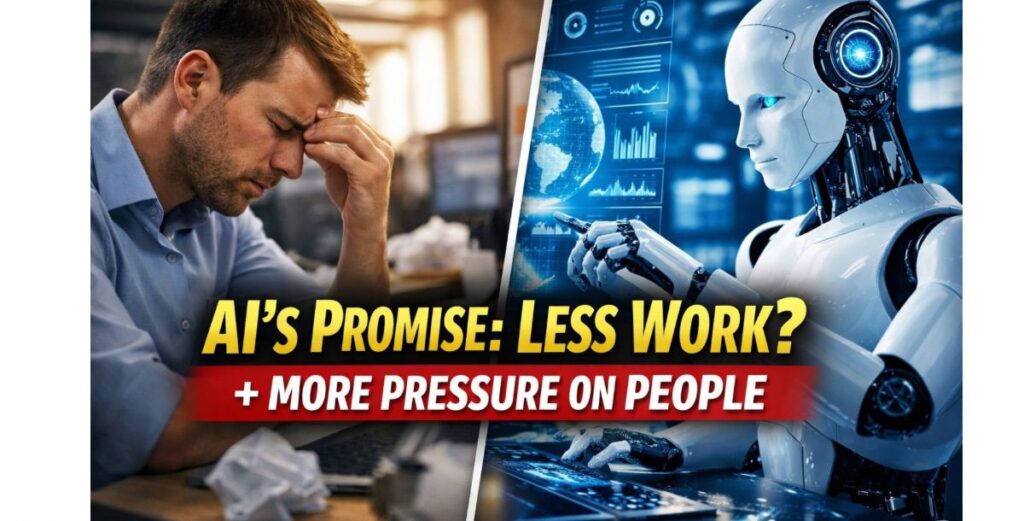
We Were Promised Time. What We Got Was Pressure.
Artificial intelligence was supposed to make work easier. By automating routine tasks AI promised less stress, fewer hours, and more balance in daily life.That promise hasn’t played out.
Across offices, classrooms, creative studios, and digital workplaces, a new reality is taking shape. AI didn’t reduce work it changed workplace expectations. Faster replies are assumed. Cleaner drafts are mandatory. Output is higher, deadlines are tighter, and tolerance for delay is shrinking.The work didn’t disappear. It multiplied quietly.
How AI in the Workplace Reset Productivity Standards
When AI tools first arrived, they felt like an advantage. Early users worked faster, produced more, and stood out. But that advantage was temporary.What once looked exceptional is now considered normal.
- Emails are expected to be instant and polished
- Reports must be detailed, data-backed, and ready faster
- Content is required across multiple platforms, every day
- Errors that were once acceptable now raise questions
Artificial intelligence didn’t replace workers.It raised the minimum performance bar for everyone.
Why AI Productivity Didn’t Reduce Workload
On paper, AI improves efficiency. In practice, the time saved rarely becomes rest.Instead, it gets absorbed into
- More meetings
- More revisions
- More deadlines
- More performance tracking
- More one last task requests
This explains a growing workplace paradox: Work is faster, but days feel heavier.AI productivity gains have been converted into higher output expectations, not lighter workloads.
Rule of AI at Work
No company memo announced it. But a silent rule spread quickly:If AI can do it faster, humans should too.If an AI tool can generate a draft in minutes, why did it take you an hour?If AI can analyze data instantly, why ask for more time?This logic ignores a key truth AI produces output. Humans carry responsibility.
Judgment, accuracy, ethics, and accountability still rest with people even as deadlines increasingly reflect machine speed.
The Hidden Mental Cost of Artificial Intelligence
The impact of AI on jobs isn’t always visible in layoffs or automation headlines. It shows up in pressure.Workers now feel expected to:
- Match machine-level speed
- Be constantly available
- Deliver perfect results on the first attempt
- Keep learning new AI tools just to stay relevant
Burnout in the AI era isn’t only about long hours. It’s about constant acceleration without recovery.
Creativity in the Age of Constant Output
AI was expected to unlock creativity. Instead, many professionals say it has narrowed it.When volume matters more than depth:
- Original ideas are rushed
- Creative risk-taking declines
- Safe, optimized output replaces bold thinking
Creativity needs time.AI-powered workflows often remove it.
Who Benefits From Rising AI Expectations
AI-driven productivity benefits organizations and consumers. Services are faster. Content is constant. Costs are lower.But for many workers, the exchange feels unequal.Without clear limits, AI in the workplace becomes a silent supervisor always efficient, always present, and impossible to compete with.
Experts say the next phase of artificial intelligence adoption must focus on people, not just output.That means:
- Redefining productivity beyond speed
- Protecting deep-focus and creative work
- Valuing human judgment and accountability
- Setting realistic expectations in AI-assisted roles
Technology should support humans not quietly exhaust them.
The Question We Still Haven’t Answered
Artificial intelligence didn’t fail its promise.We misunderstood it.
The real challenge is no longer what AI can do but what we continue to demand from humans once AI raises the standard.The future of work with AI won’t be decided by smarter machines alone.It will be decided by whether we choose sustainable expectations over endless acceleration.
FAQ
1. Did AI actually reduce work for employees?
No. AI has not reduced work; it has changed expectations. While AI automates routine tasks, organizations often raise performance standards, meaning employees may produce more in the same amount of time.
2. How has AI changed workplace expectations?
AI has made speed, accuracy, and output volume the new baseline. Tasks that were once impressive are now considered standard, and employees are expected to deliver faster and with fewer errors.
3. What is the impact of AI on employee mental health?
AI-driven productivity can increase stress and cognitive load. Employees may feel pressure to match machine-level speed, stay constantly available, and deliver near-perfect results, leading to burnout and fatigue.
4. Can AI improve creativity at work?
AI can assist in generating ideas or content, but human creativity requires time for reflection, experimentation, and risk-taking. Increased output expectations may reduce the time available for true creative thinking.
5. How can organizations balance AI and human work?
Companies should redefine productivity beyond speed, protect time for deep work, value human judgment, and set realistic expectations. AI should support employees, not increase their workload or stress.
Conclusion
Artificial intelligence didn’t reduce work. Instead, it quietly reshaped workplace expectations, raised productivity standards, and changed the way humans are evaluated. While AI can handle repetitive tasks and speed up processes, it cannot replace human judgment, creativity, and accountability