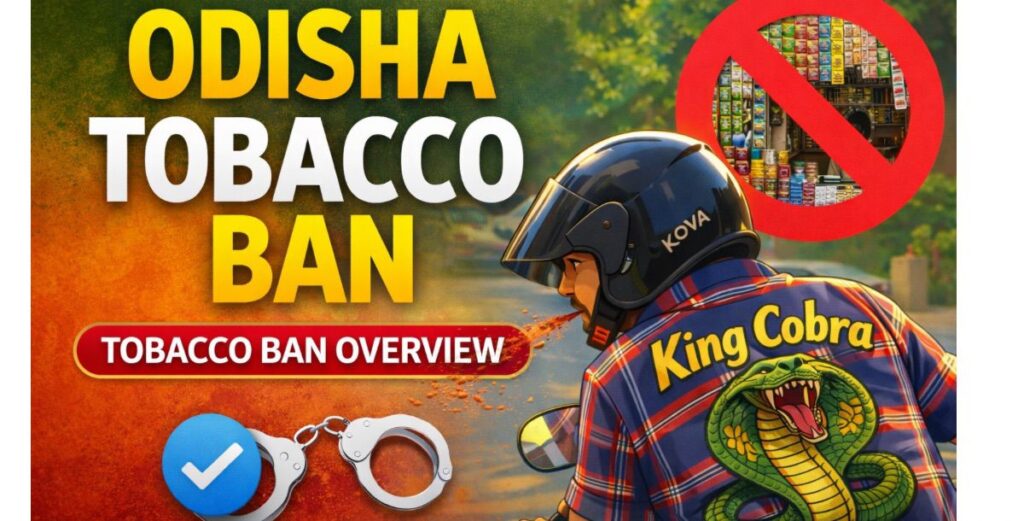
The Odisha gutkha ban marks one of the state’s most decisive public health interventions in recent years, as the government moves to eliminate tobacco-laced food products that have quietly fueled addiction, disease, and preventable deaths.
Under the new order, the manufacture, storage, transport, distribution, and sale of gutkha, pan masala, zarda, khaini, and any edible item containing tobacco or nicotine are prohibited across Odisha. The ban applies universally cutting across brands, packaging styles, and retail formats.Officials say the action is aimed at curbing the deep-rooted culture of smokeless tobacco consumption, which has disproportionately affected young people, daily wage workers, and rural populations
Why the Odisha Gutkha Ban Was Inevitable
Public health data has long pointed to Odisha’s high prevalence of smokeless tobacco use, with gutkha remaining among the most accessible and addictive products on the market. Health experts have consistently warned that these products are directly linked to oral cancer, heart disease, strokes, and chronic respiratory conditions.
Doctors note that addiction often begins in adolescence.Once dependency sets in, the damage is lifelong medically and economically,said a senior oncologist at a government hospital. The Odisha gutkha ban is designed to intervene before that damage becomes irreversible.
Strong Legal Foundation Behind the Ban
Officials confirmed that the decision aligns with Supreme Court directives and regulations issued by the Food Safety and Standards Authority of India (FSSAI), which strictly prohibit tobacco and nicotine as food ingredients.
District collectors, food safety officers, and law enforcement agencies have been empowered to conduct inspections, seize banned products, and initiate prosecution. Violators will face action under the Food Safety and Standards Act, 2006, along with other applicable laws.Authorities stressed that enforcement will be uniform statewide, ensuring the Odisha gutkha ban is not reduced to a symbolic order.
From Shops to Streets: How Enforcement Will Work
The state has instructed local administrations to monitor wholesale markets, transport routes, and retail outlets especially in high-risk zones near schools, bus stands, and industrial areas.
Officials acknowledged that illegal sales often thrive at the hyper-local level. To counter this, enforcement teams will work closely with community leaders and municipal bodies, making the Odisha gutkha ban a shared responsibility rather than a top-down directive.
Public Awareness Seen
Alongside crackdowns, the government plans targeted awareness campaigns explaining why gutkha is banned and how it harms families, not just users. Officials believe public cooperation will determine whether the policy delivers real health outcomes.Citizens have been urged to refuse banned products and report violations. “Laws alone cannot change habits. Social participation is essential,” a senior health department official said, underlining the broader vision behind the Odisha gutkha ban
Odisha Joins a Growing National Movement
With this move, Odisha joins several other states enforcing strict bans on smokeless tobacco products disguised as food. Public health advocates say such coordinated action is crucial to reducing India’s tobacco burden.The Odisha gutkha ban reinforces a national message: products that trade short-term profit for long-term public harm will no longer be tolerated.
A Clear Signal on Public Health Priorities
State officials emphasized that the ban reflects a policy shift where public health outweighs commercial interest. While challenges remain in curbing illegal trade, authorities remain confident that sustained enforcement and community support will lead to measurable improvements.
As the Odisha gutkha ban comes into force, the state sends a clear signal protecting lives and preventing disease is no longer optional, but a governing priority.more realtive news visit our site
Conclusion
The Odisha gutkha ban is more than a regulatory measure; it is a public health statement aimed at breaking cycles of addiction and illness. Its success will depend not only on enforcement, but on awareness, accountability, and citizen participation. If implemented effectively, it could become a model for other states battling the silent epidemic of smokeless tobacco