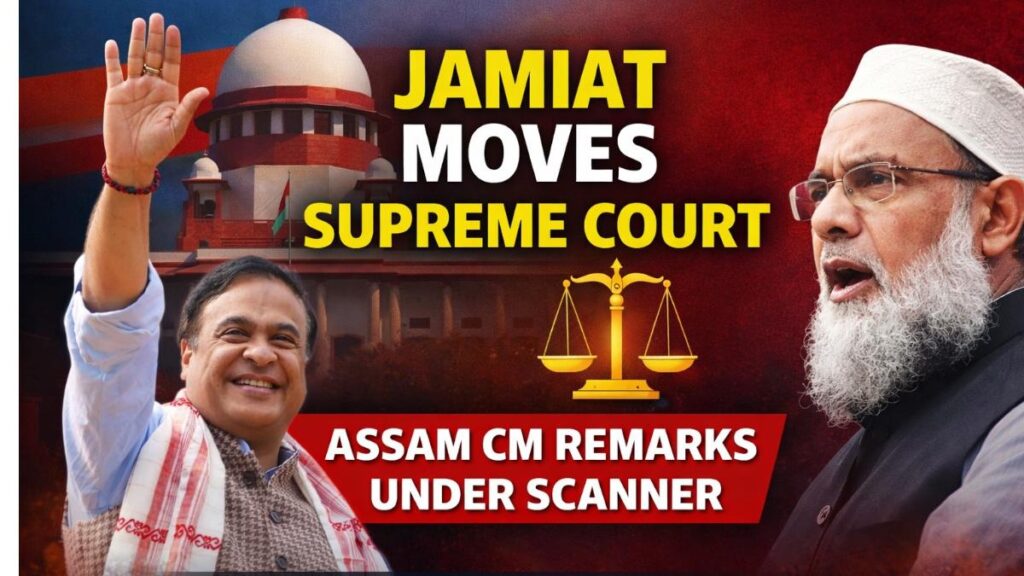
Jamiat Ulama-i-Hind Moves Supreme Court Over Assam CM Remarks
At a time when political speech is shaping public mood more sharply than ever, the Jamiat Ulama-i-Hind moves Supreme Court over Assam CM remarks, triggering a wider constitutional debate that goes far beyond one speech or one leader. The petition challenges comments allegedly made by Assam Chief Minister Dr. Himanta Biswa Sarma, arguing they cross constitutional limits and threaten social harmony.
The case arrives amid heightened national attention on how words spoken from positions of power can influence communities, polarise society, and test the boundaries of free speech under the Constitution.
The Jamiat Ulama-i-Hind moves Supreme Court over Assam CM remarks through an application filed by its president, Maulana Mahmood Madani. Senior advocate M.R. Shamshad represents the organisation before the apex court.
The plea has been submitted in an already pending matter where the Supreme Court had reserved its orders earlier, on January 20. The fresh application specifically refers to a speech delivered by the Assam Chief Minister on January 27, which the organisation alleges was targeted at a minority community and carried communal overtones.
According to the petition, such remarks are not isolated political comments but statements made by a constitutional authority whose words carry institutional weight.
Why Remarks by Constitutional Authorities Are Different
A central argument in the plea is that when a senior constitutional functionary speaks, the impact is fundamentally different from that of an ordinary political leader.
The Jamiat Ulama-i-Hind moves Supreme Court over Assam CM remarks by stressing that chief ministers and other high officeholders represent the State itself. Their speeches, the petition argues, can legitimise prejudice, normalise hostility, and influence administrative behaviour on the ground.This distinction, the Jamiat contends, is crucial while assessing whether such speech deserves protection under Article 19 of the Constitution.
What the Petition Alleges
In its detailed submissions, the Jamiat claims the remarks in question amount to
- Stigmatisation of an entire community
- Promotion of hostility between groups
- Erosion of fraternity and equality guaranteed by the Constitution
The organisation argues that allowing such statements to go unchecked risks weakening constitutional morality and normalising divisive narratives in public discourse.
The plea clearly states that freedom of speech cannot be used as a shield for remarks that undermine the foundational values of secularism and human dignity.
Demand for Clear and Enforceable Guidelines
One of the most significant aspects of the case is its broader scope. The Jamiat Ulama-i-Hind moves Supreme Court over Assam CM remarks not merely for individual relief, but to seek systemic change.
The petition urges the apex court to frame strict, enforceable guidelines governing speech by constitutional authorities. According to the plea, vague moral expectations are insufficient in an era where public statements can instantly reach millions through digital platforms.
The organisation argues that clear judicial standards would help prevent misuse of authority and act as a deterrent against communal rhetoric.
Why This Case Has National Significance
Legal observers note that this matter could have implications far beyond Assam. If the Supreme Court lays down enforceable norms, it may reshape how political speech by elected leaders is judged across India.
The Jamiat Ulama-i-Hind moves Supreme Court over Assam CM remarks at a moment when courts globally are examining the consequences of inflammatory speech by those in power. In India’s deeply diverse society, the stakes are particularly high.
Any judicial clarity could influence future campaigns, public addresses, and even administrative decision-making.
- The application has been formally filed before the Supreme Court
- It is linked to a pending matter where orders were reserved earlier
- The remarks challenged relate to a speech on January 27
- The plea seeks broader guidelines, not just case-specific action
The Supreme Court is yet to indicate how it will proceed on the fresh application.
Broader Social and Legal Impact
Civil society groups see the case as a test of institutional accountability. Legal experts suggest that judicially enforceable standards could strengthen trust in constitutional governance and discourage polarising rhetoric.
At the same time, critics caution that any intervention must carefully respect democratic freedoms. The court’s eventual response will therefore be closely studied for how it navigates this delicate balance.
As the Jamiat Ulama-i-Hind moves Supreme Court over Assam CM remarks, the outcome could redefine expectations from those who hold power.
FAQs
1.Who filed the petition?
The petition was filed by Jamiat Ulama-i-Hind through its president, Maulana Mahmood Madani.
2.Which remarks are under challenge?
The plea refers to remarks made by Assam Chief Minister Dr. Himanta Biswa Sarma in a speech delivered on January 27.
3.What does the petition seek?
It seeks strict and enforceable guidelines for constitutional authorities to prevent communal or divisive statements.
4.Is this about limiting free speech?
The petition argues that speech undermining constitutional values falls outside legitimate free speech protection.
5.Has the Supreme Court passed an order?
No final order has been passed yet; the application is pending consideration.
Conclusion
The Jamiat Ulama-i-Hind moves Supreme Court over Assam CM remarks at a moment when India is re-examining the power of political language and its real-world consequences. More than a legal challenge, the case is a reminder that words spoken from positions of authority can unite or divide.
As the Supreme Court weighs its response, the decision could set a lasting benchmark for how responsibility, restraint, and free expression coexist in India’s constitutional democracy.