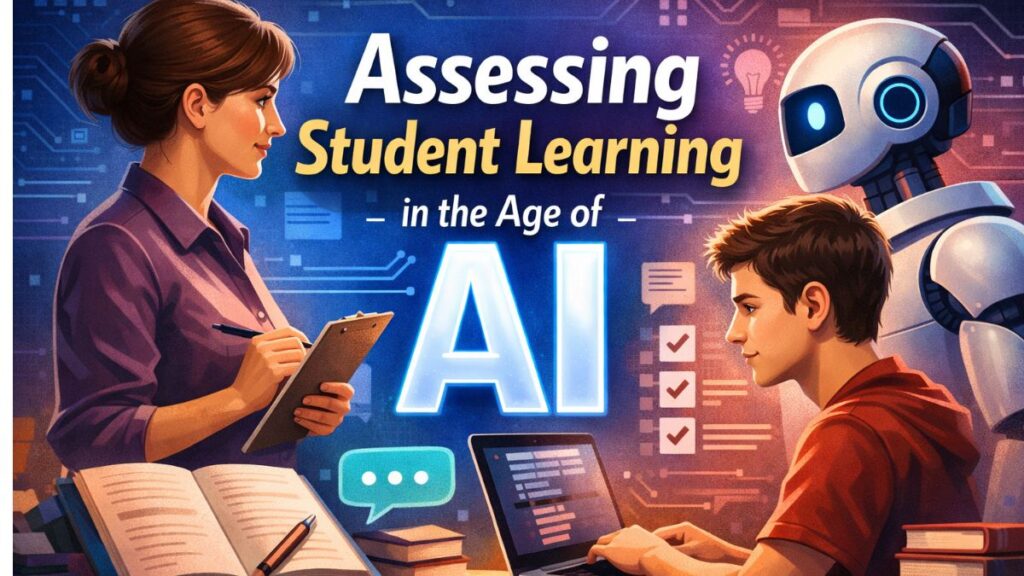
ChatGPT and AI are reshaping assessment in education, and the change is no longer theoretical. Across universities and colleges worldwide, generative AI tools have quietly become part of everyday academic life. Students use them to brainstorm ideas, clarify concepts, draft outlines, and even debug code. Educators use them to design lessons, generate examples, and save time.
What matters now is not whether AI is being used but how learning is being assessed in a world where human thinking increasingly interacts with intelligent systems.
Assessment sits at the heart of education. It determines grades, progression, and often future opportunities. When tools like ChatGPT can generate fluent essays in seconds, traditional take-home assignments and written submissions lose their ability to reliably measure what a student actually understands.
This is why ChatGPT and AI are reshaping assessment in education right now. Institutions are realising that simply banning AI or trying to detect its use is both impractical and out of step with reality. The focus is shifting from policing behaviour to redesigning assessment itself.
The Limits of Traditional Assessment Models
For decades, written assignments assumed that the text submitted reflected a student’s individual thinking. Generative AI disrupts that assumption. AI-generated content can sound confident, persuasive, and academically polished while still being inaccurate, biased, or incomplete.
Detection tools, often promoted as a solution, are unreliable and can falsely accuse students. More importantly, they do little to support learning. Educators increasingly agree that chasing AI misuse misses the bigger question: what should students actually be assessed on in an AI-rich environment?
Moving From “Did You Use AI?” to “What Did You Learn?”
Research emerging from higher education points to a clear shift in mindset. Instead of asking whether AI was used, educators are asking what cognitive skills students should demonstrate with or without AI.
This reframing is central to how ChatGPT and AI are reshaping assessment in education. Learning outcomes are being redesigned to emphasise judgment, reasoning, and reflection skills that AI cannot reliably replicate on its own.
Prompting as a New Academic Skill
One surprising outcome of this shift is the recognition that prompting itself is a skill. Writing an effective prompt for an AI system requires clarity of thought, task understanding, and logical structure.
When students are transparent about how they use AI, educators can assess the quality of prompts, the reasoning behind them, and how students refine AI outputs. In this model, AI becomes a tool that reveals thinking rather than hiding it.
Critical Thinking in the Age of AI
AI outputs often sound right even when they are wrong. This makes critical evaluation more important than ever. Assignments that ask students to verify sources, identify errors, challenge assumptions, or compare AI-generated responses with credible research actively develop analytical skills.
This approach reflects why ChatGPT and AI are reshaping assessment in education: the value of education is shifting from producing answers to judging their quality.
Protecting Authentic Writing and Original Thought
While many educators accept AI for brainstorming or language polishing, there is strong agreement that composing original arguments should remain a human process. Writing is not just a way to communicate knowledge; it is a way to build it.
Over-reliance on AI for drafting risks removing the productive struggle that helps students clarify ideas and develop independent thought. Assessment designs increasingly separate acceptable AI support from tasks that must reflect a student’s own reasoning and voice.
Five Principles Guiding AI-Ready Assessment
Based on emerging research and classroom experience, educators are aligning around several core principles
Clear expectations: Students must know when AI use is allowed, limited, or required. Unclear rules lead to confusion and mistrust.
Process over product: Drafts, reflections, and decision logs reveal learning more accurately than polished final answers.
Human judgment tasks: Assessments that require contextual understanding, ethical reasoning, or nuanced critique are harder to outsource to AI.
Evaluative literacy: Students need explicit instruction on AI’s limitations, biases, and risks.
Student voice: Assessment should foreground how students think, not just what they submit.
Together, these principles explain how ChatGPT and AI are reshaping assessment in education at a structural level
Perhaps the most controversial idea emerging from this debate is that the concept of plagiarism itself is evolving. In a world where AI tools are integrated into learning and work, collaboration with machines does not automatically equal dishonesty.
Educators are increasingly distinguishing between deceptive use and transparent, purposeful engagement with AI. The goal is not to eliminate AI from education, but to teach students how to work with it responsibly
Assessment redesign is still uneven, but momentum is growing. Expect more oral exams, in-class problem solving, reflective writing, and project-based evaluation. These formats make learning visible and harder to automate.Ultimately, ChatGPT and AI are reshaping assessment in education because they force a deeper question: what does it really mean to learn in the digital
FAQ
1.Is AI use now allowed in university assignments?
Policies vary, but many institutions now permit limited, transparent AI use under clear guidelines.
2.Can AI replace human assessment entirely?
No. Human judgment remains essential for evaluating reasoning, context, and originality.
3.Are AI detection tools reliable?
Most experts agree they are inconsistent and should not be the primary method of enforcement.
Conclusion
As AI becomes embedded in everyday learning, assessment can no longer remain frozen in the past. By focusing on thinking, judgment, and transparency, educators are redefining what academic integrity means and why ChatGPT and AI are reshaping assessment in education for the long te