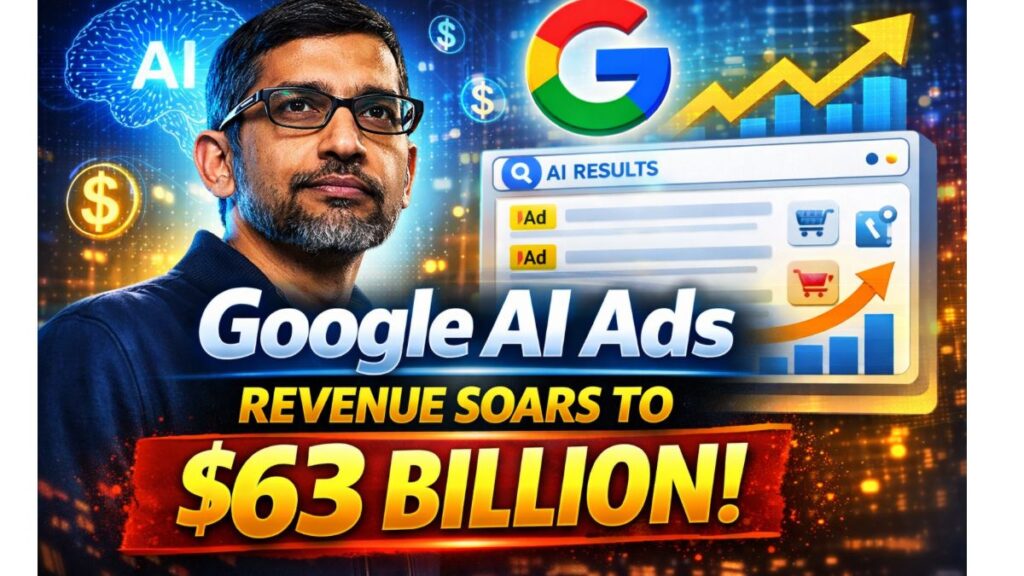
Google’s search empire is not shrinking under the weight of artificial intelligence. It is expanding and fast. Alphabet’s latest earnings confirm that Google AI Mode Ads Push Search Revenue Past $63 Billion, marking a decisive moment in how AI and advertising now coexist inside the world’s most powerful search engine.
For advertisers, publishers, and everyday users, this shift matters right now. AI is no longer an experiment sitting on the sidelines. It is actively reshaping how people search, how brands are discovered, and how money flows through the internet.
Search Revenue Crosses a Historic Milestone
In Q4 2025, Google Search and related advertising generated $63.07 billion, up 17% year-on-year. That surge helped Alphabet cross $400 billion in annual revenue for the first time in its history.
What stands out is not just the size of the number, but the timing. This growth arrived alongside the early rollout of AI-powered search features clear evidence that Google AI Mode Ads Push Search Revenue Past $63 Billion rather than dragging it down.For years, critics warned that generative AI would disrupt Google’s ad-driven model. The latest data tells a different story.
What Is Google AI Mode and Why Users Are Hooked
Google AI Mode is a new search experience designed for complex, multi-part questions. Instead of typing two or three keywords, users now ask full, conversational queries.
These AI Mode searches are three times longer than traditional ones, according to Google. They also trigger follow-up questions, creating longer and deeper search sessions.
CEO Sundar Pichai noted that once users start using AI-powered search, engagement increases across Google products. That behavioral shift is crucial, because it explains why Google AI Mode Ads Push Search Revenue Past $63 Billion without hurting traditional search usage.AI Mode doesn’t replace classic search resultsit layers intelligence on top of them.
Inside Google AI Mode Ads: Careful, Contextual, Controlled
Google is moving cautiously with monetization. Ads inside AI Mode are still in testing, and the company is clearly prioritizing user trust.
Chief Business Officer Philipp Schindler confirmed that AI Mode ads appear below AI-generated answers, and only when they are highly relevant to the query. The goal is to enhance decision-making, not interrupt it.This approach explains why Google AI Mode Ads Push Search Revenue Past $63 Billion while avoiding user backlash. The ads feel contextual, not forced.
Direct Offers and the Rise of Intent-Based Advertising
One of the most significant experiments is a new ad format called Direct Offers.These ads surface exclusive deals when Google’s AI detects strong purchase intent. Instead of broad awareness ads, brands reach users who are already close to buying.
For advertisers, this is powerful. For Google, it is highly monetizable. Longer AI Mode queries provide richer intent signals, making it easier to match ads accurately. That is another reason Google AI Mode Ads Push Search Revenue Past $63 Billion so quickly.
Google is also testing in-search checkout within AI Mode for selected merchants. This allows users to move from question to purchase without leaving the search experience.If rolled out widely, this could fundamentally change e-commerce discovery. Search becomes not just a research tool, but a transaction platform.
Again, the pattern is clear: AI is expanding what search can do. It helps explain why Google AI Mode Ads Push Search Revenue Past $63 Billion instead of cannibalizing existing revenue streams.Search remains Google’s strongest engine, but it is not alone.
- YouTube Advertising reached $11.38 billion, growing 9% year-on-year
- Google Cloud surged 48% to $17.66 billion, driven largely by AI demand
- Capital expenditure is set to increase in 2026, signaling deeper AI investment
Still, search sits at the center. The fact that Google AI Mode Ads Push Search Revenue Past $63 Billion underscores how critical AI-enhanced search is to Alphabet’s future.
What SEO, Publishers, and Creators
Google insists there is no evidence that AI Mode reduces overall traffic to websites. But behavior is changing.Longer queries, fewer clicks, and deeper sessions mean publishers must adapt. Depth, authority, and context now matter more than ever.
For the SEO world, the message is simple: surface-level content will struggle. Search is evolving toward intent satisfaction, and Google AI Mode Ads Push Search Revenue Past $63 Billion precisely because they align with that goal.
Google controls a massive share of global search activity. Even small changes ripple across the digital economy.With AI Mode ads entering live testing, advertisers, publishers, and e-commerce brands are entering a transition phase. Early understanding could mean long-term advantage.
The takeaway is clear: Google AI Mode Ads Push Search Revenue Past $63 Billion not by replacing search, but by making it smarter, longer, and more valuable.
FAQ
Q1. Is Google AI Mode replacing traditional search?
No. AI Mode complements classic search results rather than replacing them.
Q2. Where do AI Mode ads appear?
They are currently tested below AI-generated answers and only shown when relevant.
Q3. Does AI Mode hurt website traffic?
Google says it has not seen evidence of traffic decline so far.
Q4. What are Direct Offers in AI Mode?
They are exclusive deals shown when users demonstrate strong buying intent.
Q5. When will AI Mode ads roll out globally?
Google has not announced a confirmed global launch timeline.
Conclusion
Google’s latest earnings send a clear signal: AI is not a threat to search it is its next growth engine. As Google AI Mode Ads Push Search Revenue Past $63 Billion, the future of search looks longer, deeper, and more intent-driven than ever. This isn’t just an upgrade. It’s a turning point for the entire digital ecosystem.more fast and realvent news visit our site