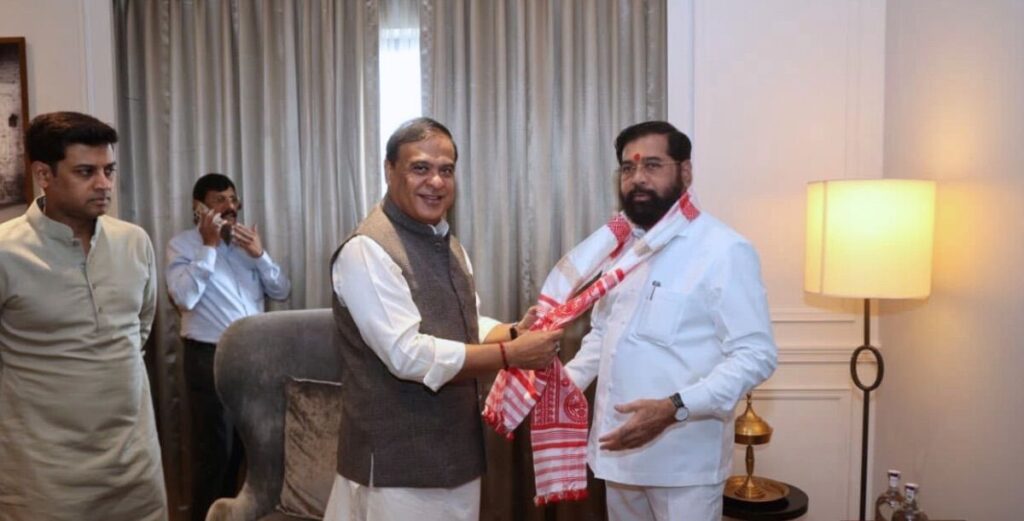
When Assam Chief Minister Dr Himanta Biswa Sarma meets Maharashtra Deputy Chief Minister Eknath Shinde in Guwahati, it is more than a routine courtesy call. At a time when Indian states are aggressively shaping their own growth stories, such interactions point to a deeper shift toward cooperative federalism and strategic state-to-state alignment.
The meeting, held on Monday at an official venue in Guwahati, comes amid heightened focus on investment, infrastructure, and cultural outreach across regions. For Assam, which is positioning itself as the gateway to the Northeast, and Maharashtra, India’s economic powerhouse, the optics and timing of the interaction carry significance.
What Happened During the Guwahati Meeting
According to official information, Himanta Biswa Sarma meets Eknath Shinde in Guwahati as part of a high-level courtesy engagement. The two leaders held detailed discussions in a cordial atmosphere, exchanging views on governance, development priorities, and inter-state collaboration.
There were no formal announcements or agreements signed during the meeting. Instead, the emphasis remained on dialogue, relationship-building, and exploring areas where both states can learn from each other’s administrative and economic experiences.
Such meetings, officials say, often serve as a foundation for future cooperation at bureaucratic and sectoral levels.
Focus on Economic Cooperation and Cultural Exchange
Both leaders reportedly discussed the scope for closer economic cooperation and cultural exchange between Assam and Maharashtra.
Maharashtra remains one of India’s largest industrial and financial hubs, while Assam has emerged as a strategic growth centre in the Northeast, benefiting from improved connectivity and policy reforms.The discussions are understood to have touched upon:
- Trade and investment opportunities between the two states
- Sharing best practices in infrastructure and urban development
- Tourism promotion and cultural linkages
- Administrative and governance innovations
As Himanta Biswa Sarma meets Eknath Shinde in Guwahati, the conversation reflects a growing recognition that state-led collaboration can complement national development goals.The timing of the meeting is crucial. Indian states are increasingly competing to attract investment while also seeking collaborative models to accelerate growth.
Under Himanta Biswa Sarma’s leadership, Assam has pushed reforms around ease of doing business, large-scale infrastructure projects, and regional connectivity. Maharashtra, with Eknath Shinde as Deputy Chief Minister, continues to focus on industrial expansion, urban development, and investment inflows.
Closer engagement between the two states could help align policies, create new economic corridors, and strengthen the Centre–State dynamic. Observers note that when Himanta Biswa Sarma meets Eknath Shinde in Guwahati, it reinforces Assam’s intent to engage with economically strong states beyond its immediate region.
Political Administration
Beyond development issues, the meeting also holds political weight. Both Himanta Biswa Sarma and Eknath Shinde are influential leaders within the broader National Democratic Alliance (NDA) framework.
Regular interactions among senior leaders help strengthen internal coordination and present a united front on governance and policy narratives. Political analysts see such engagements as part of sustained relationship-building rather than isolated events.
When Himanta Biswa Sarma meets Eknath Shinde in Guwahati, it sends a message of alignment and mutual respect within the ruling political ecosystem.
A Personal Touch: Birthday Greetings to Eknath Shinde
Adding warmth to the formal meeting, Chief Minister Himanta Biswa Sarma also extended birthday greetings to Eknath Shinde during the interaction.
The gesture highlighted the personal rapport between the two leaders and underscored the human side of political engagement. Such moments, while symbolic, often reflect strong interpersonal ties that can ease future collaboration.Political watchers often note that personal goodwill plays a quiet but important role in effective inter-state cooperation
- The meeting was a courtesy call, not a formal policy negotiation
- No memorandums of understanding were announced
- Discussions focused on long-term cooperation and shared learning
- The interaction strengthens Assam–Maharashtra relations
Officials indicate that follow-up discussions may take place at the administrative level to explore specific areas of collaboration.
Across India, chief ministers and deputy chief ministers are increasingly engaging directly with their counterparts from other states. This trend supports the idea of cooperative federalism, where states learn from each other’s successes and challenges.
As Himanta Biswa Sarma meets Eknath Shinde in Guwahati, the meeting fits into a broader pattern of Assam expanding its national outreach. Engagements with economically advanced states like Maharashtra reflect Assam’s ambition to play a larger role in India’s development narrative.Such interactions may not always produce immediate headlines, but they often shape long-term policy alignment and economic outcomes.
FAQs
1.Who met Eknath Shinde in Guwahati?
Assam Chief Minister Dr Himanta Biswa Sarma met Maharashtra Deputy Chief Minister Eknath Shinde.
2.What was discussed during the meeting?
The leaders discussed economic cooperation, cultural exchange, governance experiences, and inter-state coordination.
3.Were any agreements signed?
No formal agreements or MoUs were announced during the meeting.
4.Why is this meeting important?
It highlights growing cooperation between Assam and Maharashtra and reinforces the idea of cooperative federalism.
5.Did Himanta Biswa Sarma greet Eknath Shinde on his birthday?
Yes, the Assam Chief Minister extended birthday greetings during the meeting.
Conclusion
The meeting where Himanta Biswa Sarma meets Eknath Shinde in Guwahati may have been labelled a courtesy call, but its implications run deeper. In an era where states are key drivers of India’s growth, such interactions help build trust, align priorities, and open doors for future collaboration.