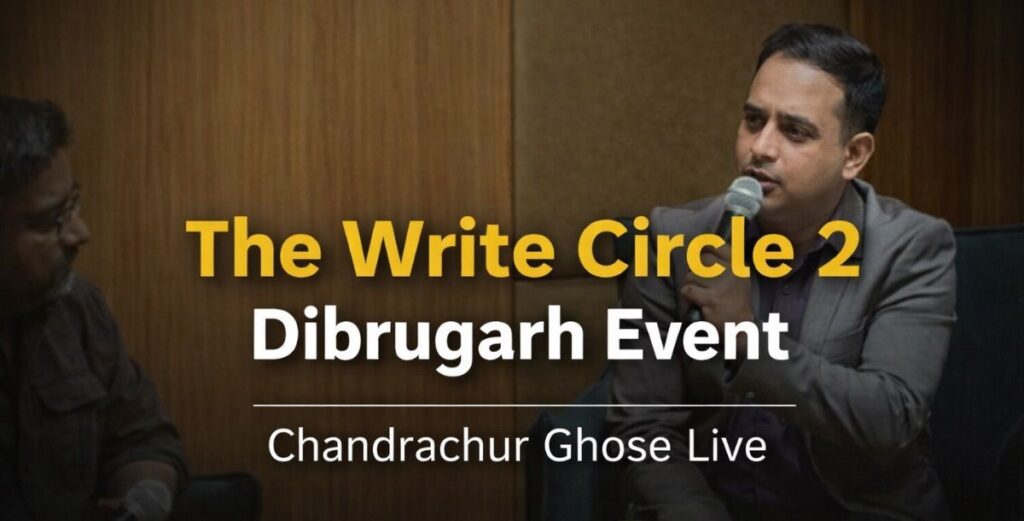
At a time when public discourse often feels rushed and fragmented, The Write Circle 2 in Dibrugarh offered something rare unhurried, thoughtful conversation.
The second edition of The Write Circle 2 brought noted author Chandrachur Ghose to Assam’s tea city, drawing students, academics and avid readers into a shared space of ideas. In an era dominated by headlines and social media snippets, the evening stood out for its depth and dialogue.For Dibrugarh, this was more than a literary event. It was a signal that serious intellectual engagement is no longer confined to India’s metros.
A Literary Evening That Felt Personal and Immediate
Hosted under the aegis of the Prabha Khaitan Foundation, The Write Circle 2 was designed as an interactive forum rather than a formal lecture.
Ghose was in conversation with Dr Kaustubh Deka, a faculty member at Dibrugarh University. The exchange moved fluidly across politics, economic policy, history and environmental challenges themes that resonate strongly in Assam today.Instead of prepared speeches, the format encouraged real-time questions. Audience members asked about governance, regional development and the long shadow of historical decisions on present realities. The result was a discussion that felt immediate and grounded.
Across India, there is growing public interest in policy debates and environmental accountability. Yet many discussions remain confined to urban centres like Delhi, Mumbai or Kolkata.
By hosting The Write Circle 2 in Dibrugarh, organisers underscored a smaller cities are emerging as hubs of intellectual exchange.
Participants described the session as refreshing. Complex topics were unpacked in accessible language, bridging the gap between scholarship and everyday understanding. That accessibility is central to the mission of The Write Circle 2.In a time of polarised debates, the event demonstrated that disagreement can coexist with civility.
Chandrachur Ghose’s Perspective: Connecting Past and Present
Ghose is widely known for examining how historical economic and political decisions continue to shape India’s present. During The Write Circle 2, he emphasised the importance of context arguing that without understanding history, contemporary policy discussions remain incomplete.
Drawing from years of research and writing, he explored how environmental concerns intersect with governance and economic planning. For a state like Assam, frequently impacted by floods and ecological pressures, these themes carried particular weight.
Attendees noted that Ghose’s approach avoided sensationalism. Instead, he relied on data, historical references and reasoned argument a style that strengthened the credibility of The Write Circle 2.
The Role of Dialogue in Regional India
Dr Kaustubh Deka’s moderation ensured that the conversation reflected local realities. By weaving regional examples into national themes, he made The Write Circle 2 especially relevant to the Dibrugarh audience.
This blend of national insight and local context gave the event depth. It also reinforced the idea that meaningful discourse does not need to originate in metro cities to be impactful.
The interactive Q&A segment was among the most engaging parts of The Write Circle 2, with students posing candid questions about policy, academic research and the responsibilities of public intellectuals.
Institutional Support and Cultural Momentum
The programme was supported by Oil India Ltd, reflecting corporate interest in cultural initiatives. Hospitality support came from Cygnett Inn.
Founded in the 1980s by noted litterateur Prabha Khaitan, the Prabha Khaitan Foundation has built a reputation for promoting literature, arts and education across India and abroad.The Write Circle 2 is part of its broader effort to foster open dialogue between authors and readers a format increasingly valued in today’s information-saturated landscape.
Dibrugarh has long been recognised for its academic vibrancy, largely anchored by Dibrugarh University. Yet events like The Write Circle 2 suggest that the city’s cultural footprint is expanding.There is a noticeable appetite for nuanced discussion among younger audiences. Many attendees were students eager to engage directly with a national-level author. The turnout indicated that intellectual curiosity runs deep beyond metropolitan India.
As more literary platforms decentralise their programming, cities like Dibrugarh could play a larger role in shaping India’s public discourse.Organisers indicated that The Write Circle 2 is part of a continuing outreach effort. Similar editions may reach other emerging urban centres.
If the Dibrugarh session is any indication, the demand for structured yet informal dialogue is growing. In an age of algorithm-driven content, platforms that prioritise substance over speed may gain renewed importance.For Assam, the event marks a cultural milestone proof that meaningful conversations are thriving far from the capital corridors.
FAQ
1.What is The Write Circle 2?
It is the second edition of a literary dialogue initiative designed to encourage open conversation between authors and readers.
2.Who were the key speakers in Dibrugarh?
Author Chandrachur Ghose and academic Dr Kaustubh Deka led the discussion.
3.Who organised the event?
The programme was organised under the aegis of the Prabha Khaitan Foundation with institutional support from Oil India Ltd.
4.Why is this event significant?
It highlights the rise of smaller cities like Dibrugarh as centres for serious intellectual engagement.
Conclusion
The Write Circle 2 in Dibrugarh was not just a literary gathering. It was a reminder that informed, civil dialogue still has an audience and that audience is expanding beyond India’s metros.
As public interest in policy, environment and history deepens, platforms like this could quietly shape the future of regional discourse. In a fast-moving digital age, Dibrugarh chose reflection over noise and the response suggests that choice resonated.