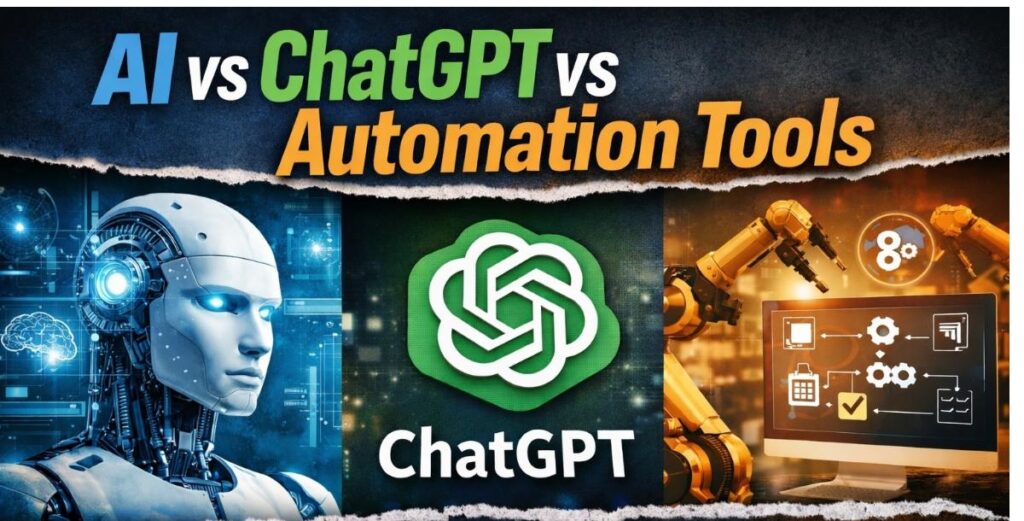
Artificial intelligence is no longer a buzzword it’s shaping hiring decisions, marketing strategies, customer service, and even how small businesses survive. But confusion is growing. Is AI the same as ChatGPT? Are automation tools replacing both? The AI vs ChatGPT vs automation tools debate is now central to how companies invest in technology in 2026.
For founders, creators, and professionals trying to make smart decisions, understanding the real difference is no longer optional it’s essential.
Why the AI vs ChatGPT vs Automation Tools Debate Matters Now
In the past year, businesses across India and globally have accelerated digital adoption. From startups to government departments, technology budgets are shifting toward artificial intelligence systems.But many decision-makers are still asking the same question:
Are we investing in AI broadly, or just using ChatGPT? And where do automation tools fit in?The AI vs ChatGPT vs automation tools discussion matters because each serves a different purpose. Confusing them can lead to wasted budgets, poor implementation, and unrealistic expectations.
What “AI” Really Means in 2026
Artificial Intelligence (AI) is the broader technology umbrella. It includes machine learning, computer vision, natural language processing, robotics, predictive analytics, and more.
AI powers systems like recommendation engines, fraud detection software, and voice assistants. When companies talk about “implementing AI,” they usually mean integrating intelligent decision-making into their systems.In the AI vs ChatGPT vs automation tools comparison, AI is the foundation layer. It’s the engine behind many advanced technologies, not a single product.
For example
- Banks use AI to detect fraud patterns.
- E-commerce platforms use AI for personalized product recommendations.
- Healthcare providers use AI for diagnostic support.
AI is infrastructure-level intelligence.
Where ChatGPT Fits in the AI Ecosation
ChatGPT is a specific application built on generative AI technology. It focuses on understanding and generating human-like text.broader AI systems, ChatGPT is conversational. It writes, explains, summarizes, brainstorms, and answers questions.
In the AI vs ChatGPT vs automation tools discussion, ChatGPT represents a user-facing AI tool. It doesn’t replace entire AI systemsit uses AI to deliver language-based solutions.Businesses today use ChatGPT for
- Drafting emails and reports
- Customer support chat responses
- Content ideation
- Coding assistance
- Internal knowledge queries
However, ChatGPT does not automatically run workflows or trigger business processes. It generates responses but it doesn’t execute operational chains unless connected to other systems.That distinction is critical.
What Are Automation Tools And How Are They Different?
Automation tools focus on task execution without manual intervention. They follow pre-defined rules or triggers.Examples include
- Email marketing automation
- CRM workflow automation
- Payroll processing system
- Social media scheduling tools
Unlike AI, traditional automation does not “learn.” It follows instructions.
In the AI vs ChatGPT vs automation tools comparison:
- AI = intelligence layer
- ChatGPT = conversational AI application
- Automation tools = process execution systems
However, in 2026, automation tools are increasingly integrating AI capabilities. That’s where the lines begin to blur.The Real-World Impact: What Businesses ShouldUnderstand
The confusion around AI vs ChatGPT vs automation tools often leads to unrealistic expectations.Some companies believe ChatGPT alone will automate their operations. Others invest in automation tools expecting them to “think” like AI.Here’s the reality
- AI analyzes and predicts.
- ChatGPT communicates and generates language.
- Automation tools execute workflows.
When combined properly, they create powerful systems.For example
A business could use ChatGPT to draft personalized responses, AI to analyze customer behavior, and automation tools to send emails based on triggers.That integrated model is where the real efficiency lies.
Cost, Risk, and Strategic Implications
From a financial standpoint, AI implementation requires infrastructure and data maturity. It’s not plug-and-play.ChatGPT is easier to adopt but requires governance policies to avoid misinformation or compliance risks.
Automation tools are predictable but limited unless enhanced with AI features.In the evolving AI vs ChatGPT vs automation tools ecosystem, strategy matters more than hype.Experts suggest organizations
- Define clear use cases
- Avoid tool overlap
- Start with workflow bottlenecks
- Train teams before scaling
Technology without training often results in low ROI.
The Human Factor: Will Jobs Be Replaced?
The fear around AI remains strong. But data from multiple industries suggests augmentation is more common than replacement.ChatGPT assists writers it doesn’t replace editorial judgment.
Automation speeds up operations but humans design the systems.
AI enhances decisions but accountability remains human.
The AI vs ChatGPT vs automation tools debate should shift from “replacement” to “collaboration.”Professionals who learn to use these systems effectively are seeing productivity gains rather than displacement.As AI regulations tighten and businesses mature digitally, the integration trend will continue.Expect
- More AI-powered automation platforms
- Smarter conversational AI beyond ChatGPT
- Industry-specific AI applications
- Stronger compliance frameworks
The AI vs ChatGPT vs automation tools discussion will increasingly focus on integration rather than comparison.The future isn’t about choosing one over the other. It’s about building ecosystems where they work together.
FAQ
1.Is ChatGPT the same as AI?
No. ChatGPT is a product built using AI technology. AI is the broader field.
2.Can automation tools work without AI?
Yes. Traditional automation follows rules without learning or adapting.
3.Which is better for small businesses?
It depends on the use case. Automation tools help with repetitive tasks, ChatGPT helps with communication, and AI supports data-driven decisions.
4.Will AI replace automation tools?
More likely, AI will enhance automation tools rather than replace them.
Conclusion
The conversation around AI vs ChatGPT vs automation tools is not about competition it’s about clarity.In 2026, businesses that understand the differences and more importantly, the synergies will move faster, operate smarter, and reduce costly experimentation.
Technology is evolving rapidly. But strategy, training, and human oversight remain the real competitive advantage.Understanding the distinction today could define business success tomorrow.