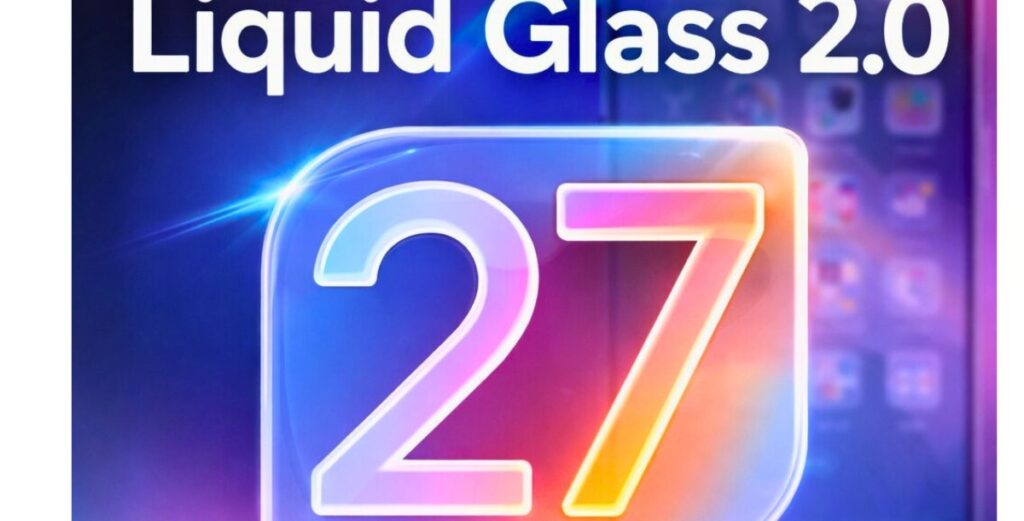
In a year dominated by AI headlines and hardware rumors, the most meaningful iPhone upgrade may come from something far less flashy: design precision.
Early leaks surrounding iOS 27 suggest Apple is preparing a significant refinement of its “Liquid Glass” interface a layered, translucent aesthetic that blends light, motion, and depth. At first glance, it looks subtle. But if history is any guide, subtle is often where Apple makes its biggest moves.
Smartphones are no longer revolutionary devices. They’re daily tools extensions of work, communication, and creativity. When a billion people interact with the same interface for hours each day, even the smallest design change can have enormous impact.
A Design Evolution, Not a Disruption
From what early visuals indicate, iOS 27 is unlikely to introduce a dramatic overhaul. Instead, it appears to focus on refinement
- Smoother animation curves
- Softer, more responsive transparency layers
- Enhanced light diffusion across menus
- More dimensional widgets
- Rounded toggles with subtle depth shadows
These changes may not dominate keynote slides, but they affect every swipe, every tap, every notification.As someone who has covered Apple’s software evolution for years, I’ve learned this: Apple rarely redesigns for attention. It redesigns for feel.And feel is what keeps users loyal.
The Liquid Glass concept isn’t new. Apple has experimented with translucency and depth for over a decade. But in iOS 27, the approach appears more mature less decorative, more intentional.
When transparency is carefully balanced, it improves visual hierarchy. When motion is calibrated correctly, it reduces cognitive strain. When UI layers respond like physical material, the experience becomes intuitive.
In a saturated smartphone market, that intuitive comfort is powerful.Users don’t necessarily want more features. They want clarity, fluidity, and stability.That’s where iOS 27 could deliver.
The Psychology Behind Smooth Interfaces
There’s science behind this.
Human brains are wired to respond to motion consistency. Predictable easing animations feel natural because they mimic real-world physics. Abrupt transitions feel jarring.If iOS 27 enhances micro-interactions the tiny transitions between actions it could
- Make devices feel faster without changing processor speed
- Improve perceived performance
- Reduce visual fatigue during long usage sessions
- Increase overall user satisfaction
These gains don’t show up in marketing bullet points. But they shape how premium a device feels.And Apple understands premium better than most.
Performance: The Make-or-Break Factor
Design enhancements can backfire if they impact battery life or speed. That’s where Apple’s vertical integration becomes critical.
Because Apple controls both hardware and software, iOS 27 can be optimized directly for its silicon architecture. If advanced animation layers are introduced, they will likely be GPU-accelerated and carefully tuned for energy efficiency.
In previous updates, Apple has shown it can refine visuals without sacrificing performance. Users will be watching closely to see if this balance continues.If the Liquid Glass refinements in iOS 27 are accurate, developers will need to adapt quickly.
Apple may introduce updated UI frameworks, deeper translucency APIs, and enhanced motion design tools. That means third-party apps from banking platforms to productivity tools could soon adopt richer visual depth.
When system design improves, app standards rise with it.That ripple effect strengthens the entire ecosystem.
Accessibility and Long-Term Usability
One overlooked advantage of refined UI layering is accessibility.If iOS 27 improves contrast control, adaptive transparency, and motion pacing, it could make devices more comfortable for
- Older users
- People sensitive to motion effects
- Professionals working extended screen hours
A well-calibrated interface reduces strain visually and mentally.In an era where screen time is unavoidable, comfort becomes a feature.
Will Some Users Be Disappointed?
Possibly.Those expecting a radical redesign may view iOS 27 as incremental. But incremental does not mean insignificant.
Apple’s most successful software shifts from early flat design transitions to dynamic island-style UI changes were evolutionary steps that compounded over time.iOS 27 appears to follow that pattern.Quiet refinement often ages better than dramatic reinvention.
What to Watch in the Coming Months
As beta cycles begin, users should pay attention to
- Animation fluidity comparisons
- Battery benchmarks
- Compatibility with older devices
- Developer feedback on UI toolkits
- Public beta impressions
The true test of iOS 27 will be how it feels in daily use.
FAQ
1.Is iOS 27 officially announced?
Not yet. Current information is based on early design leaks and industry sources.
2.Will it change the iPhone’s overall look?
It appears to refine and polish the existing design rather than overhaul it.
3.Could it improve performance?
If optimizations match the visual enhancements, users may experience smoother interaction and improved perceived speed.
Conclusion
If the leaks are accurate, iOS 27 won’t try to shock users. It will aim to impress them quietly.In a technology landscape obsessed with spectacle, Apple may once again prove that polish beats noise.
And if Liquid Glass truly evolves the way reports suggest, iOS 27 could become one of those updates people appreciate more over time not because it changed everything, but because it made everything better.