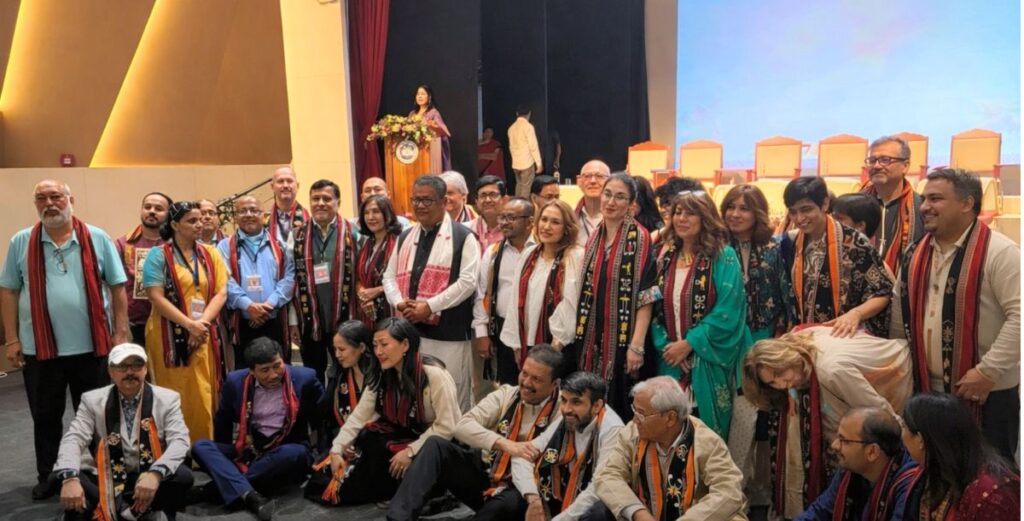
There are literary events that fill calendars and then there are those that quietly shift cultural geography.
The Dibrugarh University International Literature Festival 2026 concluded this week after four days of dialogue, debate, and deep intellectual exchange. But what unfolded on campus was more than a series of panel discussions. It was a confident assertion that Northeast India is no longer observing global literary conversations from the sidelines it is actively shaping them.
At a time when universities across India are redefining their global engagement, the scale and seriousness of the Dibrugarh University International Literature Festival 2026 signal something important: regional academic spaces are becoming international cultural hubs.
A Closing Ceremony Anchored in Vision and Cultural Diplomacy
The final session carried both gravitas and warmth.
Assam Education Minister Ranoj Pegu, attending as Chief Guest, spoke about the transformative power of reading not merely as an academic pursuit but as a social force capable of building empathy across borders. Referencing the philosophy of “Vasudhaiva Kutumbakam” The World Is One he framed the Dibrugarh University International Literature Festival 2026 as a platform rooted in Indian civilizational values yet globally outward-looking.
Vice-Chancellor Prof. Jiten Hazarika acknowledged the collective effort behind the festival, describing students and organizers as “the engine of this event.” His announcement that the fourth edition will take place from February 16–19, 2027 drew enthusiastic applause a sign that continuity now feels assured.
International literary voices including Ann Morgan, Egyptian writer Sherif Bakr, and author Murzban Fali Shroff added global resonance to the ceremony. Their presence reinforced the festival’s expanding credibility beyond national boundaries.
Numbers That Reflect Growth Not Just Scale
The Dibrugarh University International Literature Festival 2026 hosted
- 150+ authors and scholars
- Delegates from more than 25 countries
- Over 60 curated sessions
- More than 12,000 participants
These figures matter, but what matters more is consistency. In just its third edition, the festival has demonstrated structural maturity smoother coordination, thematic clarity, and deeper international participation.
Growth here appears intentional, not accidental.
Theme 2026: Conversations with the Middle East andNorth Africa
In a global climate shaped by conflict, migration, identity politics, and cultural negotiation, the Dibrugarh University International Literature Festival 2026 created space for nuanced dialogue. Sessions examined translation as political practice, the ethics of representation, publishing in conflict zones, and the evolving idea of nationhood in literature.
Rather than superficial cultural exchange, discussions engaged deeply with historical context and contemporary realities. For many students in attendance, it was their first exposure to firsthand narratives from writers working within complex geopolitical landscapes.That exposure cannot be quantified but its academic value is immense.
India’s major literary festivals often cluster around metropolitan centers. The Dibrugarh University International Literature Festival 2026 challenges that concentration of cultural capital.
By bringing global voices to Assam, the festival decentralizes literary power. It affirms that intellectual exchange does not require a metropolitan postcode.
More importantly, it expands opportunity. Students in Northeast India gain direct access to international scholars, translators, editors, and publishers. That access can shape research trajectories, writing careers, and global collaborations for years to come.
In policy terms, this is soft power. In human terms, it is confidence-building.
The Student Energy That Defined the Festival
What distinguished the Dibrugarh University International Literature Festival 2026 was not only its international lineup but its visible student ownership.
Students moderated panels, coordinated sessions, managed visiting delegations, and asked questions that were informed, probing, and often bold.Literary spaces can sometimes feel hierarchical. Here, participation felt genuinely inclusive.
Workshops on creative writing, translation studies, and publishing mechanics gave emerging writers practical insights not just inspiration. Several attendees described the experience as “career-shaping.”
That is not a small claim.
A Cultural Narrative Beyond Headlines
For a region frequently represented through political or security narratives, the Dibrugarh University International Literature Festival 2026 projected a different image of Assam: scholarly, globally engaged, culturally confident.
Delegates experienced Assamese hospitality alongside rigorous academic debate. Informal conversations between sessions often carried as much weight as the formal panels collaborations are often born in those unstructured moments.In many ways, the festival functioned as cultural diplomacy grounded in academia.
Looking Ahead to 2027
With dates for the next edition already announced, expectations are rising.Observers anticipate broader linguistic inclusion, stronger partnerships with international publishers, and expanded translation initiatives. If institutional support remains steady, the Dibrugarh University International Literature Festival 2026 may be remembered as the edition that firmly positioned Dibrugarh on the global literary map.
Sustained vision will now determine whether momentum becomes legacy.
FAQ
1.What was the central theme of the Dibrugarh University International Literature Festival 2026?
The 2026 edition focused on “Writings from the Middle East and North Africa,” encouraging cross-cultural literary dialogue.
2.How many countries participated?
More than 25 countries were represented through authors and scholars.
3.How large was the audience?
Over 12,000 participants attended sessions across four days.
4.When is the next edition scheduled?
The fourth edition is set for February 16–19, 2027.
Conclusion
The Dibrugarh University International Literature Festival 2026 did more than conclude successfully it marked..
A shift toward decentralizing literary discourse.
A shift toward global engagement from regional campuses.
A shift toward student-centered intellectual spaces.
If this trajectory continues, Dibrugarh will not merely host a festival it will anchor a movement in India’s evolving literary landscape.