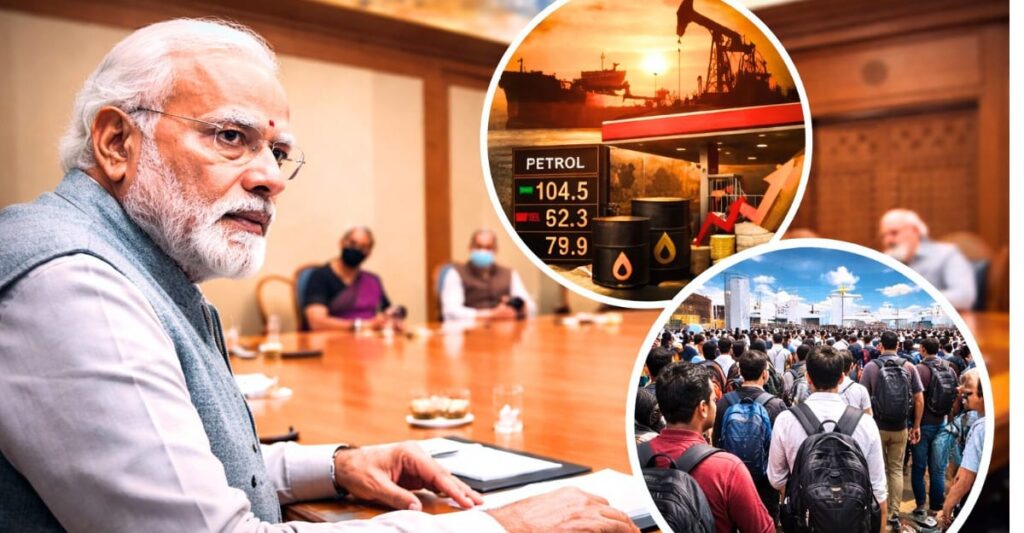
The escalating conflict in West Asia is no longer a distant geopolitical flashpoint it is a developing situation with real consequences for India’s economy, energy security, and millions of families with loved ones in the Gulf.
Recognising the urgency, Prime Minister Narendra Modi chaired a late-night meeting of the Cabinet Committee on Security (CCS) in New Delhi to assess the fast-moving developments and prepare India’s response. The message from the top was clear: India is watching closely, acting cautiously, and prioritising both people and stability.This is not routine diplomacy. It is strategic risk management at a volatile moment.
The CCS India’s highest decision-making body on national security is convened only in situations of significant strategic importance. That Prime Minister Narendra Modi called this meeting underscores the seriousness of the West Asia crisis.
According to senior government sources, the CCS reviewed three core areas
- Safety of Indian nationals in conflict-affected regions
- Stability of energy supply routes, especially the Strait of Hormuz
- Economic ripple effects, including oil prices and trade flows
Present at the meeting were Defence Minister Rajnath Singh, Home Minister Amit Shah, External Affairs Minister S. Jaishankar, Finance Minister Nirmala Sitharaman, National Security Advisor Ajit Doval, and Chief of Defence Staff General Anil Chauhan.
Officials were briefed on military developments, diplomatic backchannels, and potential escalation scenarios.
Indian Nationals in the Region: Ground Reality
India has one of the largest expatriate communities in West Asia. Around 10,000 Indians live in Iran, over 40,000 in Israel, and nearly nine million across the Gulf region.For many families in Kerala, Tamil Nadu, Telangana, Uttar Pradesh, and other states, this is deeply personal. Remittances from the Gulf form a crucial part of household incomes and state economies.
With sections of regional airspace affected and tensions rising, Indian missions have activated 24/7 helplines. Embassy teams are reportedly in direct contact with community leaders, students, and workers.
Evacuation plans, if required, are understood to be under assessment though officials emphasise there is no immediate large-scale evacuation underway.
What citizens should do
- Register with the nearest Indian embassy if in affected areas
- Follow only official advisories from the Ministry of External Affairs
- Avoid non-essential travel in sensitive zones
One of the most critical discussions during the CCS meeting reportedly centred on the Strait of Hormuz.This narrow maritime passage carries roughly one-fifth of the world’s traded oil. For India which imports more than 80% of its crude oil any disruption here can have swift economic consequences.
Even without a full blockade, heightened risk perception can push global crude prices upward.For Indian consumers, that could mean
- Rising petrol and diesel prices
- Increased transport costs
- Inflationary pressure on essentials
- Strain on government fiscal planning
Energy market experts note that India has diversified crude sourcing in recent years, including supplies from Russia and the United States. Strategic petroleum reserves also offer some buffer.However, prolonged instability would test global supply chains.
Economic Implications: Beyond Fuel Prices
The West Asia crisis affects more than oil.India’s trade links with Gulf countries are extensive. The region is a key destination for Indian exports, construction firms, healthcare professionals, and aviation networks. tensions escalate further, potential impacts include
- Air travel disruptions
- Shipping insurance cost spikes
- Currency volatility
- Pressure on stock markets
Financial policymakers are expected to closely monitor crude benchmarks, exchange rates, and capital flows in the coming days.The CCS meeting reportedly included discussions on economic contingency planning.
India maintains strategic partnerships with Israel, strong civilisational ties with Iran, and deep economic integration with Gulf nations.That makes New Delhi’s diplomatic posture delicate but also influential.India’s approach historically has emphasised dialogue, de-escalation, and non-alignment in regional conflicts.
Foreign policy experts believe India will likely
- Call for restraint and diplomatic resolution
- Protect bilateral relationships across the region
- Coordinate with global powers where necessary
The coming days may see increased diplomatic outreach behind closed doors.While the CCS meeting signals preparedness, the situation remains fluid.Three developments will determine the trajectory
- Whether tensions expand into a broader regional conflict
- Stability of maritime routes in the Strait of Hormuz
- Movements in global crude oil markets
For now, the government appears to be in monitoring-and-preparation mode rather than crisis-response mode.
FAQ
1.Why did PM Modi chair the CCS meeting?
To review security, energy, and economic risks emerging from the West Asia crisis.
2,Are Indians being evacuated?
No mass evacuation has been announced. Embassies are on alert and monitoring the situation.
3.Will petrol prices rise immediately?
Fuel prices depend on global crude trends. Short-term volatility is possible if tensions escalate.
Conclusion
The late-night CCS meeting chaired by Prime Minister Narendra Modi reflects strategic caution at a moment of global uncertainty.India’s response so far suggests preparedness without alarmism protecting citizens, securing energy interests, and maintaining diplomatic balance.
As West Asia navigates one of its most tense phases in recent years, India’s steady approach may prove crucial in shielding its economy and its people from the worst of the fallout.