
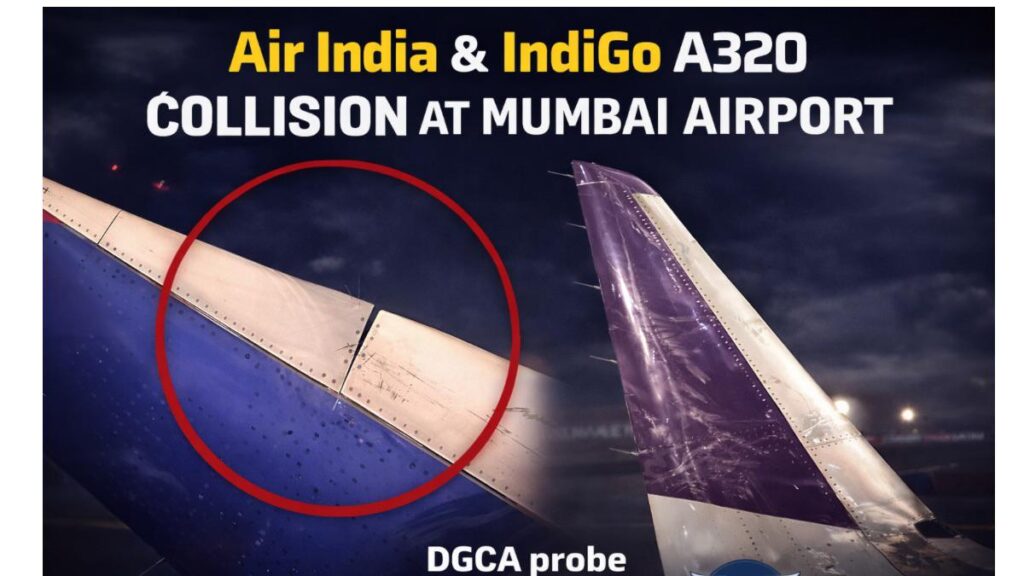
India’s aviation boom is unfolding at breakneck speed, but a late-evening ground incident at the country’s busiest airport has highlighted a growing concern beneath the surface. The Air India–IndiGo A320 wingtip collision at Mumbai Airport may not have caused injuries, but it has raised urgent questions about taxiway congestion, aircraft movement discipline, and whether airport infrastructure is keeping pace with traffic growth.
For passengers, regulators, and airlines alike, this incident is a reminder that aviation safety isn’t just about what happens in the air it’s equally about what happens on the ground.
What happened on the ground at Mumbai Airport
According to the Directorate General of Civil Aviation (DGCA), the incident occurred at around 7:30 pm on February 3, 2026, during peak evening operations at Mumbai’s Chhatrapati Shivaji Maharaj International Airport.
An Air India Airbus A320, operating flight AI2732 from Mumbai to Coimbatore, was taxiing from C1 toward M4 in preparation for departure. At the same time, an IndiGo A320 had just landed and was taxiing toward B1.Both aircraft were moving on parallel taxiways when their right wing tips came into contact, resulting in visible damage. The Air India–IndiGo A320 wingtip collision at Mumbai Airport occurred at low speed, but even minimal contact between large commercial aircraft is treated as a serious safety event.
Immediate response and operational impact
Following the incident, both aircraft were immediately withdrawn from service and returned to their respective bays for detailed inspections.
Air India confirmed that its Mumbai–Coimbatore flight was delayed, explaining that the aircraft had made contact with another airline’s plane while taxiing. IndiGo also cooperated with ground authorities as standard safety checks were initiated.Importantly, no passengers or crew members were injured, and airport operations continued after safety protocols were completed.
DGCA launches investigation
A DGCA team from the Mumbai regional office reached the site shortly after the incident and initiated a formal investigation into the Air India–IndiGo A320 wingtip collision at Mumbai Airport.The probe is expected to examine
- Taxiway separation and clearance standards
- Air traffic control instructions and sequencing
- Cockpit situational awareness
- Visibility and lighting conditions
- Human factors during peak-hour operations
Any findings could lead to revised advisories or operational changes across Indian airports.
Why wingtip collisions are taken seriously
While ground incidents rarely make headlines, aviation experts say they are critical warning signs.Wingtip collisions often indicate
- Tight taxiway geometry
- High traffic density during peak hours
- Reduced reaction time for pilots and controllers
- Infrastructure limitations at older airports
Mumbai Airport operates with two intersecting runways and limited taxiway space, handling hundreds of movements daily. As aircraft numbers rise, the margin for error shrinks making events like the Air India–IndiGo A320 wingtip collision at Mumbai Airport especially significant.
Bigger picture: India’s aviation growth vs infrastructure
India is one of the fastest-growing aviation markets in the world. Airlines like Air India and IndiGo are inducting hundreds of new aircraft, while passenger numbers continue to surge.
However, airport infrastructure particularly in metros has struggled to expand at the same pace. Industry insiders say the Air India–IndiGo A320 wingtip collision at Mumbai Airport reflects systemic pressure rather than an isolated mistake.Experts point to the need for
- Wider taxiway separation
- Advanced surface movement radar systems
- Better peak-hour slot coordination
- Faster development of secondary airports
What passengers should understand
For travelers, ground incidents can be unsettling, but safety procedures are designed to be conservative by design.Here’s what flyers should know
- Aircraft undergo mandatory inspections after even minor contact
- Delays are a safety decision, not a technical failure
- Regulators follow zero-tolerance policies on ground safety
The response to the Air India–IndiGo A320 wingtip collision at Mumbai Airport demonstrates how aviation safety systems are meant to work slow down, inspect, and clear only when s
The DGCA’s final report will determine whether procedural lapses, infrastructure constraints, or human factors contributed to the incident.Depending on the findings, authorities may
- Issue new taxiing guidelines
- Recommend infrastructure upgrades
- Mandate additional crew training
Both Air India and IndiGo are expected to fully comply with any regulatory recommendations.
FAQ
1.Was this a crash?
No. It was a low-speed ground contact during taxiing.
2.Were flights cancelled?
Flights were delayed for inspections, not cancelled.
3.Is Mumbai Airport unsafe?
No, but congestion increases operational complexity.
4.Will this affect future travel?
Not directly, but it may lead to tighter ground procedures.
Conclusion
The Air India–IndiGo A320 wingtip collision at Mumbai Airport may have ended without injuries, but it has sent a clear signal. As India’s aviation sector grows faster than ever, ground operations are emerging as the next big safety frontier.more realtibale news visit our site
For regulators and airport planners, the message is unmistakable: growth must be matched with space, systems, and safeguards because on the tarmac, even a few feet can make all the difference.




Leave a Reply