
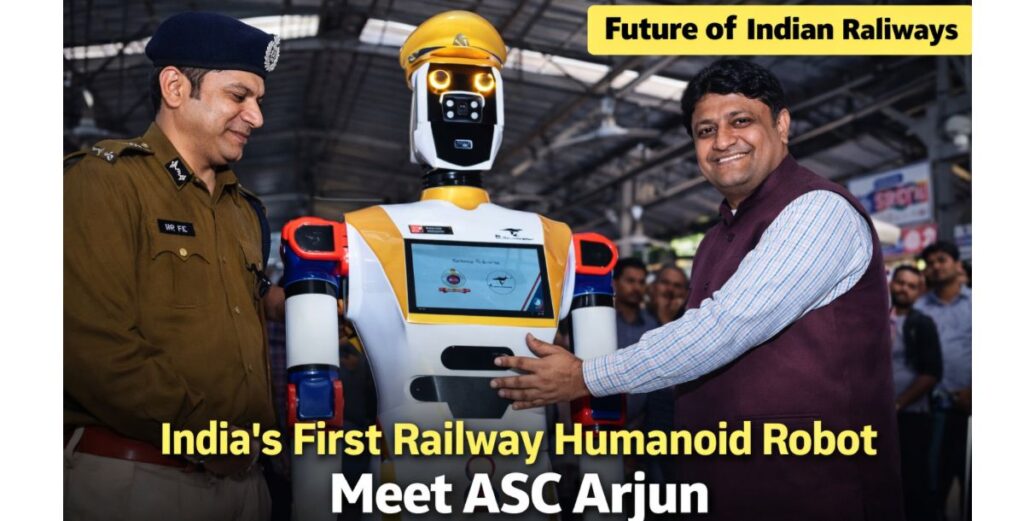
Indian Railways has crossed a quiet but historic threshold. At Visakhapatnam Railway Station, one of the busiest hubs on the east coast, a humanoid robot has officially begun active duty reshaping how passengers experience safety, assistance, and technology on the ground.
Named the ASC Arjun humanoid robot, the machine is now operational under the East Coast Railway’s Waltair Division. This is not a ceremonial showcase or a limited pilot. Railway officials confirm it is a full-fledged deployment, tasked with real-time responsibilities inside the station.
The timing matters. With passenger volumes rising sharply and safety expectations higher than ever, Indian Railways is under pressure to modernise faster and smarter.
A First-of-Its-Kind Deployment for Indian Railways
The ASC Arjun humanoid robot is the first humanoid robot ever deployed at an Indian railway station for operational use. Introduced under the supervision of the Railway Protection Force (RPF), the robot represents a shift from manual-only monitoring to AI-supported station management.
Officials say the goal is not automation for its own sake. Instead, it is about strengthening human capability cutting response time, improving situational awareness, and reducing blind spots in crowded public spaces.Globally, only a handful of rail networks have experimented with humanoid robotics at scale. India has now joined that list.
What the ASC Arjun Humanoid Robot Actually Does
Unlike static surveillance systems, the ASC Arjun humanoid robot is mobile and interactive. It patrols designated station areas while continuously feeding data to RPF control rooms.Its core functions include
- AI-powered video surveillance and anomaly detection
- Crowd density analysis during peak travel hours
- Early alerts for fire, smoke, or restricted-area intrusion
- Multilingual passenger guidance in Hindi, English, and Telugu
Facial recognition and IoT-enabled sensors allow the robot to flag unusual movement patterns, enabling staff to intervene faster than manual observation alone.
Built in Visakhapatnam, for Indian Conditions
One of the most significant aspects of the ASC Arjun humanoid robot is its origin. It has been designed and developed indigenously in Visakhapatnam by the RPF’s technical team.
According to officials familiar with the project, development took over a year and included multiple simulation and live-environment tests. The robot has been trained specifically for Indian railway conditions high footfall, varied lighting, and unpredictable movement.This local development reduces dependence on imported technology and creates a blueprint for future in-house innovation across railway zones
Why Passenger Safety Is at the Centre of This Move
Railway stations are complex environments. Thousands of people move simultaneously, often under time pressure. Even well-trained staff can miss early warning signs.
The ASC Arjun humanoid robot addresses this gap by working continuously without fatigue. It detects patterns humans may overlook and escalates alerts instantly to RPF personnel.Officials note that during festivals, holidays, and emergency situations, such assistance could be critical in preventing incidents before they escalate.
How This Fits Into Indian Railways’ Bigger Strategy
Indian Railways is in the middle of a broader digital transformation introducing smart coaches, automated signalling, and AI-based monitoring systems.The deployment of the ASC Arjun humanoid robot aligns with this strategy. It reflects a model where technology supports frontline workers rather than replaces them.
Performance data from Visakhapatnam will be closely studied. If outcomes remain positive, similar robots could be deployed at other high-traffic stations across the country.
- Deployment is currently limited to Visakhapatnam Railway Station
- Operations are supervised directly by RPF personnel
- Data from daily operations will guide future expansion
- Officials indicate scalability is already being planned
While no official timeline has been announced, senior railway sources suggest the project is being watched closely at the zonal level.Public infrastructure in India is evolving rapidly. Citizens expect safer, smarter, and more responsive services. The ASC Arjun humanoid robot arrives at a moment when technology-led governance is no longer optional it is essential.
This deployment sends a clear message: Indian Railways is willing to experiment, adapt, and lead rather than follow global trends.
FAQs
Q1. What is the ASC Arjun humanoid robot?
It is India’s first operational humanoid robot deployed at a railway station for security and passenger assistance.
Q2. Where is it currently deployed?
At Visakhapatnam Railway Station under East Coast Railway.
Q3. Was the robot developed in India?
Yes. It was designed and built in Visakhapatnam by the RPF technical team.
Q4. Will it replace railway staff?
No. It supports RPF personnel by improving monitoring and response speed.
Q5. Will more stations get similar robots?
Expansion is likely if performance metrics remain strong.
Conclusion
The arrival of the ASC Arjun humanoid robot is more than a technological milestone it is a statement of intent. Indian Railways is stepping into the future with confidence, blending human judgment with intelligent systems.and more fasting news visit our site
If Visakhapatnam is any indication, the future of railway safety in India may soon be walking the platforms quietly, efficiently, and always alert.





Leave a Reply