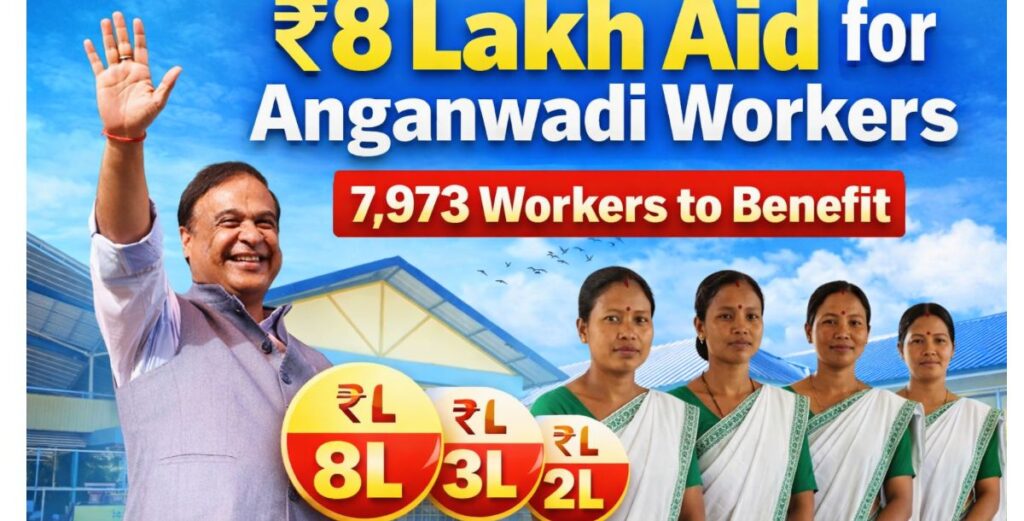
At a time when early childhood care is under national focus, Assam Announces ₹8 Lakh Aid for Anganwadi Workers, a decision that could directly impact thousands of families relying on grassroots childcare services. The announcement signals not just financial relief, but a policy shift that places frontline women workers at the centre of Assam’s development narrative.
Chief Minister Himanta Biswa Sarma confirmed that eligible Anganwadi workers, mini workers, and helpers will receive substantial lump-sum financial assistance. For many who have spent decades serving rural communities, the move is being seen as long-overdue recognition.
What Exactly Has Been Announced?
Under the decision where Assam Announces ₹8 Lakh Aid for Anganwadi Workers, the financial assistance will be structured as follows
- ₹8 lakh for full Anganwadi workers
- ₹3 lakh for mini Anganwadi workers
- ₹2 lakh for Anganwadi helpers
A total of 7,973 government Anganwadi workers and helpers are expected to benefit.
Officials describe the initiative as both a welfare measure and a recognition of long-term service. While administrative guidelines and timelines are expected soon, the announcement itself has already generated strong reactions across districts.The timing is significant.
Across India, states are revisiting how they support frontline welfare workers. Anganwadi staff operate under the Integrated Child Development Services (ICDS) framework and often work on modest honorariums despite heavy responsibilities.
When Assam Announces ₹8 Lakh Aid for Anganwadi Workers, it steps into a broader national conversation about strengthening foundational education and maternal-child health systems.For many workers, especially in remote areas, this assistance could mean:
- Financial stability after years of service
- Support for family needs such as housing or education
- A sense of dignity and institutional acknowledgement
In policy terms, this isn’t just a payout. It’s a morale decision.
The Role of Anganwadi Centres in Assam
To understand why the move carries weight, one must understand the ecosystem.Anganwadi centres provide:
- Early childhood education
- Supplementary nutrition
- Health check-up coordination
- Growth monitoring
- Community outreach for immunisation and maternal care
In large parts of rural Assam, these centres are the first structured learning environment a child experiences. Workers often double as counsellors, nutrition guides, and welfare coordinators.When Assam Announces ₹8 Lakh Aid for Anganwadi Workers, it directly touches the backbone of this system.
Infrastructure Upgrade: Not Just Financial Aid
The Chief Minister also highlighted that modern Anganwadi centres are being constructed with improved infrastructure.Officials indicate these upgraded centres may include
- Better classrooms
- Improved sanitation facilities
- Safer cooking spaces
- Enhanced child-friendly environments
This combination of infrastructure investment and worker welfare suggests a dual approach improving both physical capacity and human resources.Development experts often argue that infrastructure without motivated staff yields limited outcomes. The state’s strategy appears to acknowledge that balance.
Public policy observers note that frontline worker incentives can significantly impact service delivery quality. In rural settings, Anganwadi workers often serve as trusted figures within communities.Financial security may improve retention rates, particularly in districts where transportation and connectivity remain challenges.
Moreover, the lump-sum structure distinguishes this move from incremental honorarium revisions seen in other regions.By formally recognising service value, Assam Announces ₹8 Lakh Aid for Anganwadi Workers in a way that could set a reference point for other states evaluating similar welfare measures.
Impact on Rural Families
For families dependent on Anganwadi centres, the effects may be indirect but meaningful.Workers with improved financial stability are less likely to leave their roles. Continuity matters in early childhood care, where relationships with children and mothers build over time.
In villages, Anganwadi centres often act as
- Nutrition distribution hubs
- Preschool classrooms
- Government scheme information points
- Community gathering spaces
Stronger worker support may translate into stronger grassroots welfare systems.India’s education and child development frameworks increasingly emphasise foundational literacy and early brain development.
The first six years of a child’s life are considered critical for cognitive growth. Anganwadi workers operate at this exact stage of intervention.When Assam Announces ₹8 Lakh Aid for Anganwadi Workers, it aligns with long-term human capital investment strategies rather than short-term political messaging.
Still, experts caution that transparent eligibility criteria, timely disbursement, and administrative clarity will determine the scheme’s real-world success.As of now
- The announcement has been made publicly.
- 7,973 workers and helpers are expected to benefit.
- Detailed implementation guidelines are awaited.
Observers will closely watch how quickly funds are processed and whether similar measures expand in future budget cycles.
FAQ
1.Who will receive ₹8 lakh?
Eligible full Anganwadi workers in Assam.
2.What about mini workers?
Mini Anganwadi workers will receive ₹3 lakh.
3.How much will helpers get?
Anganwadi helpers will receive ₹2 lakh.
4.How many people benefit?
7,973 government workers and helpers.
5.When will funds be distributed?
Official timelines are expected through government notifications.
Conclusion
When Assam Announces ₹8 Lakh Aid for Anganwadi Workers, it does more than release funds it acknowledges the invisible labour shaping children’s earliest years.If implemented efficiently, this initiative could strengthen morale, improve service continuity, and reinforce Assam’s early childhood development framework.
In the long run, investing in those who teach a child’s first lesson may prove one of the state’s most impactful decisions.