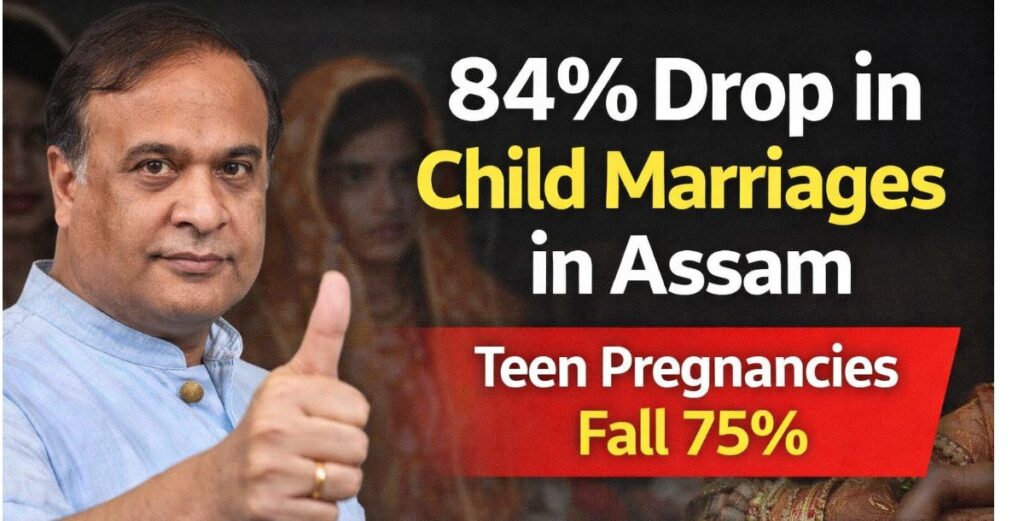
development that could reshape conversations around girls’ rights in India, Assam Reports Sharp Drop in Child Marriage Cases with an 84% decline, alongside a 75% reduction in teenage pregnancies.
At a time when early marriage continues to challenge several regions across the country, these numbers stand out not as routine administrative data, but as a potential shift in social behavior.
Officials describe it as the result of sustained legal enforcement and community-level awareness. But beyond the figures lies a deeper story about fear of law, changing attitudes, and the growing push to protect girls’ futures.According to official data shared by the state government, child marriage cases involving girls below 18 have dropped by 84% compared to previous reporting cycles.
The crackdown intensified under Chief Minister Himanta Biswa Sarma, with coordinated action across districts. Police registered cases, detained accused individuals, and intervened in ceremonies where underage marriages were allegedly being planned.
Officers familiar with the operations say enforcement was deliberately visible. The idea, one official noted privately, was to “send a strong signal that the law will not look away.”Under Indian law, 18 is the legal age of marriage for girls.
Teenage Pregnancies Fall Sharply
Equally significant is the 75% decline in teenage pregnancies reported by health authorities.Medical officers say the drop is closely linked to fewer early marriages. When girls remain in school longer and delay marriage, early pregnancies naturally decrease.
ASHA workers, school teachers, and district health teams were mobilised to conduct door-to-door awareness campaigns. Village meetings included discussions on legal age, health risks, and the long-term benefits of education.
In rural belts that historically recorded higher rates, monitoring mechanisms were tightened.The phrase Assam Reports Sharp Drop in Child Marriage Cases carries weight because child marriage is not merely a legal violation it is a social pattern tied to poverty, insecurity, and long-standing customs.
Early marriage often means
- Girls dropping out of school
- Increased maternal health risks
- Financial dependence
- Limited career prospects
In states where these cycles persist, development indicators struggle to improve.
If Assam’s reported trend continues, it could positively influence literacy levels, maternal health outcomes, and even long-term economic participation among women.Officials describe the campaign as one of the most systematic social enforcement drives in recent years.
It included
- District surveillance teams
- Coordination between police and civil administration
- Engagement with village heads
- School-level awareness drives
- Legal prosecution of offenders
In several districts, police reportedly stepped in before ceremonies took place. Families were warned of strict consequences.According to administrative sources, this combination of legal fear and social messaging appears to have shifted behavior at least for now
Teachers in government schools say attendance among adolescent girls has improved in some pockets. Health workers report that conversations about legal age and girls’ rights are becoming more common during village meetings.
For many families, delaying marriage means daughters can complete secondary education.For girls, it can mean the difference between early motherhood and the possibility of higher studies or employment.
The impact, if sustained, goes beyond compliance it touches aspiration.Social reform specialists urge careful optimism.Child marriage is deeply connected to economic insecurity. In many households, early marriage is seen as protection against financial strain or social risk.
Strict enforcement can curb cases temporarily, but durable change requires:
- Continued awareness
- Economic support schemes
- Education incentives
- Community-led engagement
Without these, gains may plateau.
What Happens Next?
While Assam Reports Sharp Drop in Child Marriage Cases has become a headline moment, the real test lies in consistency.
Will the decline hold over the next year?
Will reporting systems remain robust?
Will families continue to delay marriages voluntarily?
State authorities say monitoring remains active. Analysts suggest that if the downward trend continues, Assam could emerge as a case study for other states.
FAQ
1.How much decline has been reported?
An 84% reduction in marriages involving girls below 18.
2.What about teenage pregnancies?
Authorities report a 75% drop.
3.What drove the decline?
Strict legal enforcement combined with awareness campaigns.
4.Is the campaign ongoing?
Yes, monitoring and enforcement efforts are continuing.
Conclusion
The fact that Assam Reports Sharp Drop in Child Marriage Cases offers cautious hope in a policy area that has long resisted change.Statistics alone do not transform societies. But when enforcement, awareness, and political will converge, patterns can shift.
Whether this marks a lasting social reform or a temporary correction will depend on what happens next.For now, the numbers suggest something important: momentum is possible.