
Writer by sanjoy 10.04.2026 time 1.30 PM Published
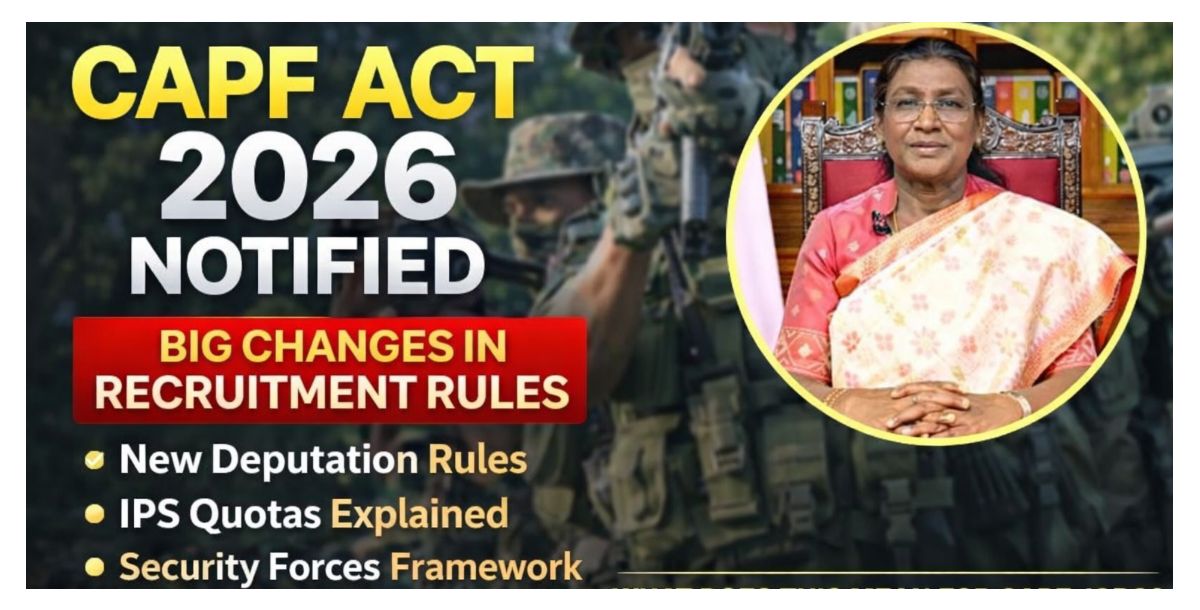
CAPF Act 2026 Notified: A New Chapter for India’s Frontline Guardians
Just yesterday, on April 9, 2026, the Centre officially notified the Central Armed Police Forces (General Administration) Act, 2026 after President Droupadi Murmu granted her assent. The law was published in the Gazette of India the same day, bringing into force a single, powerful umbrella legislation that will govern recruitment, promotions, deputation, and service conditions across India’s five major Central Armed Police Forces (CAPFs).
For years I’ve followed how these forces operate – from the icy heights of the Line of Actual Control to the dense forests of Chhattisgarh and the bustling industrial corridors they secure. What always struck me was the patchwork of rules they worked under. Different forces had slightly different service norms, leading to confusion, delays, and endless court cases. The CAPF Act 2026 finally ends that era. It’s not just another bureaucratic update it’s a structural reset designed for 21st-century threats.
Key Highlights of the CAPF Act 2026
- Officially in force from April 9, 2026
- Covers CRPF, BSF, CISF, ITBP, and SSB
- 50% Inspector General (IG) posts reserved for IPS officers on deputation
- Minimum 67% Additional Director General (ADG) posts for IPS deputation
- 100% of Special DG and Director General posts filled exclusively by IPS deputation
- Central Government empowered to frame rules “notwithstanding” any other law, court order, or previous government instruction
Until now, recruitment and service rules for Group ‘A’ General Duty officers (Assistant Commandant rank and above) came from separate Acts and executive orders for each force. Over time, Supreme Court judgments, High Court rulings, and differing interpretations created inconsistencies that affected everything from promotions to postings.
The new Act cuts through the clutter. It gives the Centre clear, overriding powers to make rules on recruitment, deputation, promotion, and conditions of service. The stated goal? Preserve the “operational distinctiveness” of CAPFs while ensuring seamless coordination between the Union and states – something IPS officers on deputation have traditionally facilitated because of their experience in both central and state police setups.
This legislation also directly addresses a May 2025 Supreme Court directive that had asked the government to progressively reduce IPS deputation in CAPFs. Instead of diluting it, the Act codifies and strengthens the existing quotas, making them statutory rather than executive orders that could be challenged again.
Deputation Rules
- The most discussed provision – and the one sparking debate is the fixed share for IPS officers:
- 50% of all IG-level posts will now be filled through IPS deputation.
- At least 67% of ADG posts are reserved for IPS officers.
- All Special DG and DG posts will be filled exclusively by deputation from the IPS.
The government’s reasoning is straightforward: CAPFs often work in close coordination with state police during elections, counter-insurgency, disaster response, and border management. IPS officers bring that crucial Centre-State bridge. For a jawan standing guard on the Pakistan border or an officer leading anti-Naxal operations, this means leadership that understands both paramilitary rigour and district-level policing realities.
The Act applies to the five big CAPFs that form the backbone of India’s internal security:
- Central Reserve Police Force (CRPF) – world’s largest paramilitary, handles internal security and elections
- Border Security Force (BSF) – guards India-Pakistan and India-Bangladesh borders
- Central Industrial Security Force (CISF) – protects airports, nuclear installations, and critical infrastructure
- Indo-Tibetan Border Police (ITBP) – high-altitude border with China
- Sashastra Seema Bal (SSB) – guards Nepal and Bhutan borders
For young officers joining as Assistant Commandants, the new uniform rules promise clearer career progression and fewer legal battles. For veterans and families, however, the high deputation quotas have raised genuine worries about promotion bottlenecks. On the very day of notification, families and veterans staged a protest at Rajghat in Delhi, highlighting fears that cadre officers may feel their growth is being capped.
Balanced View: Promise vs Concerns
On the positive side, the Act brings faster decision-making, better inter-force coordination, and legal clarity. In an era of hybrid warfare, drone threats, and multi-domain internal security challenges, a streamlined command structure is no longer a luxury it’s a necessity.
Yet the human angle cannot be ignored. Many CAPF cadre officers have spent decades in harsh field conditions. Limited promotion avenues at senior levels can affect morale. The government will now have to walk the tightrope ensuring experienced IPS leadership at the top while protecting the aspirations of officers who have risen through the ranks.
How It Affects You – The Common Citizen
When CAPFs function better, the impact is felt nationwide: smoother elections, quicker disaster response, stronger borders, and more effective anti-terror operations. Whether you live in a border village in Arunachal or travel through an airport protected by CISF, this reform indirectly strengthens the safety net around you.
FAQs
1. When did the CAPF Act 2026 come into force?
It was notified on April 9, 2026, the same day President Droupadi Murmu gave assent.
2. Does it apply only to new recruits?
No. It covers recruitment, promotions, deputation, and service conditions for existing Group ‘A’ officers as well.
3. Will IPS officers now dominate all senior posts?
Not entirely. 50% IG posts and 67%+ ADG posts are reserved for deputation; the rest remain open to CAPF cadre officers. Lower ranks (DIG and below) continue under existing rules.
4. Why the focus on IPS deputation?
The government says it ensures better coordination between central forces and state police – critical for federal policing needs.
5. What happens to previous court orders?
The Act gives the Centre overriding powers to frame rules notwithstanding any court judgment or earlier orders.
Conclusion
The notification of the CAPF Act 2026 is more than administrative housekeeping. It signals a clear policy direction: modernise, centralise, and professionalise India’s paramilitary forces for the challenges of tomorrow while retaining the federal flavour that IPS deputation brings.
As implementation begins, the real test will lie in how the government balances leadership quality with cadre morale. For the men and women in uniform who stand between us and chaos every single day, this law could either become a morale booster or a source of quiet resentment. The coming months and the first set of rules framed under the Act will tell us which way the wind blows.
One thing is certain: India’s internal security architecture just received its biggest structural upgrade in years. The jawans on the border and the officers leading them deserve nothing less.






Leave a Reply