
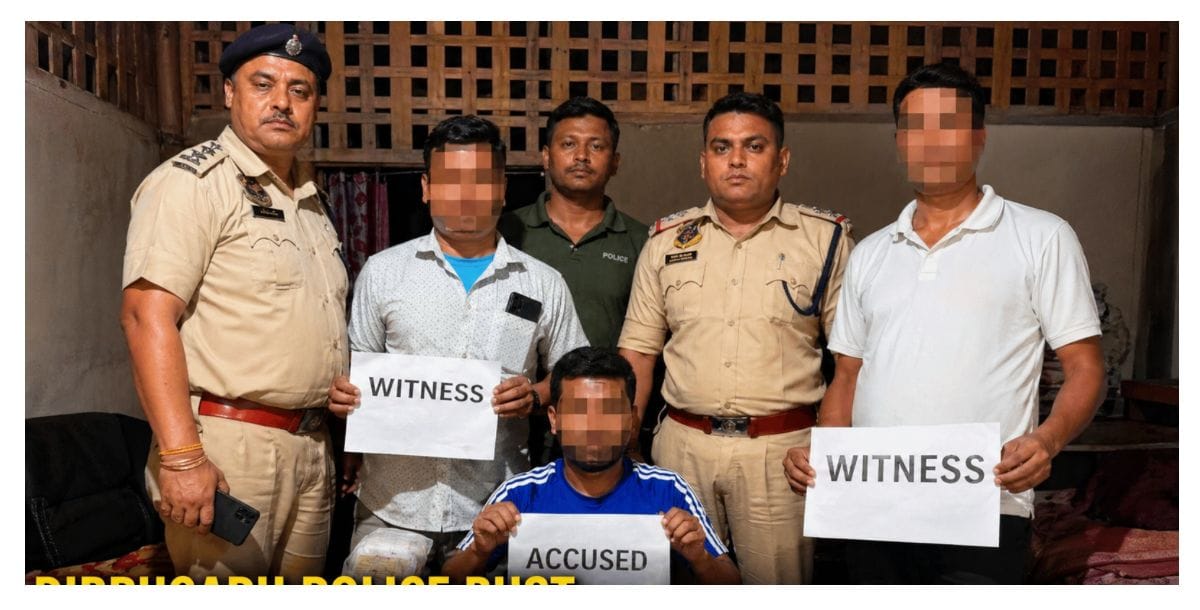
A anti-drug raid in Dibrugarh has led to the arrest of one person and the seizure of 12.31 grams of suspected heroin, underlining the region’s ongoing battle against narcotics. The operation, carried out by a team from Naharkatiya Police Station, followed a credible tip-off and was executed with precision late at night.
For residents, the news is both reassuring and concerning—reassuring because enforcement is active, and concerning because drugs continue to find their way into local communities. This case matters now as authorities step up efforts to disrupt supply chains across Upper Assam.
Key Highlights
- One accused apprehended during a targeted raid
- 12.31 grams of suspected heroin seized
- Cash recovered, probe into possible drug proceeds
- Operation based on specific intelligence
- Case registered under the NDPS Act; further investigation ongoing
What Happened During the Operation?
Police sources indicate that the team moved quickly after receiving actionable input about suspected drug activity in a residential pocket of Naharkatiya. The area was discreetly cordoned off to prevent escape routes.
During the search, officers recovered a packet believed to contain heroin, weighing 12.31 grams. The suspect was detained on the spot. As per standard procedure, two independent witnesses were present during the seizure to ensure transparency and legal compliance.
Initial field checks suggest the substance is heroin. It will be sent for forensic analysis to confirm its composition and purity.The identity of the accused has not been officially disclosed. Investigators are examining whether the individual was a courier, a local distributor, or part of a larger network.
The recovery of cash alongside the substance raises the possibility of recent transactions. Officers are tracing call records, financial links, and local contacts to map potential connections.The quantity seized is significant in legal terms. Under India’s narcotics law, penalties depend on the quantity involved—small, intermediate, or commercial. Each category carries different levels of punishment, and even intermediate quantities can attract strict jail terms.
Drug enforcement in Assam has intensified, but the demand-supply loop remains a challenge. Cases like this are important for several reasons:
- Disruption of local supply: Even small seizures can break active distribution lines.
- Intelligence-led policing: Acting on tip-offs improves success rates and prevents larger movements.
- Public safety: Reduces the risk of addiction and related crimes in neighborhoods.
Dibrugarh, a key commercial hub in Upper Assam, connects multiple districts and transit routes. This makes it vulnerable to the movement of illegal substances. Consistent crackdowns help reduce the city’s attractiveness as a distribution point.
The Legal Framework: NDPS Act Explained
The case has been registered under the Narcotic Drugs and Psychotropic Substances (NDPS) Act, India’s primary law to combat drug trafficking and abuse.
Key points under the NDPS Act:
- Strict bail conditions: Bail is not easily granted in many drug cases.
- Quantity-based punishment: Penalties vary based on the amount seized.
- Focus on networks: The law allows investigators to pursue suppliers, financiers, and handlers.
the substance is confirmed as heroin and the chain of custody is established, the accused could face serious charges, including a multi-year prison sentence.
Ground Reality: Rising Drug Concerns in Upper Assam
Over the past few years, police operations across Upper Assam have led to frequent seizures of heroin, yaba tablets, and other narcotics. Experts point to several factors:
- Transit routes: Proximity to inter-state corridors increases risk.
- Urban pockets: Growing towns create demand and distribution nodes.
- Economic factors: Drug networks often exploit vulnerable groups.
Authorities have responded with continuous drives, vehicle checks, and community outreach programs. Local participation—through tip-offs and awareness—has played a crucial role in several successful operations.The investigation will now move into deeper stages.
- Forensic testing to confirm the substance
- Interrogation of the accused to identify suppliers and buyers
- Digital and financial analysis to track transactions
- Follow-up raids if new leads emerge
Police may also collaborate with other district units if cross-border links are suspected. The aim is not just to close one case, but to weaken the wider network behind it.Law enforcement alone cannot solve the drug problem. Community vigilance is equally important. Residents are encouraged to report suspicious activity and support awareness efforts.
Schools, colleges, and local groups can help by:
- Promoting anti-drug campaigns
- Offering counseling support
- Encouraging early reporting
A combined approach—strict policing and strong community action—has shown better results in curbing drug spread.
FAQs
1. How much heroin was seized in this case?
Police recovered 12.31 grams of suspected heroin during the raid.
2. Which police unit conducted the operation?
The raid was carried out by the Naharkatiya Police Station team.
3. Has the substance been confirmed as heroin?
It is suspected heroin; final confirmation will come after forensic testing.
4. What law applies in this case?
The case is registered under the NDPS Act, which governs drug-related offenses in India.
5. What could be the punishment?
Punishment depends on the quantity category and court findings, but it can include several years of imprisonment.
Conclusion
The Dibrugarh drug bust is a clear signal that enforcement agencies are actively tracking and acting against narcotics activity. While one arrest may seem limited, each operation chips away at larger networks that threaten public safety.
For readers, the takeaway is simple: vigilance matters. When communities and police work together, even hidden networks can be exposed. As the investigation unfolds, more links may surface—strengthening the broader fight against drugs in Assam.