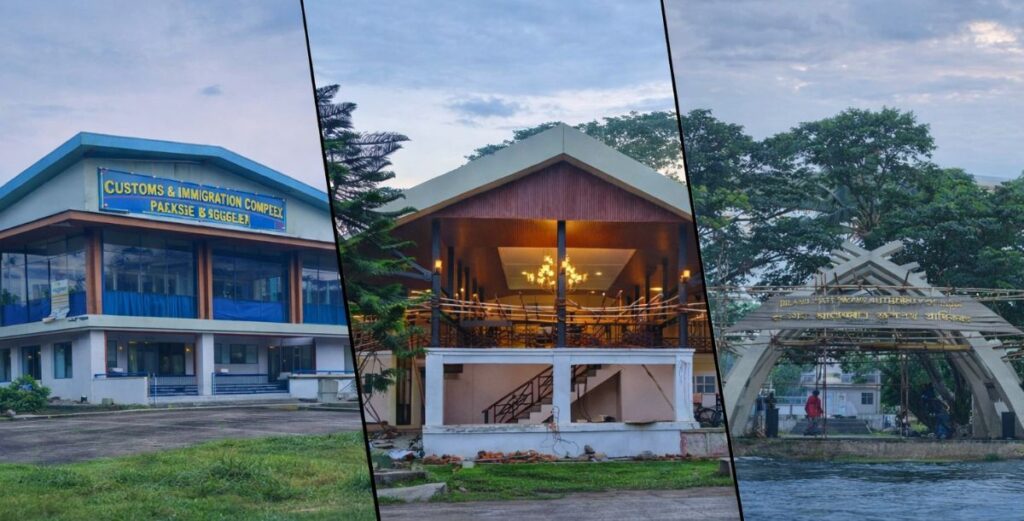
DIBRUGARH: At a time when India is racing to cut logistics costs and strengthen regional trade corridors, the launch of the Dibrugarh Inland Waterway Projects has put Assam’s river economy back in sharp focus.
Union Minister of Ports, Shipping and Waterways Sarbananda Sonowal on Friday inaugurated three key infrastructure projects aimed at modernising cargo and passenger movement along the Brahmaputra under National Waterway-2.For Upper Assam, where transport costs often determine business survival, the move is being seen as both symbolic and strategic.
Three Projects, One River Vision
The Dibrugarh Inland Waterway Projects include
- A Customs & Immigration Complex at Bogibeel (₹8.87 crore)
- A Customs & Immigration Complex at Dhubri (₹9.31 crore)
- Renovation of a heritage building in Dibrugarh (₹6 crore)
Together, the nearly ₹24-crore investment strengthens institutional and regulatory infrastructure along National Waterway-2, which runs through Assam on the Brahmaputra.Officials say the objective is clear: faster cargo clearance, smoother cross-border movement, and stronger inland water transport systems.
Bogibeel: A Gateway for Cargo and Tourism
The newly built Bogibeel facility has been developed as a modern inland water transport terminal with customs and immigration wings.
Equipped with waiting halls, security systems and administrative blocks, the complex is designed to handle both cargo and passenger operations particularly vessels operating under the India–Bangladesh Protocol Route.
For exporters in tea, coal, and agri-products, reduced transit time and simplified customs procedures could mean measurable savings.Industry observers note that the success of the Dibrugarh Inland Waterway Projects will ultimately depend on consistent cargo volumes, but the infrastructure now exists to support growth.
Dhubri: Strengthening the Western Corridor
On Assam’s western edge, the Dhubri Customs & Immigration Complex adds regulatory depth to cross-border river trade.Located strategically near the Bangladesh border, the facility enhances compliance, monitoring, and documentation processes for vessels moving along National Waterway-2.
With surveillance systems and integrated administrative infrastructure, authorities aim to formalise and expand cargo operations.
Trade analysts say improved systems at Dhubri could boost confidence among private operators hesitant about procedural delays in the past.
Restoring Heritage, Reinforcing Governance
In Dibrugarh town, a historic building has been restored at a cost of ₹6 crore and repurposed to serve administrative functions of the Inland Waterways Authority of India (IWAI).The project preserves architectural character while creating a functional operational base for waterway governance in Upper Assam.
Officials describe it as a blend of conservation and capacity-building ensuring decisions affecting National Waterway-2 are coordinated locally.
India has been aggressively promoting inland waterways as a cheaper and greener alternative to road transport.Water transport consumes less fuel, reduces carbon emissions, and lowers per-tonne freight costs. For a geographically complex region like the Northeast, these advantages are particularly significant.
The Dibrugarh Inland Waterway Projects come at a time when the Centre is positioning the Northeast as a gateway to Southeast Asia. Improved river terminals and customs systems could enhance trade flows under bilateral agreements with Bangladesh.
For Assam’s businesses, the implications are practical: faster clearance, lower logistics costs, and potentially wider market access.operational efficiency improves, the benefits could ripple outward.
Tea exporters may find more competitive freight rates.
Small industries could gain access to bulk transport.
Tourism operators may leverage improved passenger facilities.
However, experts caution that infrastructure must be matched by cargo demand and policy support.National Waterway-2 has long been recognised for its potential. The challenge now lies in sustained utilisation.
Authorities expect the newly inaugurated facilities under the Dibrugarh Inland Waterway Projects to become operational immediately.Stakeholders will be watching
- Cargo movement data in the coming months
- Uptake of India–Bangladesh river routes
- Private sector participation in inland shipping
- Integration with road and rail logistics hubs
If cargo volumes rise steadily, the Brahmaputra could reclaim its historic role as a commercial artery.
A Calculated Shift Toward River Logistics
For decades, Assam relied overwhelmingly on road transport, often at high cost.The Dibrugarh Inland Waterway Projects signal a deliberate shift toward diversified logistics combining sustainability with economic pragmatism.
The infrastructure is now in place.Whether the river becomes a transformative trade corridor once again will depend on how effectively policy, private investment, and cargo demand converge in the months ahead.
For Dibrugarh and beyond, the Brahmaputra is no longer just a river of memory it is being positioned as a river of opportunity.