
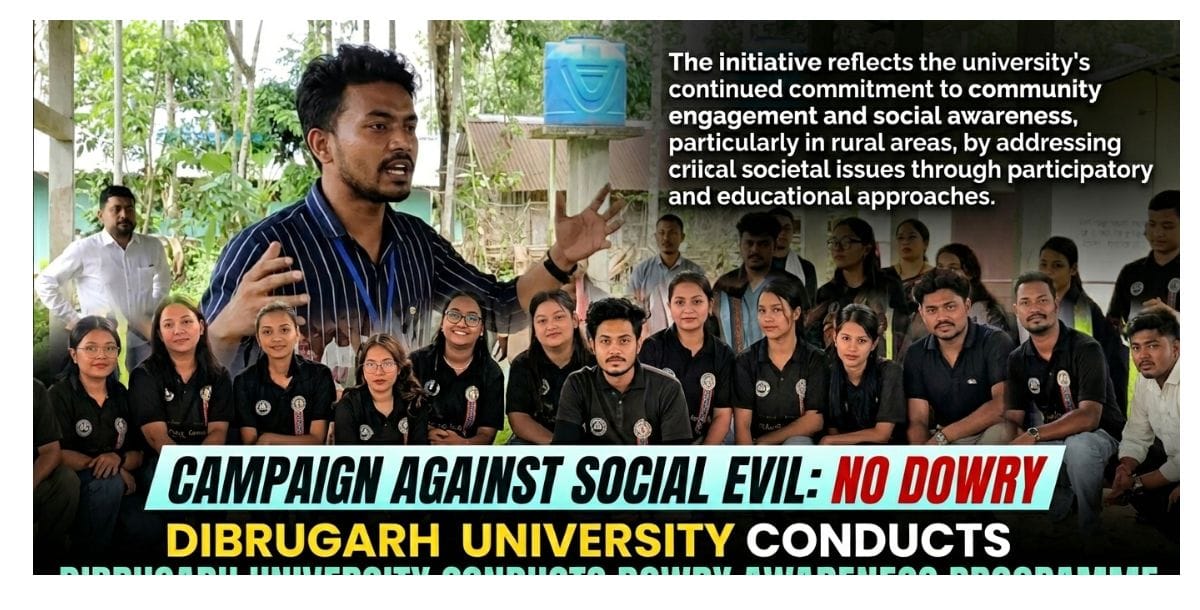
the heart of Upper Assam, where the tea gardens meet the rhythmic flow of the Brahmaputra, a different kind of movement is brewing. It isn’t a political rally or a corporate seminar; it is a battle for the soul of rural society. Dibrugarh University, a premier seat of learning in Northeast India, recently stepped far beyond its ivory towers to confront one of India’s most persistent social shadows: the dowry system.
By taking the conversation to the dusty lanes of Binoygutia village, the university has set a new benchmark for how academic institutions can act as catalysts for real-world systemic change.
Binoygutia
On a recent Wednesday, the quiet atmosphere of Binoygutia village was replaced by a vibrant assembly of nearly 120 participants. This wasn’t a gathering of passive listeners; it was a fusion of energetic youth and seasoned village elders. The event, meticulously organized by Radio Gyanmalinee (the university’s community radio station) and the Centre for Social Work, aimed to dismantle the cultural acceptance of dowry through empathy and education.
A Multidimensional Approach to Social Reform.made this drive unique was its “Triple-Threat” strategy:
- Creative Engagement: Using street plays to break emotional barriers.
- Legal Empowerment: Providing hard facts about rights and protections.
- Community Dialogue: Creating a safe space for villagers to voice their concerns.
Art as a Mirror: The Power of Street Theatre
a well-acted street play (Nukkad Natak) is worth a thousand lectures. Students from the Centre for Social Work transformed the village square into a stage, portraying the harrowing journey of a family caught in the dowry trap.
The play didn’t just focus on the financial aspect; it delved into the psychological warfare and emotional trauma that women endure. It showcased the “hidden costs” of dowry—the lost dignity, the broken dreams of young brides, and the crippling debt that haunts fathers long after the wedding music stops.
The silence that followed the performance wasn’t just quiet; it was reflective. You could see the realization on the faces of the elders that what they considered ‘tradition’ was actually a cycle of suffering.” — An attending student volunteer.
From Emotion to Action: The Legal Shield
While the street play opened hearts, Abhijit Saikia, Secretary of the District Legal Services Authority (DLSA), Dibrugarh, focused on empowering minds. Awareness without a legal foundation is often short-lived. Saikia’s session provided the villagers with a “Legal Toolkit” to fight back.
- The Dowry Prohibition Act: Understanding that both giving and taking dowry are criminal offenses.
- Section 498A: Educating women on the protections against matrimonial cruelty.
- THE Role of the DLSA: How villagers can access free legal aid without the fear of expensive lawyer fees.
- Confidentiality: Encouraging victims to speak up by assuring them of their privacy and safety.
the digital age, we often discuss social justice on Twitter or LinkedIn. However, the “offline SEO” of social change happens in places like Binoygutia.
1. Reaching the Unreachable: Rural areas are often the last to receive information about legal reforms. By physically going to these locations, Dibrugarh University bridges the “Information Divide.”
2. Youth Advocacy: By involving students, the university is grooming a generation of “anti-dowry ambassadors.” These students will eventually become husbands, wives, and parents who refuse to participate in the practice.
3. Breaking the Silence: In many rural settings, dowry is a taboo subject—not because it’s hated, but because it’s “just the way things are.” This initiative turned a private struggle into a public conversation.
The Strategic Role of Community Radio
Radio Gyanmalinee deserves a special mention. Community radio is the most powerful tool for rural Assam. It speaks the local dialect, understands the local nuances, and enters people’s homes every day. By integrating the radio station into this drive, Dibrugarh University ensured that the message didn’t end when the students left the village; it continued to echo through the airwaves, reaching thousands of other households in the district.
A Blueprint for Other Indian Universities
This drive is a clarion call for educational institutions across India. The true value of a university is not measured by the number of degrees it confers, but by the lives it improves.Transforming Mindsets
The success in Binoygutia is just the beginning. The university aims to replicate this model across other rural pockets of Assam. The ultimate goal is to create a social environment where a woman’s value is determined by her character and capability, not by the wealth her family can provide.
How You Can Help
Change doesn’t always require a university degree. You can contribute by:
- Promoting Simple Weddings: Lead by example and reject the ostentatious display of wealth.
- Educating Your Circles: Share information about the legal consequences of dowry.
- Supporting Local Outreach: Volunteer with organizations that work in rural community development.
(FAQ)
Q1: Is dowry still a major issue in Assam?
A: Yes, despite high literacy rates, social and cultural pressures often keep the practice alive in various forms, making continuous awareness drives essential.
Q2: Can a common citizen report dowry cases?
A: Absolutely. One can approach the nearest police station or the District Legal Services Authority (DLSA) for guidance and protection.
Q3: What is the role of the Centre for Social Work in this?
A: They provide the manpower and academic framework to turn social theory into practical field-based interventions.
Q4: How can other villages request such a programme?
A: Local village heads (Gaon Burahs) can reach out to Dibrugarh University’s outreach cell or Radio Gyanmalinee to organize collaborative sessions.
Conclusion
The “Dibrugarh University Dowry Awareness Drive” is a testament to the power of human connection. It reminds us that while laws are written in books, they are truly enacted in the hearts of the people. As Binoygutia moves from silence to dialogue, it carries the hope of a future where every bride enters her new home with her head held high, and every family is free from the shadow of debt.
Assam is watching. India is watching. And the change has officially begun.