
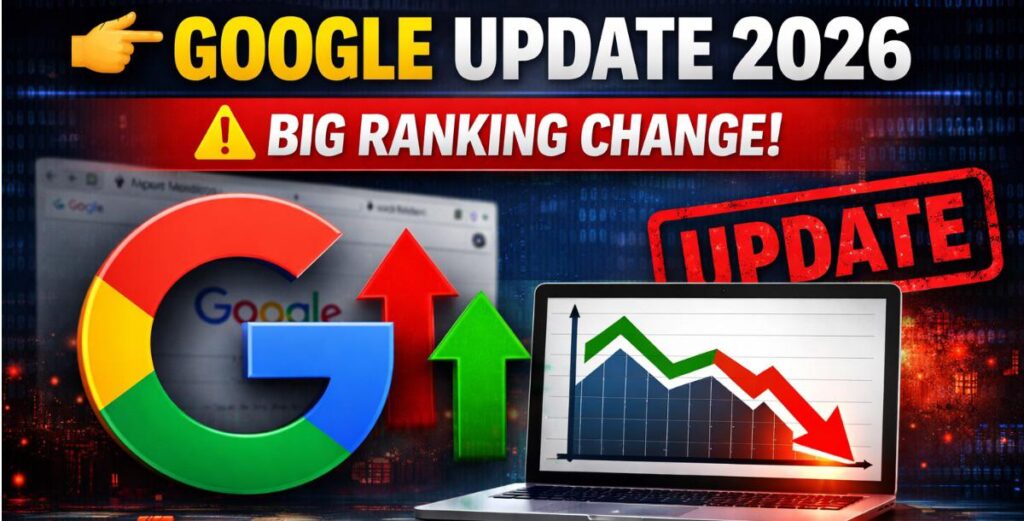
The Google algorithm update 2026 is already sending shockwaves across the blogging world. Over the past few weeks, thousands of AI-powered websites have reported sudden ranking drops, vanishing Discover visibility, and sharp traffic declines.
For creators who built content businesses around AI tools, this moment feels critical. And for readers, it may quietly change what shows up in search and Google Discover starting today.Here’s what’s really happening and why it matters right now.
What Is the Google Algorithm Update 2026?
The Google algorithm update 2026 is being described by industry analysts as one of the most aggressive quality recalibrations in recent years.While Google hasn’t framed it as an “anti-AI” update, the pattern is clear: websites relying heavily on mass-produced AI content are seeing significant visibility loss.Instead of targeting AI directly, the Google algorithm update 2026 appears to reward
- Demonstrated expertise
- First-hand experience
- Original reporting
- Author transparency
- Content depth beyond surface summaries
This aligns with Google’s long-standing E-E-A-T framework (Experience, Expertise, Authoritativeness, Trust)
Why AI Blogs Are Feeling the Impact First
AI blogging exploded between 2023 and 2025. Tools became faster, cheaper, and capable of generating thousands of articles in days.But scale came at a cost.Many AI blogs followed a similar pattern
- Rewriting trending topics
- Publishing generic explainer content
- Minimal real-world insight
- No identifiable author credibility
The Google algorithm update 2026 appears to be separating automated content farms from genuinely helpful AI-assisted publishing.Creators who simply “generated and posted” are seeing Discover traffic disappear. Meanwhile, blogs that combine AI efficiency with human editing, reporting, and insight are largely stable.This isn’t a ban on AI. It’s a filter on low-value automation.
Google Discover and AI Content
Google Discover has become one of the biggest traffic sources for publishers. The Google algorithm update 2026 seems to place stronger emphasis on
- Emotional relevance
- Topical authority
- Trust signals
- Real-world credibility
Discover is increasingly favoring content that feels written by a person with lived knowledge not just optimized for keywords.
- Personal experience matters more
- Data-backed analysis matters more
- Thin rewrites matter less
For AI-heavy blogs built purely for SEO volume, this shift is significant.
What Google Is Actually Rewarding Now
Based on early ranking data and SEO community analysis, the Google algorithm update 2026 appears to reward five clear elements:
1. Real Experience Signals
Content that shows first-hand testing, reporting, or analysis.
2. Clear Authorship
Named authors with bios, credentials, and consistency.
3. Depth Over Volume
Longer, structured, insight-driven articles instead of dozens of short posts.
4. Original Data or Perspective
Unique opinions, interviews, or case studies.
5. Editorial Quality
Human review, tone consistency, and contextual relevance.
In other words, Google is prioritizing trust not just text.
Is This the End of AI Blogging?
No. But it may be the end of effortless AI blogging.The Google algorithm update 2026 does not penalize AI usage itself. Many high-ranking publications openly use AI tools in drafting and research workflows.What appears to matter is
- Who takes responsibility for the content
- Whether it adds something new
- Whether it demonstrates real understanding
AI is becoming an assistant, not the author.This update reflects a broader shift in Google’s ecosystem.Search is becoming more competitive due to:
- AI-generated search answers
- Voice queries
- Personalized Discover feeds
To survive, Google must surface content people trust not just content that matches a query.The Google algorithm update 2026 is part of that strategy.It sends a strong signal: authority and authenticity now outweigh automation.If you run an AI blog, this is not a panic moment but it is a turning point.
Here’s what experts recommend
- Audit thin or duplicate-style content
- Add author pages with real credentials
- Include first-hand examples or insights
- Update old posts with deeper analysis
- Reduce bulk publishing
Instead of asking, “How much content can I produce?”
The smarter question now is, “How much value can I add?”
What Readers Will Notice
For everyday users, the Google algorithm update 2026 may lead to:
- Fewer repetitive AI-style article
- More opinion-driven reporting
- More transparent authorship
- Higher-quality Discover recommendations
The web may feel smaller — but more trustworthy.
FAQ
Q1: Does the Google algorithm update 2026 ban AI content?
No. It targets low-value, unoriginal content — regardless of whether AI was used.
Q2: Why did my AI blog lose traffic overnight?
It may lack strong experience signals, depth, or trust indicators under the new system.
Q3: Can traffic recover?
Yes. Updating content quality, authorship, and originality can help regain visibility.
Q4: Is this update permanent?
Major core updates typically shape ranking systems long-term, though refinements continue.
Conclusion
The Google algorithm update 2026 isn’t just another technical adjustment. It marks a philosophical shift in how online information is ranked.Automation alone is no longer enough.In 2026, credibility wins. Experience matters. And human insight is once again becoming the most valuable ranking factor on the internet.For creators willing to evolve, this update isn’t a threat it’s an opportunity.





Leave a Reply