India electronics exports in 2025 marked a defining moment for the country’s manufacturing ambitions. What once looked like a long-term vision has now become reality: India is exporting high-value electronics at a scale that few expected this fast.
At the heart of this transformation is a familiar product in millions of pockets worldwide the iPhone. But the bigger story goes far beyond smartphones. It’s about jobs, supply chains, global trust, and India’s growing role in the world’s technology economy.
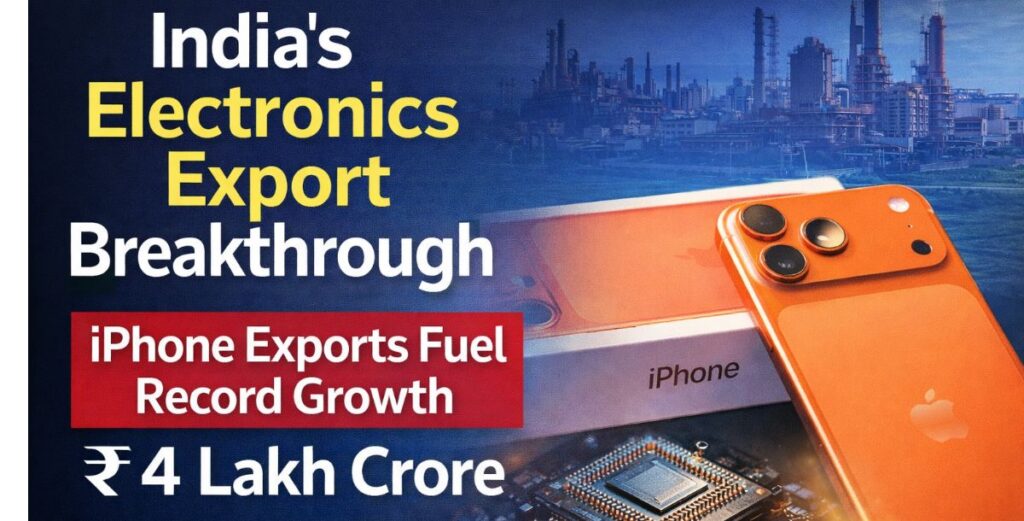
India Electronics Exports in 2025: Why This Year Changed Everything
India electronics exports In 2025 crossed ₹4 lakh crore, making electronics one of the country’s top foreign exchange earners for the first time.
This wasn’t driven by a single policy or company. It was the result of years of groundwork manufacturing incentives, infrastructure upgrades, and global companies rethinking where they build their products.
What stands out is the transition from assembly-led production to export-led manufacturing. India is no longer just making electronics for its domestic market. It is shipping them to the world.
The iPhone Effect: How Apple Became a Game Changer
One statistic captures the scale of change:
iPhone exports from India alone touched nearly ₹2 trillion in 2025.
Apple’s shipments from India grew by over 80% year-on-year, placing the country among Apple’s most important global manufacturing hubs.
This growth wasn’t accidental. Apple and its manufacturing partners expanded facilities across multiple Indian states, reducing geographic risk and improving production resilience. More importantly, Apple increased sourcing from Indian component suppliers, gradually raising local value addition.For India, this proved something critical: the country can reliably manufacture and export premium, high-value technology products at scale.
What Official Data Reveals About the Export Boom
Government-linked export figures and disclosures from major vendors reveal three clear trends behind the electronics export surge:
- Consistent quarterly growth throughout 2025, not a one-off spike
- Smartphones as the primary growth engine, led by iPhones
- Steady momentum in non-phone electronics, including components and consumer devices
Indian electronics are now reaching markets across the United States, Europe, West Asia, and Asia-Pacific, reducing dependence on a few regions and protecting exports from global demand swings.
Semiconductors: Why 2026 Could Be Even Bigger
While 2025 belonged to smartphones, 2026 could belong to semiconductors.
Four semiconductor plants are scheduled to begin commercial production next year. This matters because chips are the backbone of modern electronics from phones and cars to industrial equipment.Domestic semiconductor manufacturing will:
- Reduce import dependence
- Shorten supply chains
- Improve cost competitivenes
More importantly, it positions India as a serious long-term player in advanced electronics manufacturing, not just final assembly.
Rising Value Addition: The Quiet Success Story
One of the most important but less-discussed shifts is rising value addition.
In smartphone manufacturing, local value addition has nearly doubled in recent years. This means more components, sub-assemblies, and processes are now happening inside India.
For Indian MSMEs, this opens doors to global supply chains. For workers, it means higher-skilled jobs. For the economy, it creates depth not just export volume.This is how manufacturing ecosystems mature.
Why the Electronics Export Surge Matters Right Now
The global timing couldn’t be better.As companies diversify supply chains away from single-country dependence, India’s scale, workforce, and policy stability offer a compelling alternative.
For India, the electronics exports surge brings:
- Stronger foreign exchange inflows
- Large-scale direct and indirect employment
- Faster industrial and technological upgrading
For the world, it creates a more balanced and resilient electronics supply base.
The Challenges India Still Must Tackle
Despite the momentum, the road ahead isn’t effortless.
Logistics costs remain higher than global benchmarks. Skill gaps persist in advanced manufacturing. Policy stability and ease of doing business must be continuously improvedSustained growth will depend not on announcements, but on executionyear after year.
Frequently Asked Questions
1.What crossed ₹4 lakh crore in 2025?
India’s total electronics exports reached this record level.
2.Why are iPhone exports so important?
They demonstrate India’s ability to manufacture and export high-value technology products at global scale.
3.Will electronics exports grow further in 2026?
Yes. Semiconductor production and higher value addition are expected to boost growth.
4.Does this create jobs in India?
Yes. Electronics manufacturing generates large-scale direct and indirect employment.
5.Is India replacing other global manufacturing hubs?
Not yet. India is emerging as a strong alternative, adding resilience to global supply chains.
Conclusion
The India electronics exports in 2025 is more than a milestone it’s a signal.
With smartphones driving today’s growth and semiconductors shaping tomorrow, India is entering a decisive phase in global manufacturing. If momentum holds, the next few years could fundamentally redefine India’s position in the world’s technology supply chain.and more realtive news visit our site