
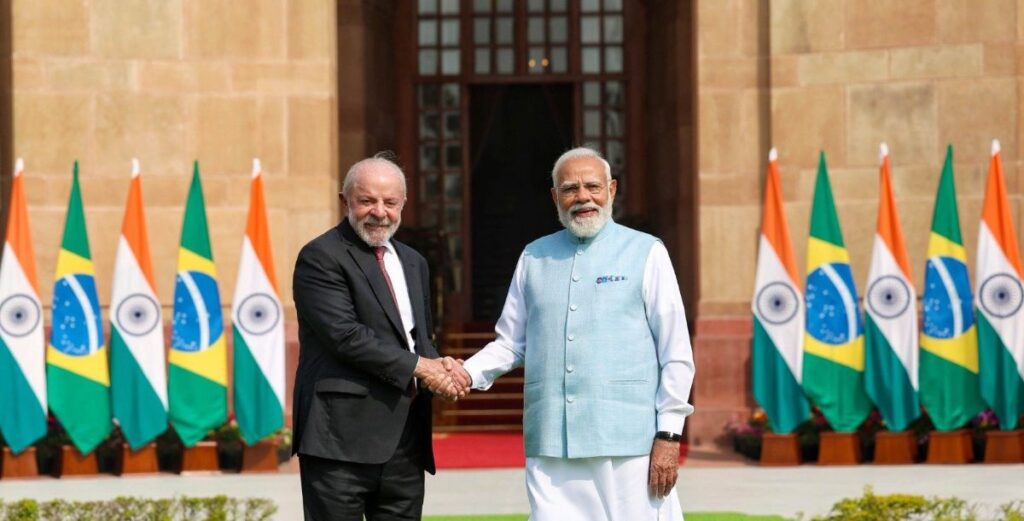
At a time when the world is witnessing fractured supply chains, rising geopolitical tensions and intense debates over artificial intelligence regulation, India–Brazil ties have quietly moved to the center of global diplomacy. The meeting between Luiz Inácio Lula da Silva and Narendra Modi in the Indian capital was not just ceremonial it reflected a deeper strategic recalibration between two of the world’s largest democracies.
From a grand reception at Rashtrapati Bhavan to extended delegation-level discussions, the optics were deliberate. But beyond the symbolism, the substance of India–Brazil ties is what truly matters now.
Global alignments are shifting. Western economies are recalibrating their trade policies, China’s economic trajectory is being reassessed, and emerging nations are demanding stronger representation in global institutions.
In this environment, India–Brazil ties represent more than bilateral engagement—they reflect an effort to reshape Global South cooperation.Both nations are founding members of BRICS and active participants in the G20. Their coordination has implications far beyond New Delhi and Brasília.
Trade: A Strong Base, Bigger Ambitions
Trade remains the backbone of India–Brazil ties.
Bilateral trade has crossed $15 billion in recent years, driven by energy imports, edible oils, sugar, pharmaceuticals and engineering goods. Brazil is India’s largest trading partner in Latin America, while India leads among Brazil’s Asian partners.But officials privately acknowledge a structural challenge: the trade basket is still narrow.
Both leaders discussed diversifying into value-added sectors—renewable energy equipment, defence manufacturing components, agri-tech and pharmaceutical research collaboration. Business delegations accompanying President Lula explored investment opportunities, signaling that policy talk may soon translate into private-sector action.
For exporters and investors, this phase of India–Brazil ties could open new corridors of opportunity.
Artificial Intelligence and Digital Governance
One of the most consequential discussions revolved around artificial intelligence.
India presented its experience with large-scale digital public infrastructure—systems that have enabled financial inclusion, real-time payments and scalable governance tools. Brazil, which has built its own digital governance architecture, is keen to collaborate on AI standards and ethical regulation.This matters because AI governance is no longer a purely Western conversation.
If India–Brazil ties evolve into coordinated digital policy frameworks, they could shape how developing economies approach data protection, algorithmic accountability and innovation ecosystems.Experts argue that such cooperation may influence multilateral AI norms over the next decade.
Clean Energy: Shared Stakes, Shared Solutions
Energy cooperation forms another strategic pillar.
Both India and Brazil are leaders in biofuels, particularly ethanol blending programs. They are also investing heavily in green hydrogen and solar expansion.During the discussions, climate justice emerged as a common theme—both countries emphasized that developing nations must receive fair climate financing and technology transfer.
Strengthening India–Brazil ties in clean energy is not merely about sustainability; it is about energy security and industrial competitiveness in a carbon-constrained future.
Defence and Strategic Calculations
Defence trade remains limited, but strategic conversations are expanding.Officials reviewed possibilities for joint exercises and technology partnerships. While no major defence agreement was announced, the dialogue itself reflects growing trust.
India–Brazil ties increasingly operate within a broader geopolitical context. As middle powers, both countries are diversifying strategic partnerships to reduce dependency on any single bloc.That strategic autonomy defines their foreign policy outlook.
The Human and Cultural Dimension
Diplomacy is not only about agreements; it is about people.Educational exchanges, cultural programs and tourism cooperation were part of the agenda. Both governments discussed encouraging student mobility and academic collaboration.
Shared democratic values and multicultural societies create natural bridges. In many ways, India–Brazil ties are strengthened by similarities—large rural populations, agricultural economies and vibrant entrepreneurial ecosystems.
These parallels make cooperation more practical, not just political.The world order is in transition.Emerging economies are seeking reforms in institutions like the United Nations and global financial systems. India and Brazil have consistently advocated greater representation for developing nations.
By strengthening India–Brazil ties, both leaders are reinforcing a broader narrative: that the Global South is not merely a recipient of policy decisions—it is an active shaper of them.This alignment may influence debates on trade reform, digital taxation, climate funding and development finance.
What Comes Next?
The real test will be implementation.Announcements and diplomatic warmth must now translate into trade facilitation, regulatory clarity and investment pipelines. Industry leaders are watching closely.
If concrete mechanisms follow, India–Brazil ties could move from steady growth to transformational partnership within five years.the visit has created momentum. Sustaining it will require institutional coordination and consistent politica
FAQs
1. Why are India–Brazil ties strategically important now?
Because both countries are coordinating on trade, AI governance and climate policy during a period of global realignment.
2. What sectors are likely to grow?
Renewable energy, agri-tech, pharmaceuticals, digital governance and AI collaboration.
3. Did the leaders sign major agreements?
No headline defence deal was announced, but discussions laid groundwork for expanded cooperation.
4. How does BRICS influence this partnership?
BRICS provides a platform for India and Brazil to align on Global South priorities and institutional reform.
5. What is the long-term outlook?
If policy follow-through matches diplomatic intent, India–Brazil ties could shape trade and technology frameworks for emerging economies.
Conclusion
India–Brazil ties are no longer limited to diplomatic courtesies.They are evolving into a strategic partnership shaped by trade ambition, digital transformation and shared global aspirations.
In a changing world order, the choices made in New Delhi this week may echo far beyond the two capitals reshaping how emerging powers collaborate in the decades ahead.



Leave a Reply