
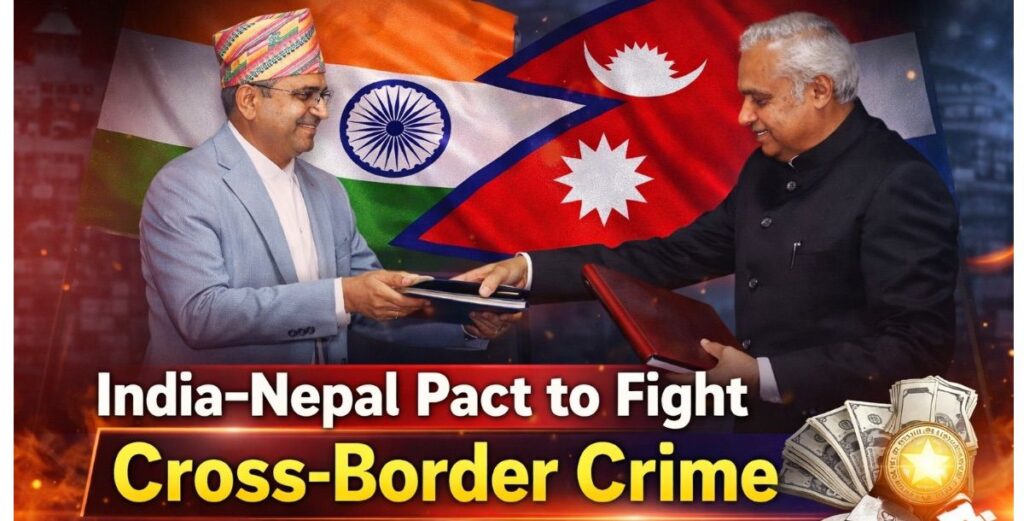
In a move that may not grab instant headlines but could significantly reshape regional law enforcement, India and Nepal have signed the India–Nepal Mutual Legal Assistance Agreement in Kathmandu.
At a time when financial fraud, cybercrime, and terror funding networks operate beyond borders, this agreement strengthens how both countries investigate and prosecute criminal cases that cross jurisdictions.For two nations connected by an open border and deep people-to-people ties, the timing is not accidental it is strategic.
India and Nepal share over 1,700 km of open border. Families, workers, traders, and students cross daily with minimal restrictions. That openness is a strength but it also creates legal challenges.
In recent years, cross-border financial crimes, digital scams, and illegal money transfers have become more sophisticated. Evidence may sit in one country while suspects are in another. Without a structured legal framework, investigators often face delays in accessing documents, bank records, or witness statements.
The India–Nepal Mutual Legal Assistance Agreement addresses that gap directly.It creates a formal, time-bound system through which both governments can request and share:
- Evidence and official records
- Financial transaction details
- Assistance in search and seizure operations
- Service of court documents
- Information relevant to prosecution
In simple terms: investigations will move faster and more efficiently.
A Long Negotiation Finally Concluded
The agreement was finalised after years of discussion and was formally signed following a Home Secretary-level meeting held in New Delhi last July.
Officials from Nepal’s Ministry of Law described the pact as a step toward strengthening rule of law and institutional coordination. Diplomatic sources say the negotiations focused heavily on ensuring clarity in procedures, legal safeguards, and sovereignty concerns.
The final signing in Kathmandu marks the operational beginning of what both sides call a “modern legal cooperation framework.One of the most important aspects of the India–Nepal Mutual Legal Assistance Agreement is its connection to anti-money laundering efforts.
Nepal was re-listed on the Financial Action Task Force (FATF) grey list in February last year. Being on the grey list subjects a country to increased international financial monitoring. It can influence foreign investment flows, banking partnerships, and global financial confidence.
Stronger cooperation with India one of Nepal’s largest economic partners signals serious intent to tighten enforcement.Legal analysts believe this agreement will
- Improve tracking of suspicious cross-border transactions
- Support prosecution of terror financing networks
- Help align enforcement standards with international compliance norms
For Nepal, that alignment is crucial to improving its global financial standing.While this may appear like high-level diplomacy, its impact could reach everyday citizens.
Cross-border online fraud cases have been rising in recent years. Scammers often exploit jurisdictional loopholes, making prosecution slow or complicated.Under the India–Nepal Mutual Legal Assistance Agreement, authorities can coordinate more quickly. This means:
- Faster evidence collection in fraud cases
- Stronger prosecution of organized criminal networks
- Better tracking of funds moved across borders
For businesses operating in both countries, especially financial institutions, the agreement also improves compliance coordination. That may reduce regulatory uncertainty in the long runOne key clarification: this agreement does not automatically allow extradition of accused individuals.
Extradition remains a separate and still unresolved issue between the two countries, particularly regarding third-country nationals.However, even without a finalized extradition treaty, mutual legal assistance allows both sides to build cases more effectively and that alone can significantly strengthen justice outcomes.
Beyond legal procedures, the India–Nepal Mutual Legal Assistance Agreement sends a diplomatic message.South Asia faces increasing challenges from cybercrime, digital financial fraud, and extremist financing networks. International pressure on compliance standards is growing.
By formalising cooperation, India and Nepal are signaling that regional security coordination is evolving with modern realities.
Experts see this as part of a wider effort by India to strengthen legal cooperation mechanisms with neighboring countries.The agreement will enter into force after both governments complete diplomatic notification procedures.
Once operational, designated “central authorities” in both countries will begin processing formal legal assistance requests.Initial cases are expected to focus on financial crime and documentation exchange, where cooperation gaps were previously most visible.
FAQ
1.What is the India–Nepal Mutual Legal Assistance Agreement?
It is a formal legal framework allowing both countries to assist each other in criminal investigations and judicial processes.
2.Why is it important now?
Because cross-border financial crime and terror financing require faster, structured cooperation.
3.Will suspects automatically be extradited?
No. Extradition is handled separately and has not yet been finalized.
4.How could this affect citizens?
It could improve prosecution in fraud and cross-border crime cases, leading to faster justice.
Conclusion
The India–Nepal Mutual Legal Assistance Agreement may appear technical on the surface, but its implications are practical and far-reaching.In a region where borders are open but crime networks are increasingly complex, legal systems must move just as swiftly.
This agreement is not dramatic diplomacy it is disciplined coordination. And in today’s security environment, that may matter even more.





Leave a Reply