By Sanjoy Gorh
January 04, 2026 | Updated 09:58 PM IST
For much of human history,India maritime power oceans decided the fate of civilizations. Long before air routes, railways, or digital highways, it was the sea that carried wealth, ideas, culture, and influence. Few people realize that India was not just a participant in this world it was a leader.india’s dominance of the oceans was real, documented, and global. Today, as the Indian Ocean once again becomes the center of world trade and geopolitics, the story of India maritime power is no longer just history it is a roadmap for the future.
A Silent Voyage That Revived a Forgotten Legacy
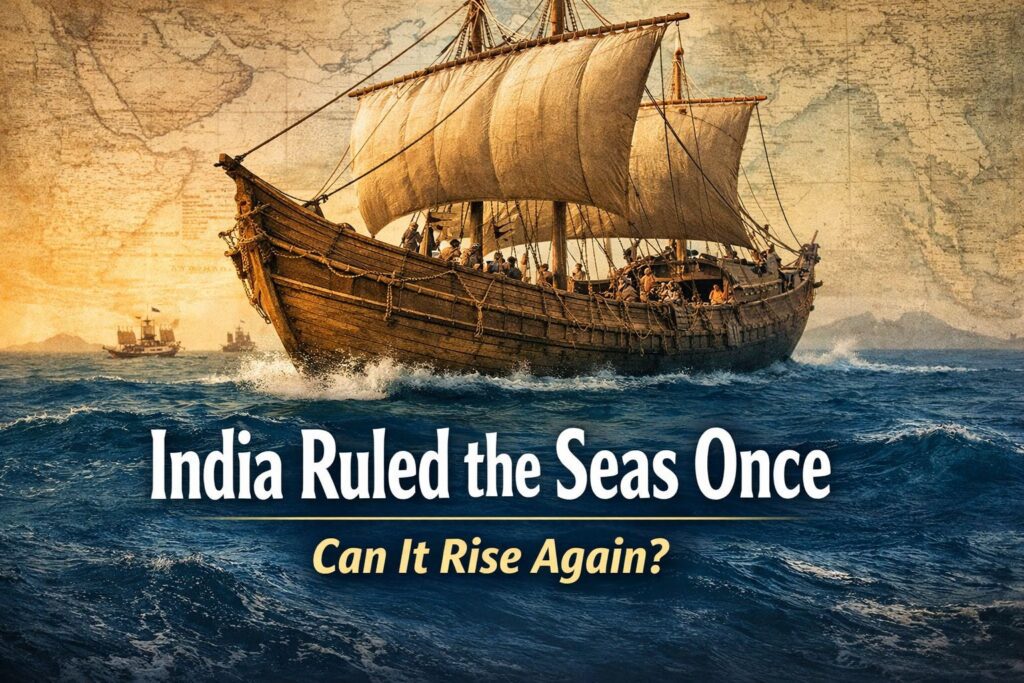
In late 2025, a handcrafted sailing vessel quietly set sail for Oman. Named INSV Kaundinya, the ship was built without iron nails, following a stitched shipbuilding method that dates back thousands of years.This was not a symbolic museum project. It was a statement. The voyage reminded the world that India maritime power was once built on innovation, sustainability, and deep ocean knowledge—qualities that remain relevant even today.
Harappan Dockyards: Where Maritime India Began
Nearly 5,000 years ago, the Indus Valley Civilization engineered one of the world’s earliest tidal dockyards at Lothal. This was not accidental infrastructure—it was advanced maritime planning.
Archaeological evidence confirms trade with Mesopotamia and the Persian Gulf, proving that India operated as a global trading hub long before Europe entered the scene. This early foundation marked the rise of India maritime power as an economic force.
Ancient Texts That Speak of Ocean Mastery
India’s oldest scriptures never treated the sea as a boundary. The Rigveda mentions ships navigating fierce waters, while the Ramayana and Mahabharata describe naval battles, overseas journeys, and island kingdoms.These references show that maritime knowledge was deeply embedded in Indian culture, reinforcing the civilizational depth behind India maritime power
Empires That Commanded the Indian Ocean
Under the Mauryas, shipbuilding became a regulated state industry, and sea routes connected India with the Mediterranean world. Ashoka used maritime diplomacy to spread ideas, not conquest.The Chola dynasty took this further. Their navy crossed the Bay of Bengal, subdued powerful kingdoms, and protected trade routes across Southeast Asia. At its peak, India maritime power rivaled any naval force of the medieval world.
How India Shaped Southeast Asia by Sea
India’s relationship with Southeast Asia was not built by invasion but by navigation. Traders, monks, and artisans sailed regularly to Java, Sumatra, and Cambodia.Languages, temple architecture, governance systems, and traditions evolved through these connections. Even today, festivals like Odisha’s Bali Jatra celebrate this era when India maritime power shaped entire regions
Shipbuilding Innovation Without Iron
Centuries before modern engineering, Indian shipbuilders mastered stitched ship technology. Teakwood planks were sewn with coir and sealed with natural resins, creating flexible yet durable vessels.Shipwrecks found near Oman confirm that Indian-built ships dominated long-distance trade. This innovation was a key pillar of India maritime power across the Indian Ocean
Why Maritime Power Matters More Than Ever Today
In the 21st century, nearly 80% of global trade still moves by sea. Energy supplies, digital cables, and strategic choke points define national security India’s investments in ports, inland waterways, naval modernization, and indigenous shipbuilding reflect a renewed realization: India maritime power is essential for economic growth and geopolitical stability.
A Future Written on Water
India’s maritime dominance was never an accident. It was built on vision, technology, and sustained engagement with the oceans.With modern tools and ancient wisdom combined, the revival of India maritime power is not a possibility—it is an inevitability.
(FAQs)
1. Why was India a major maritime power in ancient times?
India had advanced ports, superior shipbuilding techniques, and global trade networks connecting Asia, Africa, and the Middle East.
2. What makes stitched shipbuilding unique?
It used natural fibers instead of iron, making ships flexible, durable, and ideal for long ocean voyages.
3. How did the Chola dynasty dominate the seas?
The Cholas built a powerful navy capable of overseas warfare and trade protection across Southeast Asia.
4. What goods did India trade by sea?
Spices, textiles, gemstones, ivory, and cultural knowledge formed the backbone of maritime trade.
5. How is India reviving its maritime heritage today?
Through projects like INSV Kaundinya, port expansion, naval modernization, and inland waterways development.
6. Why is maritime power critical for modern India?
It ensures trade security, energy access, and strategic dominance in the Indian Ocean region.
Conclusion
India’s maritime history is not a distant memory—it is a strategic blueprint. From Harappan dockyards to Chola fleets, the oceans once carried India’s influence across continents. Today, as global power shifts back to sea routes, reconnecting with this heritage is essential.more ocen news visit this site
Modern initiatives, combined with historical insight, are laying the groundwork for renewed leadership. When innovation meets legacy, the revival of India maritime power becomes not just possible—but unstoppable.and more trending news visit our site