
At a time when global trade is being reshaped by climate shocks, supply-chain disruptions, and geopolitical uncertainty, the India–US trade deal has landed with unusual clarity. Instead of triggering anxiety among farmers, the framework has delivered reassurance while quietly expanding India’s export ambitions.
For India, where agriculture supports more than half the population either directly or indirectly, trade policy is never abstract. Every clause has real consequences for prices, livelihoods, and rural stability. That is why this latest India–US trade deal matters now: it signals growth without surrender, and openness without undermining domestic strength.
Agriculture at the Core of the India–US Trade Deal
Unlike conventional trade agreements that often push rapid market opening, the India–US trade deal places agriculture firmly at its center with clear guardrails.
The government has underlined that Indian farmers remain fully protected. Sensitive agricultural products continue to face import restrictions, ensuring that local producers are not exposed to sudden price pressure from cheaper foreign produce.This approach reflects a deliberate strategy: expand exports, not imports, in sectors where livelihoods are most vulnerable.
Sensitive Farm Products Remain Protected
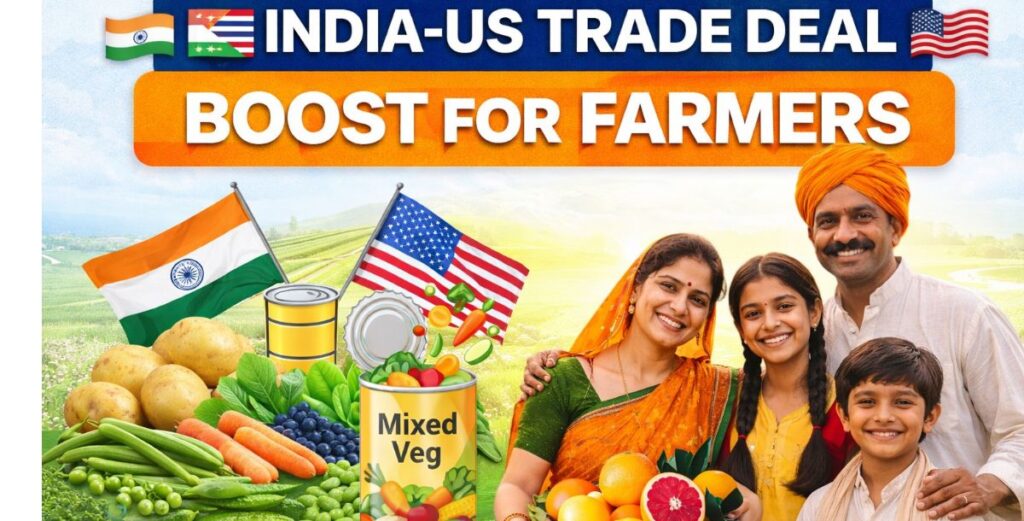
Visuals and policy notes shared by the government make one point unmistakable there is no blanket opening of Indian farm markets under the India–US trade deal.
Key vegetables and produce remain restricted, including potatoes, peas, beans, and a range of seasonal vegetables. Frozen and preserved vegetables also remain regulated under Indian standards.For farmers already dealing with rising input costs and unpredictable weather, this protection offers stability rather than shock.
Fruit Imports: Guardrails Stay Firm
Fruit growers, particularly in apple- and citrus-producing states, have been watching trade negotiations closely. Under the India–US trade deal, import controls on major fruits remain intact.
Apples, citrus varieties, grapes, and premium table fruits continue to face restrictions. Only limited, selective items such as strawberries are permitted under tightly regulated conditions.The message is clear: orchard farmers will not be undercut in the name of trade expansion.
Why the India–US Trade Deal Matters Right Now
Global food systems are under stress. Climate volatility, shipping bottlenecks, and rising energy costs have made food trade increasingly fragile.
In this context, the India–US trade deal sends a signal of confidence. It positions India as a reliable trading partner while refusing to compromise domestic food security or price stabilityThis balance is especially significant as India seeks to strengthen its role as a global supplier of agricultural and processed food products.
Export Opportunities for Farmers and MSMEs
While imports remain controlled, the India–US trade deal opens fresh pathways for Indian exports.
Fruits, vegetables, processed foods, and value-added agricultural products are expected to gain improved access to US markets. This shift directly benefits agri-based MSMEs, food processors, and farmer-producer organisations.By linking agriculture with manufacturing, storage, and logistics, the deal supports rural job creation and higher farm incomes.
Boost to Make in India and Rural Employment
The ripple effects of the India–US trade deal extend well beyond farms.
Agri-processing units stand to gain from higher export demand. Cold storage, warehousing, and transport sectors are likely to see increased investment. Women-led and youth-led agri enterprises, often concentrated in value-added segments, could benefit the most.In policy terms, the deal aligns closely with the broader Make in India vision integrating rural production into global value chains.
Technical Cooperation, Not a Free Trade Shortcut
Importantly, this is not a traditional free trade agreement. The India–US trade deal focuses on technical and regulatory cooperation rather than unrestricted market access.
Areas of collaboration include food safety standards, storage technology, sustainable farming practices, and faster export clearances for Indian produce. These steps reduce friction for exporters without opening the door to uncontrolled imports.For farmers, this means better market access without increased competition at home.
Bilateral trade between India and the US has crossed $190 billion in recent years, making the relationship one of India’s most important economic partnerships.
Within that framework, the India–US trade deal represents a careful recalibration strengthening ties while respecting domestic realities. Agriculture, often the most politically sensitive sector, has been handled with caution rather than haste.
Trade agreements often fail when they ignore social impact. By prioritising protection first and opportunity second, the India–US trade deal sets a template for future negotiations.It reinforces India’s credibility as a country that can engage globally without losing sight of those at the grassroots.
FAQ
Q1. Does the India–US trade deal allow free import of US farm products?
No. Sensitive agricultural products remain restricted to protect Indian farmers.
Q2. Who benefits most from the India–US trade deal?
Farmers, agri-exporters, food processors, MSMEs, and logistics providers benefit directly.
Q3. Is this a full free trade agreement?
No. It is a trade framework focused on cooperation and facilitation, not unrestricted access.
Q4. Will fruit growers be affected?
No. Import controls on apples, citrus fruits, and grapes remain in place.
Q5. How does this help consumers?
By supporting stable prices, better-quality exports, and stronger rural incomes.
Conclusion
The India–US trade deal stands out not for what it opens, but for what it safeguards. It reassures farmers, empowers exporters, and strengthens India’s negotiating confidence.more realtive news visit our site
In a volatile global economy, this balance between protection and opportunity may prove to be India’s most valuable advantage.





Leave a Reply