

Writer by 07.02.2026 Time 2.00 PM Published
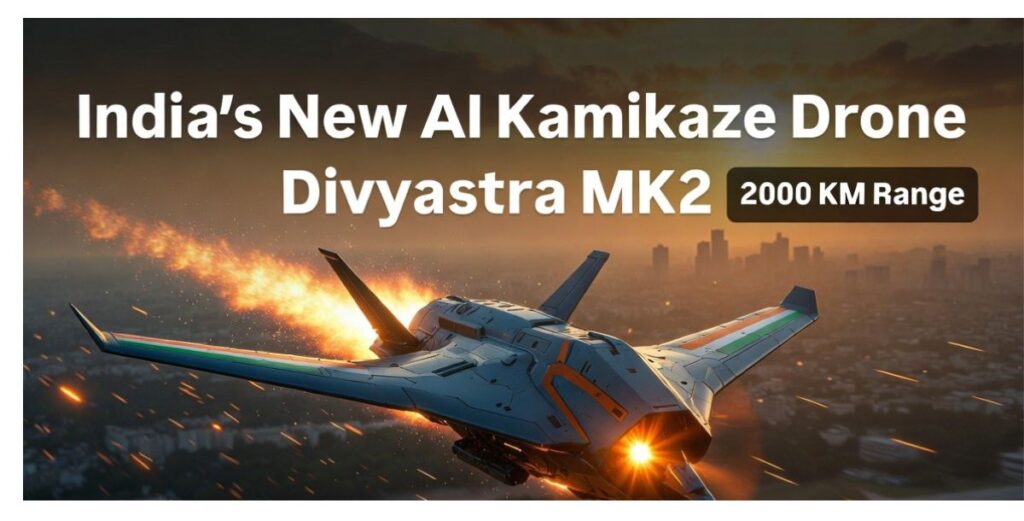
India’s AI-Powered Divyastra MK2: The Kamikaze Drone That Just Took a Giant Leap Forward
Imagine a silent predator in the sky patient, intelligent, and lethal. It can loiter for hours, scan the battlefield in real time, then strike with pinpoint accuracy, all without risking a single human life. That’s not science fiction. That’s the Divyastra MK2, and right now, in Lucknow, it’s moving from drawing board to reality at breakneck speed.
Lucknow-based defence startup HoverIt has successfully completed high-speed taxi trials of its long-range AI loitering munition, the Divyastra MK2. Developed inside the Uttar Pradesh Defence Industrial Corridor, this indigenous “kamikaze drone” marks a bold step in India’s quest for self-reliant, next-generation warfare tech. And the timing couldn’t be more perfect.
Key Highlights
- AI-powered loitering munition built for deep-strike missions
- Operational range: 1,500–2,000 km
- Endurance: 8–12 hours in the air
- Payload capacity: 50–100 kg (high-explosive, ISR, or electronic warfare modules)
- Swarm intelligence for coordinated saturation attacks
- GPS-denied operations using advanced onboard AI navigation
- Cruise speed ~180 km/h; terminal attack speed up to 400 km/h
What Exactly Is the Divyastra MK2?
Forget your regular surveillance drone. The Divyastra MK2 is a true loitering munition a smart, autonomous system that circles above a target area like a hawk waiting for the perfect moment. Once it locks on, it becomes a guided missile with a brain.
Unlike traditional cruise missiles that follow a fixed path and detonate on impact, this drone gives operators (or its own AI) the flexibility to assess, track, and decide in real time. The MK2 version takes everything up a notch: it’s designed for strategic deep strikes far beyond frontline zones. Think striking enemy airbases, command centres, or supply lines hundreds of kilometres inside hostile territory without putting pilots in harm’s way.
It’s the evolved sibling of HoverIt’s earlier Divyastra MK1 (which already proved itself with a 500 km range). The MK2 doubles down on range, endurance, and smarts, making it a genuine game-changer for India’s defence ecosystem.
Advanced Features That Make It Stand Out
Long Range + Serious Staying Power
With up to 2,000 km reach and 8–12 hours of endurance, the Divyastra MK2 can loiter patiently over high-value targets. That extended airborne time turns it into both a persistent eye in the sky and a sudden hammer. During trials on the Ganga Expressway, it hit stable high-speed runs at 145 km/h—clear proof the airframe and controls are rock-solid and ready for the next phase: full flight testing.
Multi-Role Payload Flexibility
One drone, multiple missions. Swap in a high-explosive warhead for precision strikes, an ISR (Intelligence, Surveillance, Reconnaissance) package for real-time battlefield intel, or electronic warfare modules to jam enemy radars and communications. This versatility means commanders don’t need separate fleets for different jobs—just one adaptable platform.
AI Swarm Intelligence
Here’s where things get futuristic. Multiple Divyastra MK2 drones can talk to each other in real time, coordinate attacks, and overwhelm enemy defences through sheer numbers and smart tactics. It’s the classic “quantity has a quality of its own” principle except now it’s AI-driven. One cheap drone might get intercepted; a coordinated swarm? That’s a nightmare for even the best air-defence systems.
Built for GPS-Denied Battlefields
Modern wars are full of jamming and spoofing. The Divyastra MK2 doesn’t panic. Its advanced AI navigation keeps it on mission even when satellite signals vanish. Encrypted sovereign command-and-control systems add another layer of security, ensuring it stays under Indian control in contested airspace.
Taxi trials are done. The drone performed beautifully, validating its structure and systems ahead of full flight trials. HoverIt operating as KAWA UAV Pvt. Ltd. is moving fast, embodying the rapid prototyping spirit of Atmanirbhar Bharat. Official induction timelines haven’t been announced yet, but the momentum is unmistakable. A low-cost, homegrown alternative to expensive imported strike systems is exactly what India’s defence planners have been waiting for.
Warfare isn’t what it used to be. Look at recent conflicts: cheap loitering munitions have repeatedly humbled billion-dollar defence systems. A single well-placed drone can take out a tank, radar station, or even a warship—and do it for a fraction of the cost.
For India, the Divyastra MK2 delivers three massive advantages
- 1. Cost-Effective Power Projection Traditional air strikes need jets, pilots, tankers, and huge logistics chains. This drone slashes those costs and risks while delivering similar (or better) results.
- 2. True Self-Reliance Developed entirely in Lucknow’s defence corridor, it strengthens India’s indigenous manufacturing base and reduces dependence on foreign suppliers. It’s Make in India in action—on steroids.
- 3. Future-Proof Readiness AI-driven swarm tactics and autonomous operations are already reshaping global military doctrines. India isn’t just catching up; with projects like this, it’s positioning itself to lead in the drone warfare era.
Global Context: Loitering Munitions Are Rewriting the Rules
From Ukraine’s battlefields to Middle Eastern hotspots, affordable autonomous drones have proven they can punch way above their weight. Expensive interceptors are being burned through at alarming rates just to stop low-cost threats. Nations worldwide are racing to build similar systems. India’s entry—with a 2,000 km deep-strike capability—signals it’s serious about staying ahead in this new era of asymmetric, high-tech conflict.
FAQs
1. What is the Divyastra MK2?
An AI-powered, long-range loitering munition (kamikaze drone) developed by Indian startup HoverIt for precision deep strikes.
2. How far can it fly?
Between 1,500 and 2,000 kilometres—enough to reach deep strategic targets.
3. Can it operate without GPS?
Absolutely. It’s engineered for jammed or denied environments using onboard AI navigation.
4. What makes it different from regular drones?
It combines long-endurance surveillance with autonomous strike capability and swarm coordination—turning one platform into a complete mission package.
5. Is it combat-ready yet?
Not yet. High-speed taxi trials are complete; full flight testing is next. But the pace of development is impressive.
Conclusion
The successful taxi trials of the Divyastra MK2 aren’t just a technical milestone they’re a statement. India is no longer content to import cutting-edge weapons; it’s building them at home, faster and smarter than ever before.
With AI at its core, swarm tactics in its DNA, and a range that can reshape entire battle spaces, this homegrown kamikaze drone could become one of the most important tools in India’s defence arsenal. The future of warfare is autonomous, affordable, and intelligent and the Divyastra MK2 is proof that India is ready to own that future.
Source of refrence
• idrw.org: “Indian Company Begins Taxi Trials of DIVYASTRA Mk2 Kamikaze Drone with 2000 km Reach”

Leave a Reply