

Writer by sanjoy 04.04.2026 time 07.45 pm Published
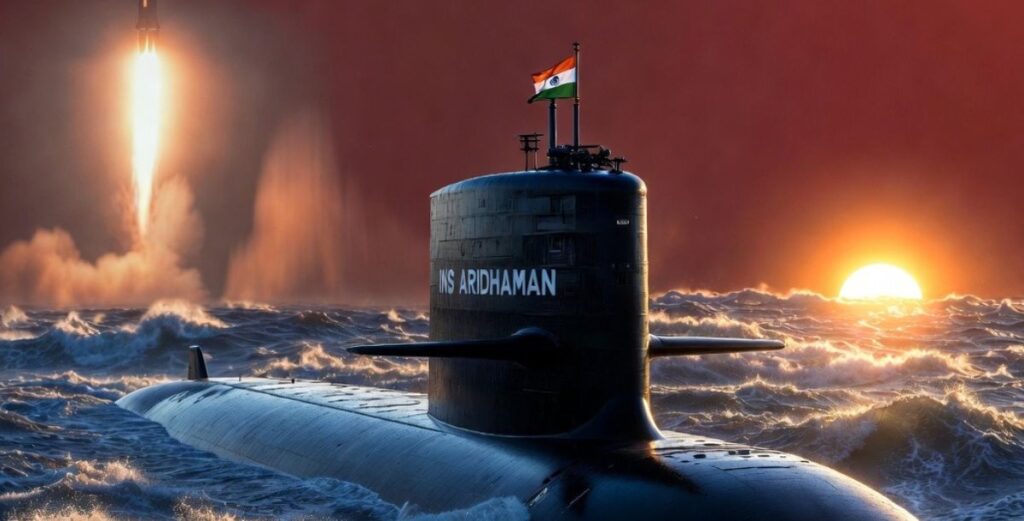
INS Aridhaman: India’s Silent Nuclear Guardian Just Got Stronger
In a low-key but landmark move on April 3, 2026, India commissioned INS Aridhaman its third indigenous nuclear-powered ballistic missile submarine (SSBN) into the Indian Navy at Visakhapatnam. Defence Minister Rajnath Singh presided over the quiet ceremony, later posting on X: “Shabd nahi, shakti hai ‘Aridhaman’” (It’s not words, it’s power, Aridhaman).
This is no ordinary addition to the fleet. INS Aridhaman marks a significant upgrade in India’s underwater nuclear deterrence, pushing the country closer to a robust, credible second-strike capability. At a time when Indo-Pacific security dynamics are tense, this 7,000-tonne stealth powerhouse reinforces India’s position as the only nation outside the five permanent UN Security Council members with continuous nuclear-armed submarine patrol potential.
Key Highlights
- India’s third Arihant-class nuclear-powered ballistic missile submarine now operational
- Nearly 90% indigenous content under Atmanirbhar Bharat initiative
- Nuclear reactor enables months-long submerged operations without surfacing
- Equipped with eight vertical launch tubes — double that of INS Arihant and INS Arighat
- Carries advanced K-15 and K-4 missiles; future-ready for K-5
- Strengthens India’s nuclear triad with reliable sea-based deterrent
What Makes INS Aridhaman a True Game-Changer
INS Aridhaman (S4) belongs to the Arihant-class but is a substantially improved variant. At approximately 7,000 tonnes displacement, it is larger and more capable than its predecessors INS Arihant (commissioned 2016) and INS Arighat (commissioned August 2024), both around 6,000 tonnes.
The extra size translates into greater weapon capacity, improved fuel storage, enhanced crew facilities, and superior stealth features. Powered by an indigenous 83 MW pressurised water reactor, the submarine can remain underwater for extended periods virtually unlimited range limited only by crew endurance and supplies. This “silent strength” is the hallmark of modern SSBNs: undetectable, mobile, and always ready.
In naval warfare, stealth is survival. INS Aridhaman’s advanced hull design, anechoic coatings, and quiet propulsion make it extremely difficult for adversaries to detect, giving India a decisive edge in strategic deterrence.
Missile Firepower: Doubling India’s Underwater Strike Potential
The real leap lies in INS Aridhaman’s missile configuration. It features eight vertical launch tubes (compared to four in earlier Arihant-class boats), allowing faster, more devastating salvo launches.
Missile Loadout:
- Up to 24 K-15 Sagarika missiles (range: 750–1,500 km)
- Or 8 K-4 ballistic missiles (range: ~3,500 km)
- Future upgrade path to K-5 missiles (range: ~6,000 km)
This doubled capacity significantly enhances India’s second-strike ability the assurance that even after a first strike on land or air assets, the nation can retaliate decisively from the depths. Experts note that the combination of reach, payload, and survivability makes INS Aridhaman a formidable pillar of India’s nuclear doctrine of “credible minimum deterrence.”
The induction was deliberately low-profile, in line with the strategic sensitivity of India’s SSBN fleet. Defence Minister Rajnath Singh’s cryptic social media post was the first public hint, followed by confirmations from multiple official and media sources.
On the same day, Rajnath Singh also commissioned INS Taragiri — the latest stealth frigate under Project 17A — at Visakhapatnam’s Naval Dockyard. The twin events underscore India’s accelerating push toward self-reliance in defence manufacturing. Both platforms were built domestically, aligning with the government’s vision of reducing import dependence and boosting indigenous innovation.
Why This Induction Matters in Today’s Geopolitical Landscape
1. A More Robust Nuclear Triad With three operational SSBNs, India now possesses a reliable sea-based nuclear deterrent. Land and air systems can be targeted; submarines, however, remain hidden and mobile, ensuring survivability and retaliation.
2. Strategic Depth in the Indo-Pacific Rising naval activities by China and evolving threats in the Indian Ocean Region demand stronger underwater presence. INS Aridhaman extends India’s reach and denial capabilities far beyond coastal waters.
3. Atmanirbhar Bharat in Action Nearly 90% indigenous content showcases India’s growing technological maturity from reactor design to missile integration — reducing vulnerability to supply chain disruptions.
4. Enhanced Credible Deterrence Longer-range missiles and greater firepower send a clear message: India can protect its national interests and maintain regional stability without escalation.
- Displacement: ~7,000 tonnes
- Length: Approx. 125–130 metres
- Propulsion: Indigenous 83 MW nuclear reactor
- Speed: Up to 45 km/h submerged
- Missile Tubes: 8 vertical launch tubes
- Indigenous Content: ~90%
- Missile Range: 750 km (K-15) to 3,500 km (K-4); up to 6,000 km (future K-5)
- Crew: Approx. 95 personnel
India’s Evolving Naval Strategy
Nuclear submarines are the crown jewels of any modern navy. They combine stealth, endurance, and precision strike in one platform. The Arihant-class programme, part of the Advanced Technology Vessel (ATV) project, reflects decades of quiet investment in indigenous nuclear propulsion and ballistic missile technology.
With INS Aridhaman operational, India moves closer to a fleet that can maintain continuous at-sea deterrence. Future plans include additional SSBNs and the separate Project-77 indigenous nuclear attack submarines (SSNs). Together, these assets will help secure sea lanes, protect economic interests, and project power across the Indian Ocean.
INS Aridhaman is not just a submarine it is a symbol of India’s emergence as a technologically advanced maritime power.
FAQs
1. What is INS Aridhaman?
It is India’s third indigenously built nuclear-powered ballistic missile submarine (SSBN) and the third vessel in the Arihant-class.
2. Why is the induction significant?
It doubles missile launch capacity, increases displacement and stealth, and strengthens the sea-based leg of India’s nuclear triad for assured second-strike capability.
3. What missiles does INS Aridhaman carry?
It can deploy 24 K-15 Sagarika (750–1,500 km) or 8 K-4 (3,500 km) missiles, with future integration of the longer-range K-5.
4. How does it differ from INS Arihant and INS Arighat?
Larger size (7,000 tonnes vs 6,000 tonnes), eight missile tubes (vs four), greater weapon loadout, and enhanced stealth and endurance.
5. Can it remain underwater for long periods?
Yes. Its nuclear reactor provides virtually unlimited submerged endurance, limited only by food and crew provisions.
Conclusion
The commissioning of INS Aridhaman is a quiet yet powerful milestone in India’s defence journey. Built with cutting-edge indigenous technology, it reflects years of dedicated research, engineering excellence, and strategic foresight.
In an era of complex global security challenges, this silent underwater guardian strengthens India’s ability to deter aggression and safeguard sovereignty. As the Indian Navy continues to modernise, INS Aridhaman stands as proof that India is not only ready to protect its interests but is steadily building the capability to shape the maritime future of the Indo-Pacific.

Leave a Reply