

writer by sanjoy gorh 04.04.2026 Time 1.10 PM Published
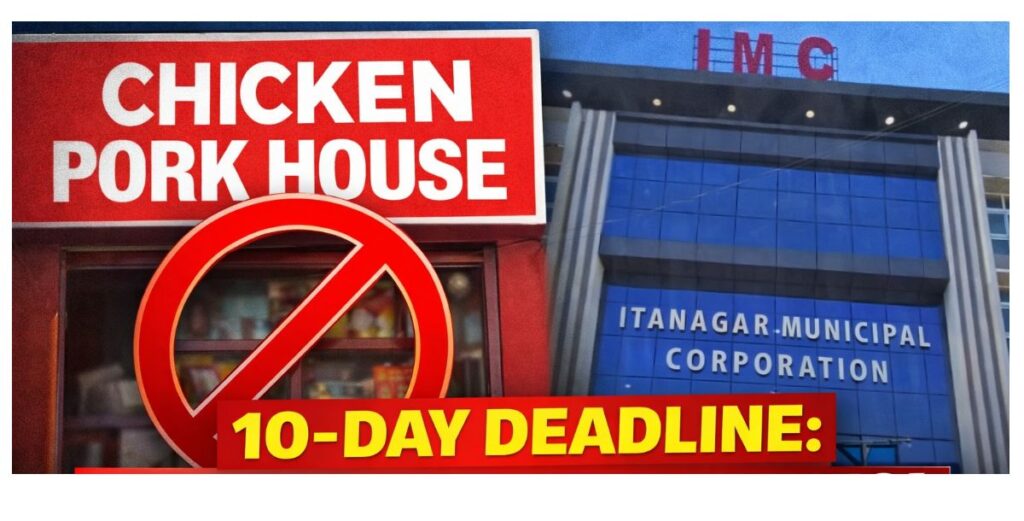
A fresh order from the Itanagar Municipal Corporation (IMC) has sent ripples across Arunachal Pradesh’s capital. On March 31, 2026, IMC Joint Commissioner Datum Gadi directed all hotels, restaurants, and eateries to remove direct references to specific meats—pork, chicken, beef, and mutton—from their business names, trade licences, signboards, banners, and promotional materials. Businesses have just 10 days to comply or face legal action under municipal bylaws. New trade licences with such names will no longer be approved.
The move, framed as promoting “public decency, animal welfare norms, and prevailing sensitivities,” has triggered intense debate. In a state where non-vegetarian food is not just everyday fare but deeply woven into tribal identity and culture, many view the directive as unnecessary interference in local food habits.
What Exactly Does the IMC Order Say?
The official directive invokes the Arunachal Pradesh Municipal Corporation Act, 2019. It states that names explicitly mentioning particular animal meats are “inappropriate and inconsistent with prevailing norms.” Existing establishments must switch to “general and appropriate business nomenclature.” The order does not ban the sale or serving of any meat—only its appearance in public branding.
Key points from the IMC notice:
- 10-day compliance deadline for updating signboards and licences.
- Inspections expected after the deadline.
- No new licences for meat-specific names.
- Non-compliance may lead to action under relevant municipal laws.
Restaurants can continue serving pork, chicken, beef, mutton, or any other dish. The change is strictly about visible naming and branding.
Why This Order Now? Official Reasoning vs Ground Reality
IMC officials argue the rule aligns signage with broader urban sensitivities and animal welfare concerns. However, in Arunachal Pradesh—a tribal-majority state where over 80% of the population follows non-vegetarian diets—the decision feels disconnected from daily life. Pork, in particular, holds immense cultural value among communities like the Nyishi, Adi, Apatani, and others. It features prominently in festivals, rituals, and home cooking. Beef and mutton are equally common staples.
Locals point out that clear names like “Pork Corner,” “Chicken Centre,” or “Beef House” help customers make informed choices quickly. One resident, Ranju Dodum, told reporters: “Such naming ensures non-beef eaters don’t accidentally walk into such places. In that case, authorities should also shut down KFC, and we will seek closure of ‘pure veg’ restaurants.”
The backlash has been swift and widespread on social media and in local discussions. Many call it “politically driven” and intrusive, especially since Arunachal Pradesh is ruled by the BJP and the IMC is under its control. Critics question whose “sensitivities” are being protected in a state with no major historical taboos around these meats.
Cultural Context: Food as Identity in Arunachal Pradesh
Arunachal’s diverse tribal communities celebrate a rich, meat-centric food culture. Pork is a favourite across tribes, often prepared in bamboo tubes or with local herbs. Mithun (a semi-domesticated bovine), chicken, fish, and beef form the backbone of traditional feasts and daily meals. Unlike many mainland Indian states, there is no widespread cultural or religious prohibition on beef or pork here.
Naming eateries after signature dishes has long been a practical tradition—simple, honest marketing that tells customers exactly what to expect. For small family-run joints in Itanagar and nearby areas, these names are more than branding; they are part of the local ecosystem.
Ground Reality: Heavy Impact on Small Businesses
For hundreds of small and medium eateries, this order is more than a paperwork exercise—it’s a sudden financial and operational burden. Changing signboards, updating licences, reprinting menus, and rebranding can cost thousands of rupees per outlet. In a competitive market where footfall depends on quick visibility, losing descriptive names could hurt business, especially for new visitors or tourists.
Business owners are worried about:
- Immediate costs of new signage and legal updates.
- Loss of brand recall built over years.
- Customer confusion during the transition.
- Potential dip in sales if neutral names feel generic.
Traders’ associations are seeking clarity on partial changes (e.g., keeping “non-veg” but removing specific meats) and possible extensions. As of now, the IMC has not issued detailed guidelines on acceptable names or penalties.
Broader Implications and Similar Trends
This is not the first time signage related to meat has sparked controversy in the Northeast. A 2022 order targeting “beef” names in parts of Arunachal was later withdrawn after public outcry. The current directive, however, is wider in scope, covering all major meats.
Across India, municipal bodies are increasingly regulating public aesthetics and “sensitivities” in urban spaces. Yet in a culturally diverse region like Arunachal, such top-down rules risk alienating the very people they govern. Policy experts note that successful regulations require stakeholder consultation—something many feel was missing here.
What Happens Next? The 10-Day Countdown
The deadline falls around April 10, 2026. In the coming days, expect:
- Many eateries rushing to repaint signboards with neutral names like “Tasty Bites,” “Capital Kitchen,” or “Hill View Restaurant.”
- Increased demand for signboard makers and licence consultants.
- Possible representations to the IMC for clearer guidelines or relaxations.
- Continued public debate on social media and in local forums.
If enforced strictly, the order could set a precedent for other towns in Arunachal. If faced with strong resistance, authorities may issue clarifications or even revise the timeline.
FAQs
1. Is non-vegetarian food banned in Itanagar?
No. The order only affects business names and signage. Restaurants can still serve any type of meat.
2. Which words are banned from names?
Direct references to pork, chicken, beef, mutton, or any specific animal meat.
3. What is the deadline?
10 days from March 31, 2026 (approximately April 10, 2026).
4. What happens if businesses don’t comply?
Legal action under the Arunachal Pradesh Municipal Corporation Act, 2019 and municipal bylaws. Exact penalties are yet to be detailed publicly.
5. Will new restaurants be affected?
Yes. New trade licences mentioning specific meats will not be approved.
6. Can partial changes work (e.g., “Non-Veg Corner”)?
The order is not fully clear yet. Businesses are awaiting detailed guidelines from the IMC.
Conclusion
The Itanagar meat name ban highlights the tension between regulatory intent and lived cultural reality. While the IMC aims to create a more “neutral” public space, critics argue it overlooks the unique food identity of Arunachal Pradesh’s tribal heartland.
In the end, this is about more than signboards. It raises bigger questions: Should governance dictate how local businesses communicate their offerings? How far should “public sensitivity” extend in a diverse society? And can policies that ignore ground realities truly serve the people?
Source of refrence
- Covers the full order details, 10-day deadline, Joint Commissioner Datum Gadi, and the Arunachal Pradesh Municipal Corporation Act, 2019.
- Excellent for backlash coverage, public reaction, and cultural context in Arunachal Pradesh.
- Itanagar Municipal Corporation Directs Eateries to Drop Specific
- Order issued by: IMC Joint Commissioner Datum Gadi
- Legal Provision: Arunachal Pradesh Municipal Corporation Act, 2019

Leave a Reply