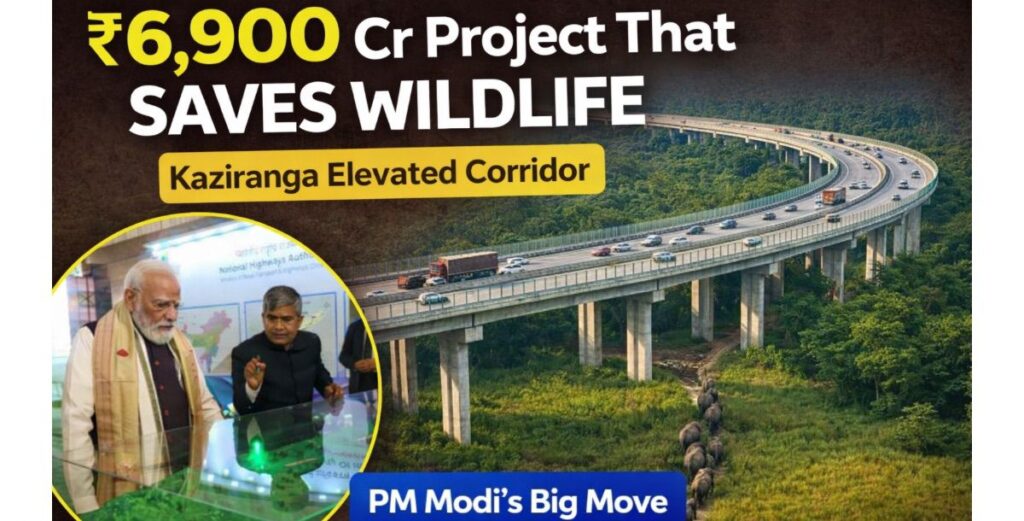
Kaziranga, Assam In a defining moment for Assam’s infrastructure journey, Prime Minister Narendra Modi on Sunday laid the foundation stone for the ₹6,900-crore Kaziranga Elevated Corridor Project, a landmark initiative designed to solve one of the state’s toughest challenges: expanding transport without endangering its natural heritage.
Stretching across nearly 86 kilometres, the project includes a 35-km elevated wildlife corridor through the Kaziranga landscape—an area globally recognised for its ecological sensitivity. Officials say the corridor is not just about faster roads, but about rethinking how development and conservation can coexist.
For a state witnessing rapid economic movement and rising traffic pressure, the project represents a shift from conventional highway building to environment-first infrastructure planning.
Why the Kaziranga Corridor Matters Now
Kaziranga National Park is home to the world’s largest population of one-horned rhinoceroses, along with elephants, swamp deer, and several endangered species. For years, increasing highway traffic along the park’s edge has posed a serious risk to wildlife movement and human safety.
The elevated corridor directly addresses this issue by allowing vehicles to pass above sensitive animal corridors, ensuring uninterrupted wildlife movement underneath. Conservationists and transport planners alike view this as a long-overdue solution to a problem that has claimed both animal and human lives.
Key Project Highlights at a Glance
- Total project cost: 6,900 crore
- Overall road development: 86 km
- Elevated wildlife corridor: 35 km
- Estimated travel time reduction: Up to 1 hour
- Primary districts covered: Nagaon, Karbi Anglong, Golaghat
- Core objective: Reduce roadkill and human–wildlife conflict
Transforming Travel Across Assam
Traffic congestion near Kaziranga has long been a bottleneck for commuters, tourists, and freight operators moving between Upper and Lower Assam. Once operational, the corridor is expected to:
- Ease chronic traffic jams near forest zones
- Improve long-distance passenger and cargo movement
- Strengthen tourism access to Upper Assam
- Reduce vehicle emissions caused by slow-moving traffic
Transport officials say the corridor will also divert heavy vehicles away from vulnerable forest stretches, making journeys safer, faster, and more predictable.
Wildlife Safety at the Centre of the Design
Unlike traditional highway expansion projects, the Kaziranga corridor has been engineered with wildlife movement as a core design principle.Key features include:
- Elevated road sections allowing animals to cross freely
- Controlled access points to limit human intrusion
- Continuous environmental monitoring during construction
Experts believe this model could set a national benchmark for road projects passing through ecologically sensitive regions.
Economic and Regional Impact
Beyond conservation, the corridor is expected to deliver a significant economic boost. Improved road connectivity will benefit:
- Local farmers transporting produce
- Small businesses and logistics operators
- Tourism-linked employment
- Regional trade corridors under India’s Act East policy
Lower logistics costs and faster freight movement could make central Assam more attractive for future investment.
Rail Connectivity Boost Alongside the Corridor
Complementing the road initiative, the Prime Minister also flagged off two new Amrit Bharat Express services:
- Dibrugarh–Gomti Nagar
- Kamakhya–Rohtak
These services aim to strengthen long-distance rail links between Assam and northern India, further integrating the state into the national transport network.
What Authorities Have Confirmed
- Construction will be executed in phases
- Central funding with national highway authority oversight
- Environmental safeguards will remain in force throughout
- Wildlife protection remains a non-negotiable priority
Officials have stressed that sustainability assessments will continue even after the project becomes operational
A Broader Message for India’s Infrastructure Future
As Assam emerges as a strategic gateway to Southeast Asia, infrastructure expansion is inevitable. The Kaziranga Elevated Corridor signals a policy shift one where economic ambition does not override ecological responsibility.
At a time when climate resilience and conservation are central to public discourse, the project stands as an example of how modern infrastructure can respect nature rather than replace it.
Frequently Asked Questions
1.Where is the Kaziranga Elevated Corridor located?
Near Kaziranga National Park, primarily across Nagaon and adjoining districts in Assam.
2.How much does the project cost?
₹6,900 crore.
3.Will wildlife be affected?
The elevated design is specifically intended to protect wildlife and reduce road accidents.
4.How long is the elevated section?
Approximately 35 kilometres.
5.Who benefits most from the project?
Daily commuters, tourists, transport operators, and local communities across Assam.
Conclusion
The Kaziranga Elevated Corridor is not merely a highway it is a statement of intent. By blending speed, safety, and sustainability, Assam is attempting something rare in large-scale infrastructure: growth without ecological compromise.
If executed as planned, the project could redefine how India builds in its most fragile landscapes.