
Published: January 27, 2026
Smartphones are no longer just communication tools they’re where we manage money, store personal data, and access work accounts. Yet most people still use them in public spaces where privacy is fragile. From metro rides to office elevators, shoulder surfing has quietly become a real digital risk.
Samsung’s newly teased Galaxy S26 Privacy Display directly targets this everyday problem, and that’s why it stands out. Instead of adding another software warning or accessory-based solution, Samsung is rethinking privacy at the display level itself a move that could change how future smartphones protect user data.
Samsung’s First Official Look at Built-In Display Privacy
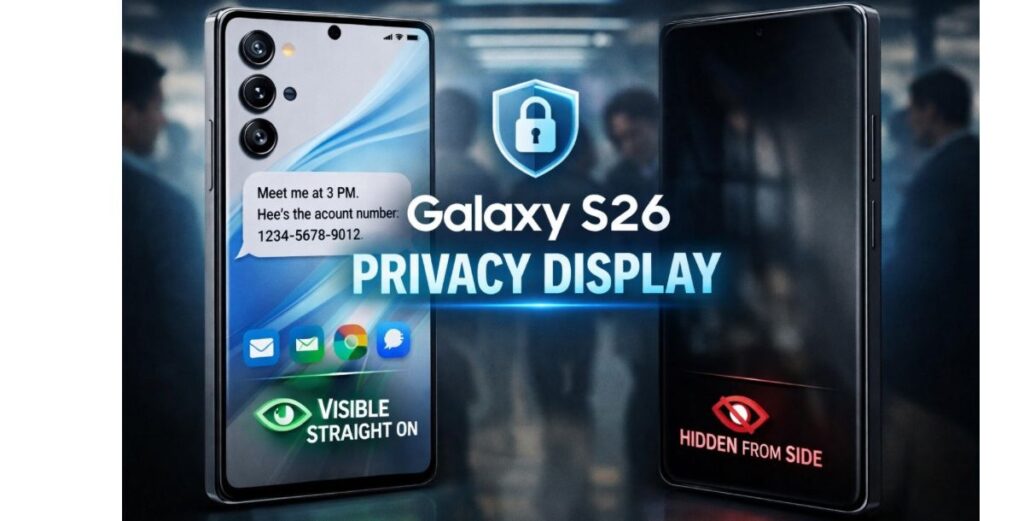
In its latest teaser video, Samsung demonstrates a screen that behaves very differently depending on how it’s viewed.When looked at straight-on, the display appears normal bright, sharp, and readable. But when viewed from an angle, the content fades or disappears entirely, making it nearly impossible for nearby people to read messages or notifications.
This is the first public look at what’s widely expected to be called the Galaxy S26 Privacy Display, even though Samsung hasn’t officially locked in the name yet. The feature appears to be baked into the screen itself, rather than relying on physical privacy protectors.
How This Is Different From Traditional Privacy Screens
Until now, privacy protection meant sticking a dark filter on your phone. While effective, those accessories often reduce brightness, distort colors, and make touch response worse.Samsung’s approach changes that equation.
The Galaxy S26 Privacy Display appears to combine specialized display hardware with intelligent software controls. That allows privacy to activate only when needed and only for the content that matters.
This shift from “always-on blocking” to “context-aware privacy” could make the feature far more practical for daily use.
Smarter Controls, Not a Blunt On/Off Switch
Samsung’s teaser hints that users won’t be forced into a single privacy mode. Instead, control is a major part of the design.Based on the information shared
- Users can enable privacy for specific apps
- Sensitive screens like logins or payment pages can be protected automatically
- Privacy intensity may be adjustable based on environment or task
That means the Galaxy S26 Privacy Display doesn’t interfere when you’re casually scrolling but activates instantly when you open something sensitive. This balance between protection and usability is where the feature could truly shine.
Five Years of Development Signals Serious Intent
Samsung says the technology behind this feature took more than five years to develop. That detail is important.
Display-level privacy isn’t something that can be rushed or added with a software patch. It requires coordination between panel engineering, display drivers, and the operating system.The long development timeline suggests Samsung sees the Galaxy S26 Privacy Display not as a gimmick, but as a foundational capability that could expand in future devices
Which Galaxy S26 Models Will Support It?
Samsung hasn’t confirmed model availability yet, but early indications suggest the feature will debut on the premium end.Current expectations
- Galaxy S26 Ultra: Almost certain to include Privacy Display
- Galaxy S26 Plus: Possible, but not guaranteed
- Galaxy S26 Standard: Still unclear
If Samsung limits the Galaxy S26 Privacy Display to the Ultra model initially, it would align with its strategy of testing advanced hardware features at the top tier before wider adoption
Why This Feature Could Influence the Entire Industry
Smartphone innovation has slowed in recent years, with many upgrades feeling incremental. Display-level privacy, however, addresses a real, universal concern.
If Samsung’s implementation proves reliable, competitors may be forced to follow. Similar privacy displays already exist in enterprise laptops, but smartphones used far more publicly arguably need them more.The Galaxy S26 Privacy Display could
- Reduce dependence on third-party privacy accessories
- Push privacy protection from software into hardware
- Set new expectations for flagship phone security
This is the kind of feature that quietly reshapes user behavior rather than grabbing attention with flashy specs.
What Users Should Watch Before Launch
Samsung is expected to unveil the Galaxy S26 lineup in late February 2026, with an Unpacked event likely around February 25.Key questions still remain
- Does the feature impact battery life?
- Can users fully disable it if they prefer?
- Will apps automatically detect and integrate with it?
The real-world success of the Galaxy S26 Privacy Display will depend on how seamlessly it works behind the scenes.
FAQ
1.What is the Galaxy S26 Privacy Display?
It’s a built-in screen feature that hides on-screen content from side angles to prevent shoulder surfing.
2.Is it always active?
No. Samsung suggests users can customize when and where it activates.
3.Does it replace privacy screen protectors?
Yes, it’s designed to eliminate the need for physical privacy filters.
4.Which model will get it first?
The Galaxy S26 Ultra is expected to be the first.
conclusion
Samsung isn’t pitching the Galaxy S26 Privacy Display as a flashy headline feature and that’s exactly why it matters. It solves a quiet but widespread problem in a thoughtful, engineering-driven way. Samsung delivers on what it’s teased, smartphone privacy may finally move beyond accessories and settings and into the screen itself.more realtive news visit our site




Leave a Reply