
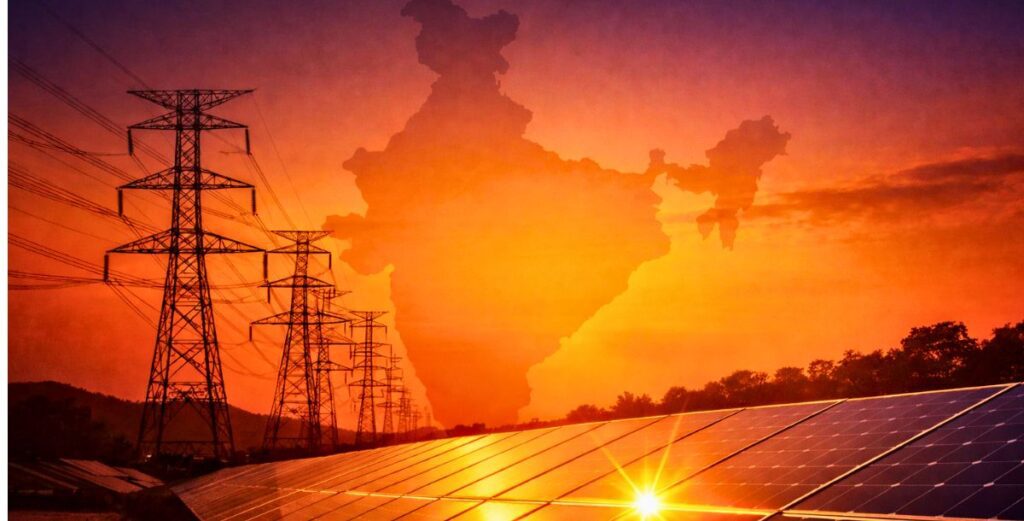
India’s power surplus era is no longer a projection it is unfolding in real time.For decades, electricity shortages defined India’s growth story. Industries faced outages. Homes dealt with power cuts. States battled deficits.
Today, the script has flipped. With record renewable additions and falling solar tariffs, India’s power surplus era is reshaping how the country thinks about energy, economics, and long-term strategy.And at the heart of this shift lies an unlikely case study: Assam.
India’s power surplus era has been driven by scale and speed. Over the past few years, the country has added more than 40 GW of renewable capacity annually one of the fastest expansions globally.Solar tariffs have fallen dramatically, touching ₹2–3 per unit in competitive bids. Compared to a decade ago, when solar power was considered expensive, the economics have transformed.
Under the leadership of Prime Minister Narendra Modi, power sector reform became central to infrastructure policy. Generation capacity expanded. Transmission corridors strengthened. Renewable integration accelerated.The result? India is no longer scrambling for electricity. It is learning how to manage abundance
The timing is critical.
According to the International Energy Agency, India’s urban growth is equivalent to adding a city the size of Los Angeles every year. That means rising demand from homes, transport, manufacturing, and especially digital infrastructure.Data centers, green hydrogen plants, electric vehicle charging networks all of them depend on stable, affordable electricity.
India’s power surplus era gives policymakers room to think strategically. Cheap, clean electricity is no longer just about comfort. It is becoming the backbone of industrial competitiveness.
The Hidden Structural Problem
But surplus does not automatically mean stability.Nearly 85–90% of power procured by state distribution companies (discoms) remains tied to long-term fossil-fuel power purchase agreements (PPAs). These legacy contracts limit flexibility.
Even when renewable energy becomes cheaper, discoms cannot easily switch. Financial stress and accumulated debt make fresh investments risky.
The 15th Finance Commission allowed additional state borrowing linked to measurable power reforms. The 16th Finance Commission went further, recommending structural governance changes and debt restructuring.India’s power surplus era, in other words, demands discipline not just generation capacity.
Nuclear Energy’s Strategic Comeback
As renewable capacity expands, grid stability becomes a concern. Solar and wind are intermittent. Storage solutions like batteries and pumped hydro are improving but remain costly.That’s where nuclear re-enters the conversation.
India currently has around 8 GW of installed nuclear capacity. The long-term target is 100 GW by 2047. Nuclear provides round-the-clock, carbon-free base-load power a crucial complement in India’s power surplus era.The shift signals a maturing energy strategy: diversify, stabilize, and future-proof.
Assam’s Reform Model: Fixing Distribution First
While national policy grabs headlines, energy reform is executed at the state level.In Assam, Chief Minister Himanta Biswa Sarma focused on distribution reform before chasing large-scale generation expansion.The results are tangible
- Distribution losses fell from 24% in 2021 to 15.4% in 2024–25
- 75% of consumers now use smart meters
- Billing efficiency improved sharply
- Collection efficiency reached 100%
- The state discom earned consecutive ‘A’ category ratings
- Domestic tariffs were reduced by ₹1 per unit
Power demand in Assam has grown at roughly 7% annually for five years. Rooftop solar adoption has cut daytime electricity bills for households.In India’s power surplus era, Assam demonstrates that efficiency not just capacity determines success.
The Northeast’s Hydropower Moment
The Brahmaputra basin holds massive hydropower potential. Neighboring Arunachal Pradesh alone has over 50 GW of largely untapped capacity.As new hydro projects come online, the Northeast could transition from deficit to structural surplus. Assam may evolve into a regional balancing hub, managing renewable variability across states.
India’s power surplus era may find its stability anchor in this region.The challenge now is managing growth wisely.Surplus electricity can either strengthen competitiveness or create financial strain. Cheap power without reform can deepen debt. Clean power without grid upgrades can trigger instability.
Assam’s experience offers a blueprint: invest in smart metering, enforce billing discipline, modernize governance, and align incentives.If replicated nationwide, India’s power surplus era could become a global case study in energy transition management.
FAQs
1. Is India facing electricity shortages today?
No. India is transitioning into a power surplus phase, driven by rapid renewable expansion.
2. Why are discom reforms crucial now?
Distribution companies manage billing and collections. Financial discipline ensures sustainability across the entire power chain.
3. How much renewable capacity is India adding annually?
More than 40 GW each year, among the highest growth rates globally.
4. What role will nuclear power play?
Nuclear provides stable, carbon-free base-load power to balance renewable variability.
5. Why is Assam being highlighted?
Assam reduced distribution losses, deployed smart meters widely, improved collections, and maintained financial stability.
Conclusion
India’s power surplus era marks a historic turning point.The country has moved beyond fighting scarcity. It is preparing to manage abundance.
But abundance requires responsibility. Financial reform, grid modernization, and disciplined governance will decide whether this moment strengthens India’s economic future.Assam’s lesson is clear: build strong foundations before celebrating growth.In the energy transition race, strategy matters as much as supply.






Leave a Reply