

writerby finbuzzindia 06.04.2026 time 5,15 Pm Published
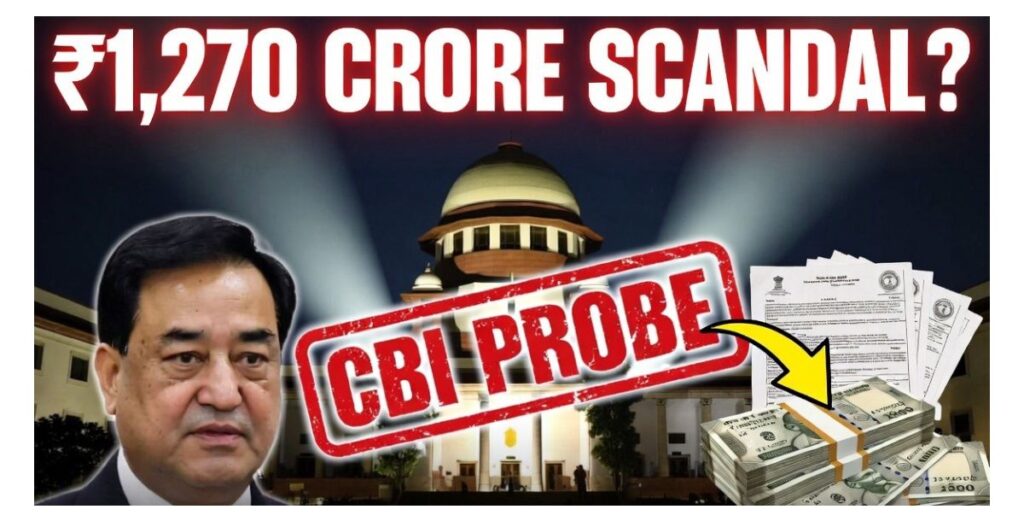
Supreme Court Orders CBI Probe in Arunachal ₹1,270 Cr Case
Key Highlights
* Supreme Court directs CBI to launch preliminary enquiry within 2 weeks
- ₹1,270 crore in public works contracts under scanner for alleged favouritism
- Firms linked to CM Pema Khandu, his wife, brother, and other family members
- Probe covers contracts from January 1, 2015 to December 31, 2025
- CBI must submit status report in 16 weeks; state government ordered to cooperate fully
Supreme Court Steps In: A Landmark Order for Transparency
In a decisive intervention that has sent ripples across the political landscape, the Supreme Court on April 6, 2026, ordered the Central Bureau of Investigation (CBI) to conduct a preliminary enquiry into alleged irregularities in the award of public works contracts in Arunachal Pradesh.
A bench headed by Justice Vikram Nath, along with Justices Sandeep Mehta and N.V. Anjaria, passed the order while hearing public interest litigations (PILs) filed by two Arunachal-based NGOs Save Mon Region Federation and Voluntary Arunachal Sena. Senior advocate Prashant Bhushan, representing the petitioners, had argued that the case “reeked of corruption” and involved clear conflict of interest.
The court emphasised that the CBI must register the preliminary enquiry (PE) within two weeks and proceed strictly in accordance with law. This is not an accusation of guilt but a serious first step to examine whether a full-fledged investigation is warranted and the apex court’s direct monitoring ensures credibility and independence.
Detailed Allegations
The core of the case revolves around claims that contracts worth approximately ₹1,270 crore were awarded to four firms allegedly linked to Chief Minister Pema Khandu’s immediate family members. These include his wife Tsering Dolma (firms: Brand Eagles and Frontier Associates), brother Tsering Tashi (RD Construction), and sister-in-law Nima Drema (Alliance Trading Company). Some references also mention step-mother Rinchin Drema.
Petitioners alleged that these companies received preferential treatment including tenders granted out of turn, at inflated rates, and in some cases without competitive bidding. Earlier affidavits filed by the state government (in response to Supreme Court directions) revealed that in Tawang district alone, these firms secured 146 contracts worth over ₹383 crore between 2012 and 2023, with dozens awarded without tenders.
The projects involved critical infrastructure: roads, bridges, drains, irrigation channels, power lines, retaining walls, and community facilities all funded by public money in a state that relies heavily on central assistance for development.
Importantly, the Supreme Court has not yet adjudicated on the merits. It has only directed an impartial probe to verify the claims.
Timeline Under Scanner: From PIL to CBI Order
The case has a clear paper trail:
- January 2024: PILs filed by the two NGOs seeking CBI or SIT probe.
- December 2025: Supreme Court directs Arunachal Pradesh government to file a comprehensive affidavit detailing all contracts from 2015–2025.
- February 17, 2026: Bench reserves order after petitioners highlight “remarkable coincidence” in contract awards.
- April 6, 2026: Final order directing CBI preliminary enquiry.
The court has explicitly asked the CBI to examine the award and execution of all public works, contracts, and work orders between January 1, 2015, and December 31, 2025 with liberty to probe beyond this period if required. The…state has been directed to preserve all records and extend full cooperation.
Public Money, Strategic State, and Governance Standards
Arunachal Pradesh is not just another state it is a strategically vital border region sharing a long international boundary with China. Billions of rupees are being pumped into infrastructure under schemes like the Vibrant Villages Programme and national highway projects to strengthen connectivity and security.
When public contracts of this magnitude are allegedly routed to a handful of family-linked firms, it raises fundamental questions about transparency, fair competition, and conflict-of-interest rules in government procurement. Taxpayer funds meant for development could be compromised, eroding public trust.
Legal experts note that a Supreme Court-monitored CBI probe carries immense weight. It minimises local political influence and sets a strong precedent for accountability in smaller states where family-run politics and business often overlap. At a time when citizens across India are demanding cleaner governance, this order reinforces the message that no one not even those in the highest offices is above the law.
Political Impact and Broader Ramifications
The controversy comes at a sensitive time for Arunachal’s BJP-led government. Chief Minister Pema Khandu, who has been in power since 2016, has focused on infrastructure and connectivity. Any adverse findings could dent his image and trigger political repercussions ahead of future elections.
Opposition parties have already begun questioning the “Na khaunga na khane doonga” narrative on corruption. For the ruling dispensation at the Centre, the order highlights the judiciary’s independent role in upholding probity in public life even in BJP-ruled states.
Key Facts & Data
- Total value under probe: ₹1,270 crore
- Period: 2015–2025 (10+ years)
- Investigating agency: CBI
- Bench: Justice Vikram Nath & others
- Enquiry deadline to start: Within 2 weeks
- Status report deadline: 16 weeks
What Happens Next?
1. Preliminary Enquiry Phase CBI will gather documents, verify firm ownership, examine tender processes, and check for any procedural violations or undue favour.
2. Status Report to Supreme Court Within 16 weeks, the agency will inform the court whether a full FIR and detailed investigation are needed.
3. Possible Outcomes If prima facie evidence of corruption or nepotism is found, a regular case may be registered. If not, the matter could be closed with the court’s approval.
The court has made it clear: the CBI must act independently and swiftly.
Expert Insight (Simple & Clear Explanation)
Legal observers describe a preliminary enquiry as a “low-threshold filter” — it is not a trial and does not presume guilt. Its purpose is simply to assess whether enough material exists to justify a full probe. However, when the Supreme Court itself orders it and keeps the matter on its radar, the signal is unmistakable: this is a serious issue that demands urgent, unbiased scrutiny.
Why This Story Is Exploding on Social Media and Search
Three elements make this case national news: massive public funds (₹1,270 crore), direct family links at the highest level of state power, and immediate Supreme Court intervention. In an era of heightened scrutiny over cronyism and governance standards, such stories resonate strongly with citizens who want development without compromise.
For Arunachal Pradesh a state racing to catch up on infrastructure while guarding its strategic frontiers the outcome of this probe could shape public perception for years.
FAQs
1. What exactly did the Supreme Court order?
It directed the CBI to start a preliminary enquiry into the award of public works contracts allegedly linked to CM Pema Khandu’s family.
2. Who filed the case and who is arguing it?
Two local NGOs — Save Mon Region Federation and Voluntary Arunachal Sena — through senior advocate Prashant Bhushan.
3. Has anyone been found guilty?
No. This is only the first stage of enquiry. No charges have been framed.
4. How much money is involved?
Contracts worth approximately ₹1,270 crore over a decade.
5. What is the next big milestone?
CBI’s status report to the Supreme Court in 16 weeks.
Conclusion
The Supreme Court’s order marks a significant victory for transparency and the rule of law. By entrusting the CBI with this probe under its direct oversight, the apex court has sent a powerful message: public contracts must serve the people, not private interests.
While the investigation is in its early stages, the coming months will be critical. Arunachal Pradesh and the rest of the country will be watching closely. In the end, this case is about more than one state or one leader. It is about restoring faith that taxpayer money is spent fairly, efficiently, and without fear or favour.
The focus now remains firmly on facts, due process, and accountability the very foundations of a strong democracy.
Sources of Reference
You can mention or link these major publications that reported the story on April 6, 2026:

Leave a Reply