
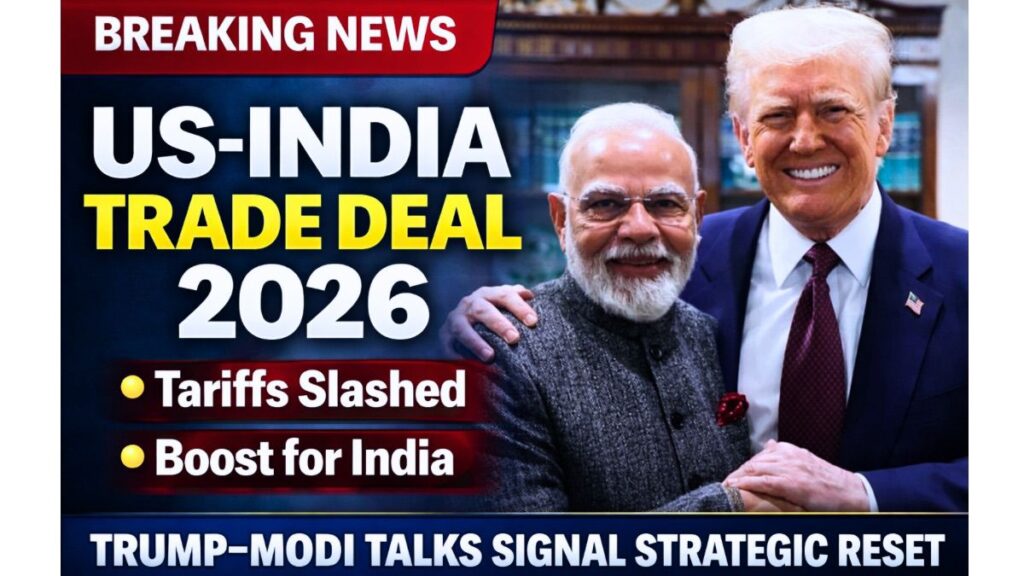
The US-India Trade Deal 2026 has moved sharply into focus after a surprise announcement by former US President Donald Trump, who revealed a reduction in tariffs on Indian goods entering the American market. At a moment when global trade is slowing and supply chains are being reshaped, even a single policy signal between two major economies can ripple far beyond borders.
For India, the timing is critical. Exports are under pressure, manufacturing ambitions are rising, and geopolitical choices especially around energy are being watched closely. For the United States, strengthening trade ties with India fits into a broader effort to diversify economic partnerships in an uncertain world.
According to Trump’s statement, the US will lower tariffs on Indian exports from 25% to 18%. While the percentage drop may seem modest, trade experts stress that such changes can significantly affect pricing, competitiveness, and long-term contracts.
The announcement followed a phone conversation between Trump and Prime Minister Narendra Modi, adding a political signal to what would otherwise be a technical trade adjustment. Trump publicly referred to Modi as a “close friend,” a phrase that quickly stood out in diplomatic and business circles.This framing has positioned the US-India Trade Deal 2026 as more than a tariff tweak it is being read as an attempt to reset a relationship that has faced friction in recent years.
India’s Response: A Message to Businesses and Voters
Prime Minister Modi welcomed the tariff reduction, calling it a positive development for Indian exporters and Made in India products. His response on social media emphasized opportunity, confidence, and global trust in Indian manufacturing.
For New Delhi, messaging matters. Presenting the US-India Trade Deal 2026 as a win for domestic industry helps reinforce the government’s broader narrative around self-reliance, exports, and global competitiveness especially at a time when economic confidence is closely tied to political credibility.
Trade Talks That Went Beyond Tariffs
Trump also claimed that discussions touched on wider geopolitical issues, including the war in Ukraine and global energy flows. He suggested that India may reduce purchases of Russian oil and explore increased energy imports from the US and Venezuela.Indian authorities have not officially confirmed these claims, and analysts urge caution. Energy sourcing is a sensitive issue for India, shaped by cost, availability, and strategic autonomy. Still, the fact that energy entered the conversation shows how the US-India Trade Deal 2026 sits within a much larger geopolitical context.
The US-India Trade Deal 2026 arrives after years of trade tension, including disputes over tariffs, market access, and energy purchases. In the past, higher US duties on Indian goods created uncertainty for exporters and strained negotiations.
A tariff rollback now suggests a willingness to soften positions on both sides. For the US, India represents a growing market and a strategic alternative in global supply chains. For India, access to the US market remains vital for export growth and investor confidence
Impact on Indian Exporters and MSMEs
Lower tariffs can immediately improve the price competitiveness of Indian goods in the US market. Sectors likely to benefit include engineering products, agriculture, textiles, and technology-linked manufacturing.
For MSMEs, which often operate on tight margins, the US-India Trade Deal 2026 could mean higher demand, better margins, and greater stability. Large exporters may also use the moment to renegotiate contracts and expand their footprint.
Economists note that even before formal agreements are signed, positive trade signals can influence investor sentiment and long-term planning.
Despite the optimism, key details remain unclear. There has been no joint statement outlining timelines, sector-specific concessions, or legal mechanisms. Without formal notifications, businesses cannot fully assess the real impact.
Experts caution that the success of the US-India Trade Deal 2026 will ultimately depend on implementation, not announcements. Clear policy documents and follow-through will determine whether exporters feel benefits quickly or gradually.
How This Fits Into Global Trade Shifts
Globally, countries are reassessing trade partnerships amid slowing growth and geopolitical uncertainty. The US-India economic relationship combines India’s scale and workforce with American capital and technology.
Any easing of barriers under the US-India Trade Deal 2026 strengthens this alignment and sends a reassuring signal to global investors looking for stability in emerging markets.
FAQs
1.What is the US-India Trade Deal 2026?
It refers to renewed trade engagement highlighted by a US announcement to reduce tariffs on Indian goods.
2.How much will tariffs be reduced?
Tariffs are expected to fall from 25% to 18%, according to the announcement.
3.Has India confirmed all aspects of the deal?
India has welcomed the tariff cut, but some energy-related claims remain unverified.
4.Which sectors stand to gain most?
Manufacturing, agriculture, textiles, and export-oriented MSMEs.
Conclusion
The US-India Trade Deal 2026 may still be short on formal detail, but its symbolic value is undeniable. It signals renewed engagement between two major economies at a time when global trade needs confidence and clarity.and more realetive news visit our site
For Indian exporters, it offers hope. For policymakers, it opens room for deeper negotiation. And for the world, it reinforces how trade diplomacy continues to shape economic power in uncertain times.




Leave a Reply