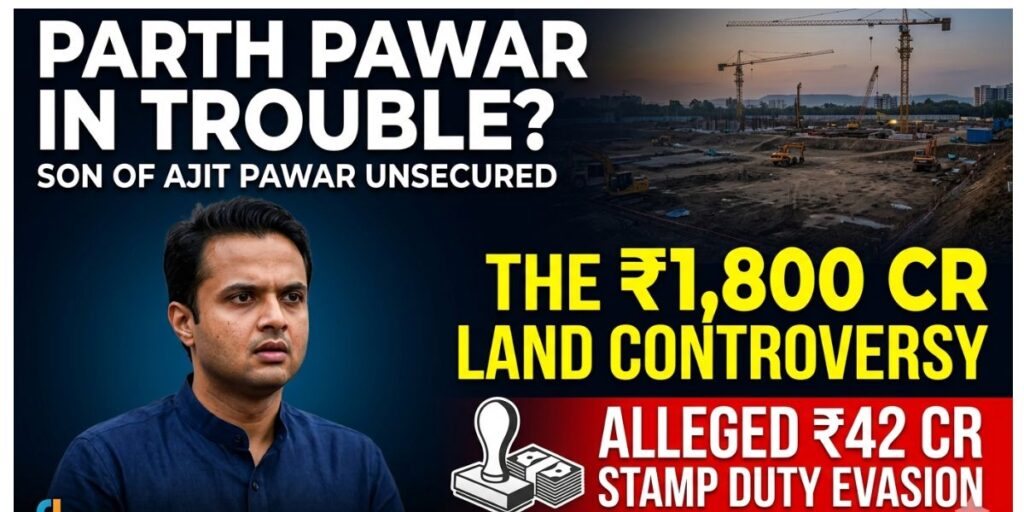
The intersection of politics,power,and real estate in Maharashtra has always been a subject of intense public scrutiny.However, the latest controversy involving Parth Pawar,son of Maharashtra Deputy Chief Minister Ajit Pawar, has sent shockwaves through the state’s political corridors. At the heart of the storm is a prime piece of land in Pune, allegations of a ₹1,800 crore undervaluation, and a ₹42 crore stamp duty discrepancy.
For a digital news platform like Finbuzzindia, understanding the layers of this case is essential to provide readers with a clear picture of how public assets and private interests often collide.
The Core of the Controversy: What Happened in Mundhwa?
The dispute centers on a massive 40-acre plot located in the Mundhwa area of Pune.Historically, this land was classified as government-owned,intended for public utility or specific agricultural purposes.
The controversy erupted when it was revealed that this land, which has a market valuation of approximately ₹1,800 crore, was allegedly transacted for a mere ₹300 crore. The primary entity involved in this acquisition is Amedia Holdings LLP, a company where Parth Pawar holds a significant position.
The Missing ₹42 Crore
Beyond the valuation gap,the most immediate legal “red flag” is the alleged evasion of stamp duty.Investigative reports suggest that the transaction was registered in a way that bypassed the actual market rate (Ready Reckoner rate),leading to a loss of ₹42 crore to the state exchequer in unpaid stamp duty and registration fees.
A Deep Dive into the Allegations
- Land Classification: The land in question is “Gairan” (grazing land) or government-vested land. Under Maharashtra state law, such land cannot be sold to private entities without a rigorous de-reservation process and cabinet-level approval.
- The Role of Revenue Officials: The controversy isn’t just about the Pawars. It highlights a potential systemic failure. A Sub-Registrar in Pune has already been suspended following an initial probe into how such a high-value transaction was allowed to proceed without verifying the government’s title over the land.
- The Valuation Gap: Why the ₹1,500 crore difference? Critics argue that by undervaluation, the parties involved not only saved on taxes but also obscured the true scale of the asset transfer.
Why Should the Common Man Care?
Behind every “Land Scam” headline is a story of public loss. When government land is diverted into private hands at a fraction of its cost:
- 1. Loss of Public Space: Land meant for schools, hospitals, or parks is permanently lost.
- 2. Economic Inequality: It reinforces the perception that the “elite” can bypass the rules that ordinary citizens must follow when buying a small apartment.
- 3. Revenue Loss: That ₹42 crore in missing stamp duty could have funded rural infrastructure or local healthcare in Maharashtra.
- 4. The Response from the Pawar Camp
a journalist must present both sides. Ajit Pawar has been vocal in his son’s defense.
The Defense Strategy
- Lack of Knowledge: Ajit Pawar stated that the company was unaware of the land’s “government-vested” status at the time of the deal.
- The Reversal: In a strategic move to mitigate political damage, the deal has reportedly been cancelled or the transaction has been sought to be reversed.
- Political Vendetta: As is common in Indian politics, the NCP (Ajit Pawar faction) has hinted that the timing of these leaks is linked to upcoming electoral cycles.
This case is not happening in a vacuum. It comes at a time when the Enforcement Directorate (ED) and other central agencies are actively monitoring financial transactions of high-profile political families in Maharashtra.
The “Parth Pawar Trouble” narrative adds pressure on the Mahayuti alliance, specifically because Ajit Pawar holds the Finance portfolio. The irony of the Finance Minister’s son being accused of revenue evasion is a point the opposition is unlikely to let go of easily.
Conclusion
For the readers of Finbuzzindia, this isn’t just about a politician’s son; it’s about the integrity of the land registry system and the accountability of those in power. As the high-level inquiry ordered by the state government proceeds, all eyes will be on Pune to see if the law treats everyone equally.