
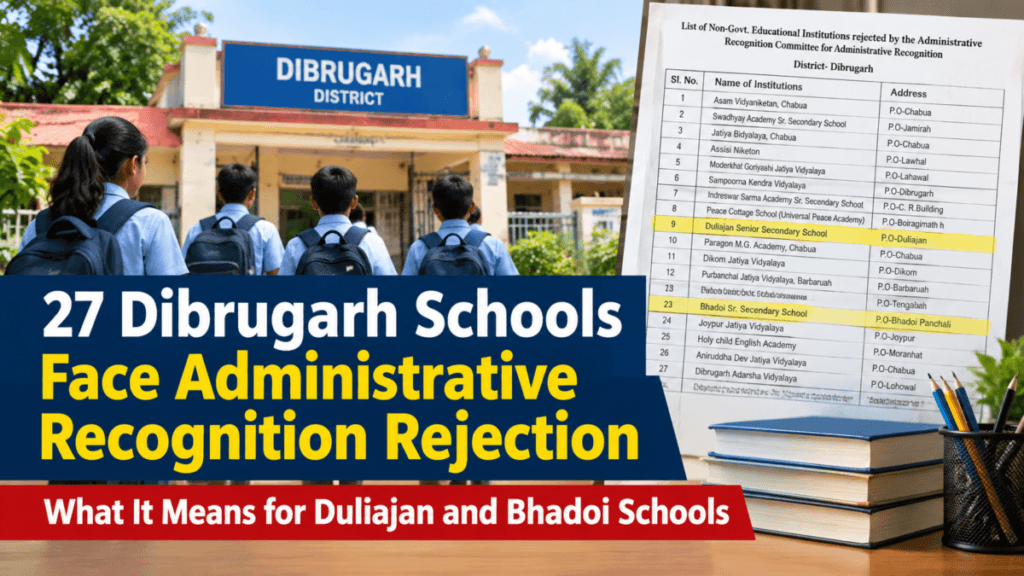
A list circulating in connection with the Assam Secondary Education Department has put the spotlight on 27 non-government educational institutions in Dibrugarh district. The list describes the institutions as having been rejected by the Administrative Recognition Committee for administrative recognition.
Two names highlighted in the circulated image are Duliajan Senior Secondary School and Bhadoi Sr. Secondary School.
However, there is an important point that students, parents and teachers should understand: rejection of administrative recognition should not automatically be described as permanent closure of a school. The legal process under Assam’s education law is more specific.
The available document image does not clearly show the order number, date or individual reasons for rejection. Therefore, those details should be confirmed from the original government order before drawing final conclusions.
What is administrative recognition in Assam?
Administrative recognition is a regulatory process for non-government educational institutions in Assam.
Under the Assam Non-Government Educational Institutions (Regulation and Management) Act, 2006, a school has to meet prescribed requirements before administrative recognition can be granted. The Director of Secondary Education examines the application and an Administrative Recognition Committee considers the relevant report and information.
For secondary and higher-secondary institutions, the committee includes representatives connected with the Directorate of Secondary Education, the Assam government, SEBA and AHSEC.
If the committee finds that an institution has not fulfilled requirements under the Act, rules or its undertaking, administrative recognition can be refused, with reasons recorded in writing. The Director then issues the order according to the committee’s recommendation.
Which Dibrugarh schools are highlighted?
The circulated list contains 27 serial numbers, although serial number 22 is not visible in the supplied image.
The two schools specifically highlighted are:
- Duliajan Senior Secondary School, P.O. Duliajan
- Bhadoi Sr. Secondary School, P.O. Bhadoi Panchali
The list also names institutions from areas including Chabua, Lahowal, Dibrugarh, Barbaruah, Tengakhat, Mancotta, Moranhat, Joypur and other parts of the district.
Because the image available for verification does not show the complete underlying government order, the missing serial number and the exact legal status of every institution should be verified before publication as a definitive government action.
Does this mean the schools have been permanently closed?
Not necessarily.
This is the most important clarification in the story.
Section 5 of the Assam Act provides a process for administrative recognition. If recognition is refused, the applicant can appeal before the State Government.
The Act separately contains provisions dealing with withdrawal of recognition and closure. Section 24 provides for closure in circumstances where a non-government institution fails to comply with the Act, rules or relevant orders, after the prescribed process and opportunity of being heard.
Therefore, a headline saying “27 schools permanently closed” would be too strong unless the original order specifically confirms closure.
The more accurate description is that the institutions are listed in connection with rejection of administrative recognition.
Why can administrative recognition be rejected?
Assam’s law contains several requirements for non-government schools.
These include requirements relating to:
- adequate land;
- classrooms and educational facilities;
- separate toilets for boys and girls;
- libraries and laboratories;
- suitable school buildings;
- health and hygiene;
- drinking water;
- adequate accommodation;
- student-teacher requirements;
- inspection and record keeping;
- safety arrangements;
- fire-safety measures;
- disaster-management preparedness;
- building-safety certification; and
- other prescribed requirements.
For example, the amended requirements provide specific land standards for high schools, higher-secondary schools and senior-secondary schools, depending on whether the institution is located in a rural area or an urban/local-body area.
But the circulated image does not establish which particular requirement was allegedly not fulfilled by Duliajan Senior Secondary School, Bhadoi Senior Secondary School or the other institutions.
It would therefore be misleading to claim that the schools were rejected specifically because of land, fire safety, toilets or any other single issue without the individual order.
What about students studying in these schools?
Parents and students should not panic solely because of the circulated graphic.
The exact consequences depend on the actual government order and the current recognition/registration status of the individual institution.
Another important provision of the Assam Act concerns transfer certificates. The Act states that transfer certificates issued by institutions that have not received administrative recognition are not to be countersigned by the concerned Education Department authority.
This demonstrates why administrative recognition is important for a school’s regulatory status.
At the same time, the Act separately addresses academic recognition by bodies such as SEBA and AHSEC. Section 9 makes clear that administrative recognition under the Act does not itself determine academic recognition by the relevant Board or Council.
Duliajan Senior Secondary School: What is confirmed?
The supplied document specifically highlights Duliajan Senior Secondary School at P.O. Duliajan.
However, the available image does not provide the individual reason for the rejection.
Therefore, at this stage, the safest conclusion is:
Duliajan Senior Secondary School appears in the circulated list as an institution for which administrative recognition was rejected.
It should not be reported as permanently shut down unless the original Directorate order confirms that status.
Bhadoi Senior Secondary School: An important distinction
Bhadoi Sr. Secondary School is also highlighted in the document.
Its appearance on an administrative-recognition rejection list should not automatically be interpreted as meaning that the institution has never had any academic recognition.
This distinction is important because administrative recognition and academic recognition are governed through different processes. The Assam Act itself specifically separates the two.
Consequently, anyone reporting the present status of Bhadoi Senior Secondary School should verify both:
- its administrative-recognition status; and
- its current academic/board recognition status.
Can a school appeal the decision?
Yes.
Under Section 5 of the Assam Non-Government Educational Institutions Act, an applicant whose administrative recognition is refused can appeal before the State Government.
The amended Act also provides an appeal mechanism against orders of the Director, subject to the prescribed time period.
This means the status shown in one order may not necessarily represent the final position if the institution subsequently appeals or obtains another order.
What should parents check?
Parents whose children attend any of the institutions named in the list should avoid relying only on social-media graphics.
They should check:
1. The original government order
Look for the order number and date issued by the Directorate of Secondary Education, Assam.
2. The school’s current recognition status
Ask the school management for its latest administrative-recognition or registration documents.
3. Board affiliation/recognition
Check the relevant SEBA/AHSEC or other applicable board records.
4. Any appeal or subsequent government order
A later decision could change the institution’s status.
5. Instructions from the district education authorities
These can clarify what happens to students if any institution is ultimately required to stop operating.
The Government of India’s National Government Services Portal also currently lists an online service for institutions to apply for administrative recognition under Sections 5 and 6 through the Directorate of Secondary Education, Assam. The service was updated on April 30, 2026.
Why this development matters for Dibrugarh
The issue is significant because non-government schools play an important role in providing education across Dibrugarh district.
Administrative recognition is not simply a paperwork exercise. It is connected with whether institutions meet regulatory standards relating to infrastructure, safety, sanitation, educational facilities and management.
The Assam framework also gives authorities powers to inspect institutions and require compliance with prescribed conditions.
At the same time, reporting must distinguish between rejection of administrative recognition, withdrawal of recognition and actual closure.
These terms should not be treated as interchangeable.
Bottom line
A circulated list identifies 27 non-government educational institutions in Dibrugarh district in connection with rejection of administrative recognition, with Duliajan Senior Secondary School and Bhadoi Sr. Secondary School prominently highlighted.
The Assam law confirms that administrative recognition is a formal regulatory process and that recognition can be refused when required conditions are not fulfilled. It also provides an appeal mechanism.