
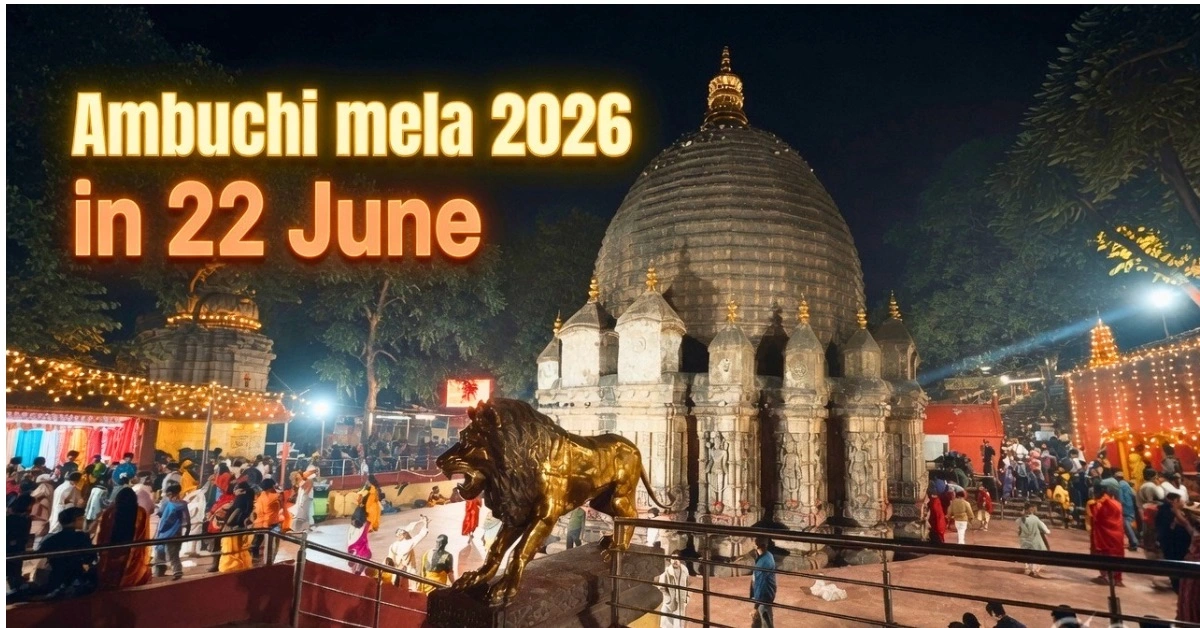
Guwahati, Assam | June 2026 — Every year, the ancient Nilachal Hills of Guwahati transform into one of the most extraordinary spiritual spectacles on earth. Lakhs of devotees, Tantric sadhus, and pilgrims from across India and beyond converge at the sacred Kamakhya Temple for the Ambubachi Mela — a festival unlike any other in the Hindu calendar. In 2026, the mela runs from the night of June 22 to sunrise on June 26, and preparations are already in full swing.
What Is Ambubachi Mela?
Ambubachi Mela is the annual festival celebrated at the Kamakhya Temple on Nilachal Hill, Guwahati, Assam — one of the 51 Shakti Peethas and the most powerful Tantric shrine in India. The word “Ambu” means water and “Bachi” means flowing, and the festival is observed during the monsoon month of Ashara, according to the Assamese calendar. Greenlimon Holidays
At its spiritual core, the mela celebrates something that most traditions have historically considered taboo: the annual menstruation of Goddess Kamakhya. Here, however, it is honoured as a profound symbol of divine fertility, cosmic creativity, and the sacred power of womanhood. Unlike most Hindu festivals that celebrate divine power, Ambubachi uniquely honours divine fertility — treating menstruation as the source of creation rather than something to be hidden. StayVista
This radical, liberating philosophy is exactly why the festival draws not just ordinary pilgrims, but Tantric practitioners, ascetics, and spiritual seekers from across the subcontinent and the world.
Ambubachi Mela 2026: Confirmed Dates and Daily Schedule
Ambubachi Mela 2026 begins on the night of June 22 and concludes at sunrise on June 26. The festival falls on the seventh day of the Assamese month of Ahaar, when devotees believe Goddess Kamakhya enters her annual menstrual phase. StayVista
Here is the day-by-day breakdown:
- June 22 (Night): The Pravritti rituals begin. Temple priests perform commencement ceremonies and the sanctum sanctorum is closed to all devotees.
- June 23–25: The temple doors remain completely shut as Goddess Kamakhya is believed to be menstruating during this three-day period. Sadhus and pilgrims gather on the hillside for meditation, chanting, and Tantric rituals. Tantra Sadhana Blog
- June 26 (Sunrise): The Nivritti (conclusion) rituals are performed by temple priests. The doors reopen to massive crowds. Devotees receive darshan, blessings, and the sacred prasad — a piece of red cloth considered highly auspicious.
“Mahakumbh of the East” — The Scale of the Festival
Often referred to as the “Mahakumbh of the East,” the festival attracts followers from across Assam, West Bengal, Bihar, Uttar Pradesh, and several other parts of the country every year. The Nilachal Hills fill with red-robed Naga sadhus, Tantric ascetics, wandering saints, and ordinary families — all sharing the same sacred ground. Goodreturns
Several sadhus have already started arriving at the Kamakhya Dham ahead of the mela, and temple authorities expect a significantly larger gathering of ascetics and devotees this year. Pratidin Time
The scale is staggering. Temporary camps, open-air discourses, devotional music, and Tantric rituals run continuously through the four days, creating an atmosphere that pilgrims describe as electric, transcendent, and deeply moving.
2026 Preparations: New Routes, Tight Security, and Major Upgrades
Authorities are treating Ambubachi Mela 2026 as a major national event. This year, an additional access route from the Pandu side will be opened for devotees alongside the main approach road via the Nursery route, aimed at easing crowd movement. Pratidin Time
Temple authorities and the district administration have also kicked off security preparations, including installing advanced CCTV cameras across the temple premises. Times Kerala
Arrangements being put in place include:
- Accommodation — Temporary shelters and dharamshalas for lakhs of pilgrims
- Drinking water — Large-scale water supply stations across the hill
- Medical services — On-site health camps and ambulance access
- Sanitation — Mobile and temporary toilet facilities across the premises
- Crowd management — Dedicated entry and exit lanes, security personnel deployment
- Traffic control — Multi-point traffic regulation around Nilachal Hill
Economic and Cultural Impact on Assam
Ambubachi Mela is far more than a religious event — it is one of Assam’s most significant cultural and economic occasions of the year. When lakhs of pilgrims pour into Guwahati over four days, the city’s economy gets a powerful seasonal boost.
Local vendors selling flowers, coconuts, sindoor, red cloth prasad, and religious items see their busiest days of the year. Hotels, guesthouses, auto-rickshaw drivers, food stall operators, and transport services all benefit directly. The festival positions Guwahati — and Assam as a whole — on the national and international spiritual tourism map.
For the local community, Ambubachi is as much a celebration of Assamese identity and pride as it is an act of devotion.
Why Ambubachi Mela Is Unique in the World
No festival in India — or the world — quite mirrors the philosophy of Ambubachi Mela. At a time when conversations around women’s health and menstruation remain sensitive in many societies, this ancient festival has celebrated it as sacred for centuries. Ambubachi Mela reminds us that menstruation is sacred, fertility is divine, and rest is part of cosmic rhythm.
The Nilachal Hills are described across classical Tantric literature and local oral traditions as possessing a distinct reddish hue, profoundly linked to the cosmic principle of fertility and the creative life-force of the Divine Mother. Tantra Sadhana Blog
For anyone seeking a spiritual experience of genuine depth — one rooted in thousands of years of tradition — the Kamakhya Temple during Ambubachi Mela 2026 stands in a category entirely its own.
Plan early. Book accommodation in advance. Arrive with an open heart.