
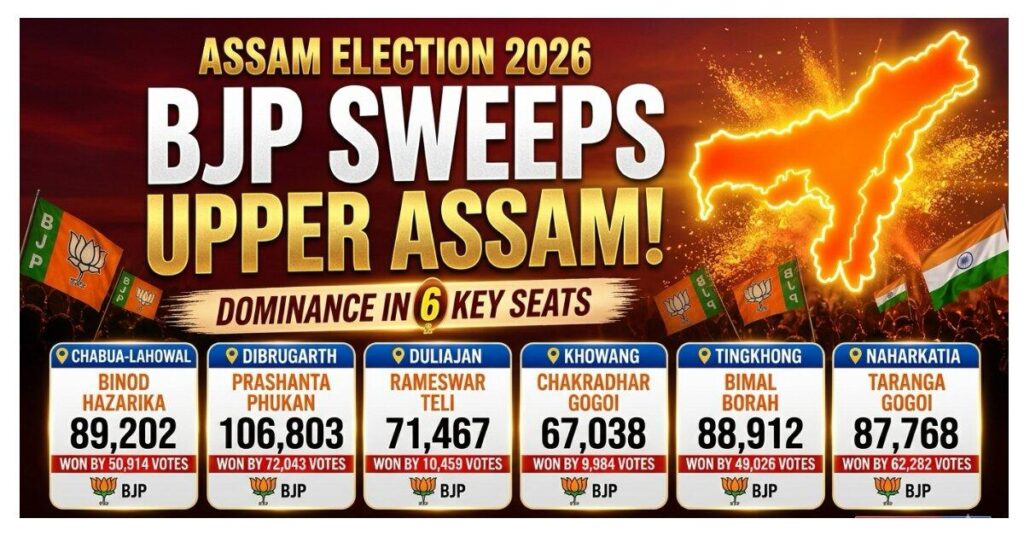
The 2026 Assam Assembly Election has delivered a decisive political message from Upper Assam, where the Bharatiya Janata Party (BJP) secured commanding victories across multiple constituencies. The results highlight a strong voter mandate in favor of the ruling party, with significant winning margins in six major seats: Chabua-Lahowal, Dibrugarh, Duliajan, Khowang, Tingkhong, and Naharkatia.
This outcome not only reinforces BJP’s dominance in Upper Assam but also reflects evolving political preferences among voters in the region.
Dominance in Chabua-Lahowal
In the Chabua-Lahowal constituency, Binod Hazarika emerged as a clear winner. He secured 89,202 votes, defeating Pranjal Ghatowar of the Indian National Congress (INC), who received 38,288 votes.
The margin of victory stood at a remarkable 50,914 votes, indicating strong grassroots support for BJP in this constituency. Analysts suggest that local development initiatives and organizational strength played a crucial role in this landslide win.
Massive Victory in Dibrugarh
The Dibrugarh seat saw one of the biggest victories of the election. Prashanta Phukan of BJP secured an impressive 106,803 votes, defeating Mainak Patra of the Assam Jatiya Parishad (AJP), who managed 34,760 votes.
With a winning margin of 72,043 votes, this result clearly demonstrates BJP’s strong urban and semi-urban appeal in Dibrugarh, a key political and economic hub of Assam.
Tight Contest in Duliajan
Unlike other constituencies, Duliajan witnessed a relatively closer contest. Rameswar Teli from BJP won with 71,467 votes, while Dhruba Gogoi of INC secured 61,008 votes.
The victory margin was 10,459 votes, significantly narrower compared to other seats. Despite the tighter race, BJP managed to retain its hold, suggesting that while opposition presence exists, it is not yet strong enough to overturn the ruling party’s advantage.
Strong Performance in Khowang
In Khowang, BJP candidate Chakradhar Gogoi secured 67,038 votes, defeating Lurinjyoti Gogoi of AJP, who received 57,054 votes.
The victory margin of 9,984 votes reflects a competitive contest but ultimately underscores BJP’s consistent voter base in the region.
Landslide Win in Tingkhong
The Tingkhong constituency delivered another decisive verdict in favor of BJP. Bimal Borah won with 88,912 votes, defeating Bipul Gogoi of INC, who received 39,886 votes.
The margin of 49,026 votes indicates a strong consolidation of support for BJP, likely driven by local governance performance and effective campaign strategies.
Overwhelming Support in Naharkatia
Naharkatia, Taranga Gogoi secured a commanding victory with 87,768 votes. His closest rival, Pranati Phukan from INC, received 25,486 votes.The winning margin of 62,282 votes further strengthens BJP’s dominance in Upper Assam and reflects a clear voter preference for continuity in leadership.
Key Trends and Insights
1. Strong BJP Wave in Upper Assam
Across all six constituencies, BJP candidates secured comfortable to massive victories. This suggests a strong regional wave favoring the party, possibly influenced by development projects, infrastructure growth, and political stability.
2. Weak Opposition Fragmentation
The opposition vote appears divided between INC and AJP in several constituencies. This split likely contributed to BJP’s large victory margins, especially in Dibrugarh and Naharkatia.
3. Margin Variations Reflect Local Dynamics
While seats like Dibrugarh and Naharkatia saw overwhelming wins, constituencies such as Duliajan and Khowang had comparatively narrower margins. This indicates that local factors and candidate popularity still play a significant role.
4. Urban vs Semi-Urban Voting Patterns
Urban centers like Dibrugarh showed exceptionally high margins, pointing toward strong urban support for BJP. Semi-urban and rural areas also backed the party, but with slightly more competitive contests.
Political Implications
The results from Upper Assam are likely to have a broader impact on state politics. BJP’s sweeping victories strengthen its position ahead of future elections and reinforce its governance narrative.
For the opposition, these results highlight the urgent need for strategic unity and stronger grassroots engagement. Without consolidation, competing parties risk further erosion of their voter base.
Conclusion
The 2026 Assam Assembly Election results from Upper Assam clearly underline BJP’s dominant position in the region. With decisive wins across all six major constituencies, the party has once again proven its electoral strength and organizational depth.
From massive margins in Dibrugarh and Naharkatia to competitive victories in Duliajan and Khowang, the overall picture remains consistent: voters in Upper Assam have placed strong trust in BJP leadership.
As Assam moves forward, these results will shape the political landscape and influence governance priorities in the coming years. The message from Upper Assam is loud and clear—stability, development, and continuity remain key factors driving voter decisions.
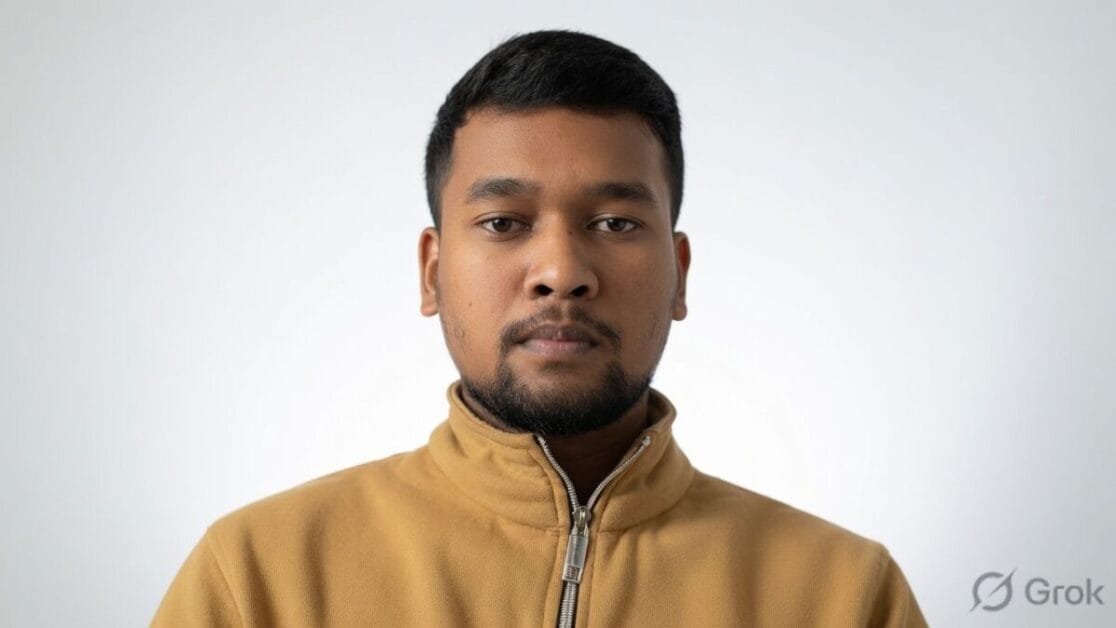
Sanjoy Gorh – Founder & Editor, FinBuzz India
Sanjoy Gorh is the founder and editor of FinBuzz India (finbuzzindia.com), an independent digital news platform delivering accurate, clear, and timely news to readers across Assam, Northeast India, and beyond.
Driven by a deep passion for digital journalism, Sanjoy launched FinBuzz India with a clear mission: to give grassroots stories the attention they deserve and bring local voices to a national stage. Hailing from Assam, he brings hands-on, on-ground experience in news reporting, content creation, and digital media management.
His editorial focus spans Assam local news, Northeast India developments, government schemes and exam updates, finance, technology and AI, business and startups, sports, and national affairs — always with an emphasis on making important topics simple, relevant, and accessible to everyday readers.
At the heart of his work lies an unwavering commitment to factual, unbiased reporting. Sanjoy believes journalism’s greatest responsibility is building reader trust, and every story published on FinBuzz India reflects that belief.
With a vision to grow FinBuzz India into the most trusted digital news voice of Northeast India, Sanjoy continues to raise the bar, one story at a time.
Connect with Sanjoy: [Twitter/Xhttps://x.com/amolgorh84648?s=11 ] | [https://www.linkedin.com/in/finbuzz-india-6b0a00307?utm_source=share_via&utm_content=profile&utm_medium=member_ios]