
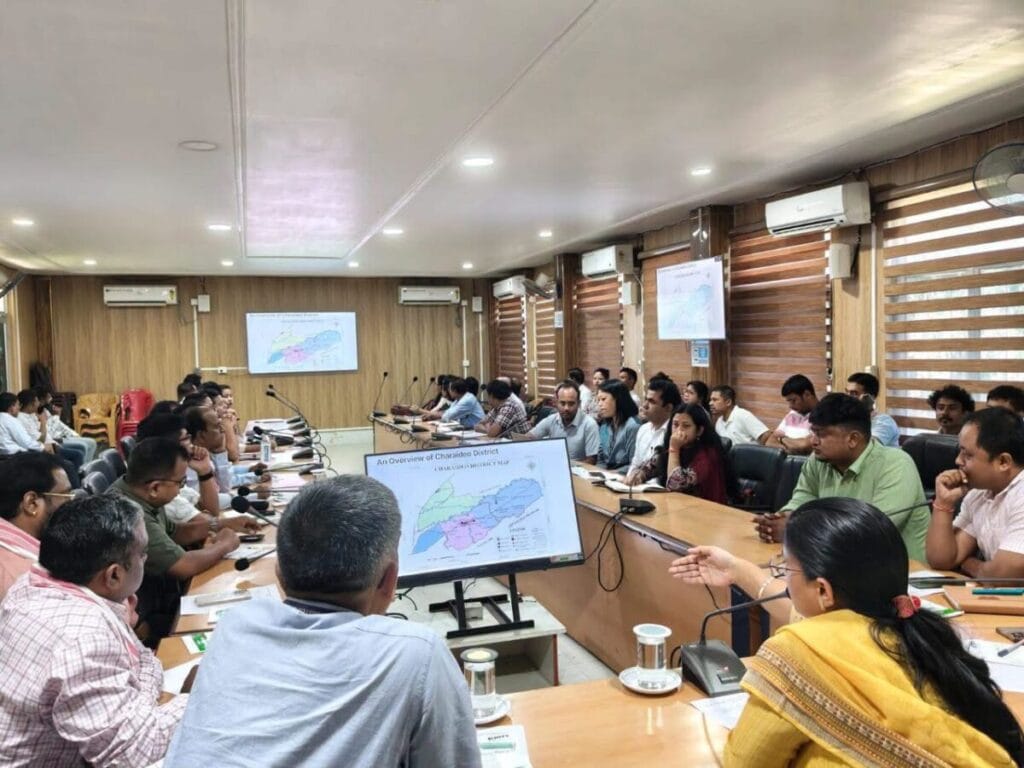
Charaideo, Assam, September 22, 2026: A National Disaster Management Authority (NDMA)-led investigation team visited Assam’s Charaideo district on September 21 to assess the impact of the state’s recent flood situation, according to a post shared by the Assam State Disaster Management Authority (ASDMA). The team held discussions with the district administration before conducting field visits to flood-affected areas of Sonari and Mahmora.
The visit comes as Assam continues its assessment of damage caused by the 2026 floods, with Charaideo among the four districts identified by the state government for detailed damage assessment and rehabilitation-related surveys.
NDMA-led team holds meeting with Charaideo administration
During its visit on September 21, the team met officials of the Charaideo district administration at the Deputy Commissioner’s Conference Hall.
The meeting focused on the flood situation and the assessment of damage on the ground. Officials from ASDMA accompanied the visiting team and helped facilitate the field investigation.
According to the information shared by ASDMA, the assessment was not limited to an administrative meeting. The team subsequently travelled to flood-affected locations in Sonari and Mahmora to examine the situation directly.
The September 21 visit is part of the continuing assessment process following the severe flooding experienced across several Upper Assam districts earlier this year.
Sonari and Mahmora among areas affected by flooding
Sonari and Mahmora have remained important locations in Charaideo’s flood response.
The district’s disaster-management documents identify flood as one of its recurring hazards, with the potential to affect houses, livestock, crops and infrastructure. The official Charaideo District Disaster Management Plan specifically lists vulnerable areas within both the Sonari and Mahmora revenue circles.
The district administration has also maintained a flood contingency plan covering vulnerable communities and locations, including areas around Sonari and Mahmora.
This background makes the latest field assessment significant because ground-level inspections can provide authorities with information about the actual condition of affected communities and infrastructure.
Charaideo among four districts under detailed damage assessment
The latest NDMA-led visit comes against the backdrop of a wider Assam government assessment programme.
On September 15, Assam Chief Minister Himanta Biswa Sarma reviewed the progress of the flood-damage assessment being conducted in Charaideo, Sivasagar, Jorhat and Golaghat.
The first phase of the assessment and survey for rehabilitation assistance had already been completed in these districts. The state government subsequently directed officials to complete the second phase by October 10, 2026, with emphasis on accurate and transparent beneficiary identification.
Officials were also instructed to carry out re-verification or fresh assessments wherever required so that eligible flood-affected families were not left out of the process.
The continuing assessment means that the September field visit in Charaideo forms part of a broader effort to document the consequences of the floods and establish the extent of damage.
Earlier central assessment team also visited Charaideo
The latest visit follows an earlier assessment by an Inter-Ministerial Central Team (IMCT) in July.
The six-member central team visited some of Assam’s worst flood-affected districts, including Charaideo, Sivasagar, Jorhat and Golaghat. During its visit, the team examined flood damage and later participated in a review meeting with senior Assam government officials in Dispur.
At that time, Assam officials told the central team that the flooding had been particularly severe in Charaideo and Sivasagar. They also highlighted challenges associated with relief and rehabilitation.
The state government informed the central team that damage assessment was still continuing and that a final flood memorandum would be prepared after the flood season. Officials also sought relaxation of certain SDRF assistance norms for affected people.
July floods caused major disruption in Upper Assam
The 2026 flood episode had a significant impact on several districts of Upper Assam.
In July, Charaideo was among the districts affected by flooding that prompted large-scale rescue and relief operations. The situation led to the deployment of multiple agencies, including the NDRF, SDRF and Indian Army in affected parts of the region.
Akashvani reported on July 27 that more than 37,000 people were staying in relief camps across the worst-affected districts of Sivasagar, Golaghat, Jorhat and Charaideo. The report also recorded additional flood-related deaths in Sonari at that stage of the crisis.
The Assam government subsequently estimated the overall flood damage at around ₹480 crore, with 26,681 houses affected across the state. The government said rapid damage assessment was continuing in Charaideo, Sivasagar, Jorhat and Golaghat.
Flood damage also affected local tea growers
The consequences of the flooding have extended beyond residential areas.
In August, small tea growers in Charaideo sought financial assistance for gardens they said had been damaged during the July floods. A report published by The Times of India said growers demonstrated outside the Sonari Deputy Commissioner’s office and requested compensation and other assistance.
The growers’ association said more than 300 small tea gardens across several locations, including Sonari and Mahmora, were affected, although these figures represented the association’s assessment rather than a final government damage figure.
What happens after the field assessment?
The September 21 visit is expected to contribute to the continuing documentation of flood-related damage in Charaideo.
However, no independently published detailed findings from the NDMA-led September 21 field visit were located in the sources reviewed for this report. Therefore, specific claims about the team’s final assessment, the exact amount of damage identified during the visit, or any new compensation package should not be treated as confirmed unless they are subsequently announced by the authorities.
The assessment process remains important as Assam works to identify affected households, document damage and implement relief and rehabilitation measures.
For Charaideo, the latest inspection also highlights the continuing focus on Sonari and Mahmora, two areas repeatedly identified in official disaster-management planning and recent flood-response activities.
As the second phase of the broader flood-damage survey continues toward its October 10 deadline, further official findings could provide a clearer picture of the long-term impact of the 2026 floods on Charaideo and other affected districts.