
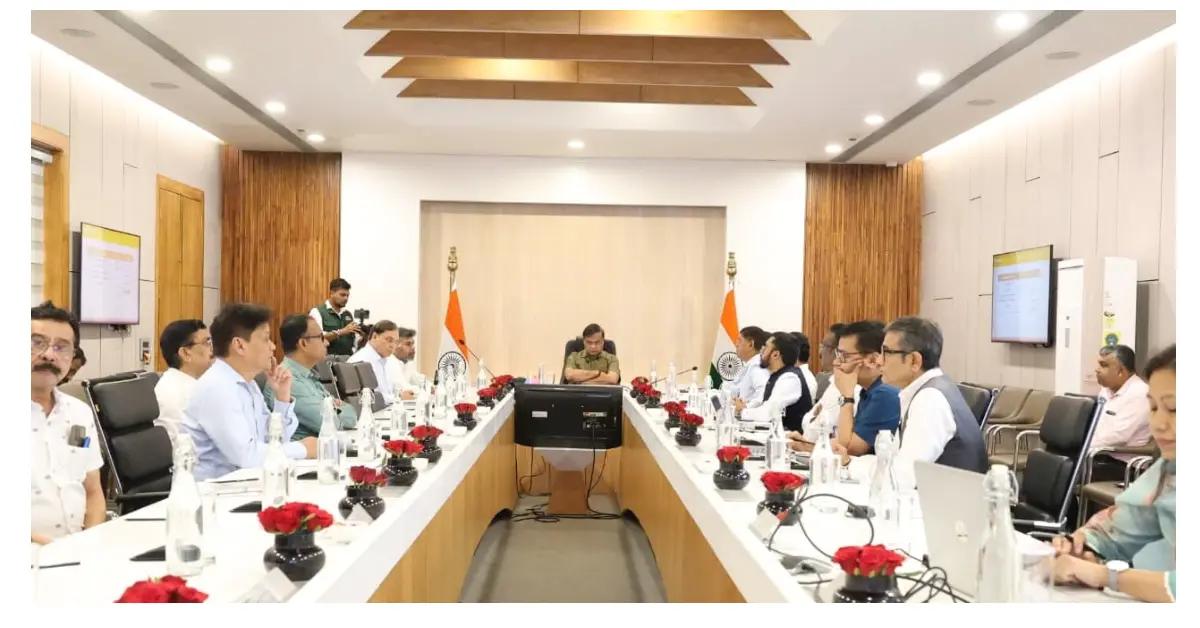
The Assam government has intensified its focus on industrial development and investment execution as Chief Minister Himanta Biswa Sarma reviewed the progress of Memorandums of Understanding (MoUs) signed during Assam industrial growth Advantage Assam 2.0 The high-level review meeting highlighted the government’s intention to ensure that investment proposals announced during the summit move rapidly toward implementation on the ground.
During the meeting, the Chief Minister directed officials across departments to provide swift and coordinated support to industries that are currently in different stages of establishment. The government also emphasized improving Assam’s ease of doing business ecosystem so that investors can set up operations without unnecessary delays.
The review comes at a time when Assam is attempting to position itself as one of the fastest-growing investment destinations in Northeast India. With infrastructure expansion, policy reforms, and industrial connectivity projects gaining pace, the state government believes the commitments made during Advantage Assam 2.0 can significantly transform the regional economy over the coming years.
Focus on Turning Investment Promises Into Reality
The Advantage Assam 2.0 summit attracted major investment proposals across sectors including infrastructure, manufacturing, green energy, logistics, tourism, food processing, information technology, and petrochemicals. While investment announcements generate attention during such events, the real challenge lies in converting those commitments into operational projects.
This was the central focus of the Chief Minister’s review meeting.
Officials were asked to closely monitor every signed MoU and identify bottlenecks slowing project implementation. Departments dealing with land allocation, environmental clearances, industrial permissions, electricity connections, and transportation infrastructure were instructed to accelerate approvals wherever possible.
The state government is reportedly creating a system where industries can receive faster administrative support through coordinated inter-departmental mechanisms. The objective is to reduce procedural delays that often discourage investors in emerging industrial regions.
According to officials present during the review, the government wants Assam to develop a reputation for policy stability and quick execution. Such an image is considered essential for attracting both domestic and international investors in the future.
Industrial Growth Seen as Key Economic Driver
The Assam government views industrial expansion as a critical tool for employment generation and long-term economic growth. Over the past few years, the state has focused on improving highways, railway connectivity, inland waterways, airports, and digital infrastructure to support industrial activity.Chief Minister reiterated that industrialization must benefit local youth by creating jobs and entrepreneurship opportunities. He stressed that investment projects should not remain limited to paperwork but must translate into actual economic activity on the ground.
Several sectors have emerged as priority areas for Assam’s industrial strategy. These include renewable energy, semiconductors, electronics manufacturing, tea processing, bamboo-based industries, ethanol production, food processing, and tourism infrastructure.
The government also believes Assam’s geographical position provides a strategic advantage for trade with Southeast Asian countries under India’s Act East Policy. Improved connectivity corridors are expected to enhance the movement of goods and attract logistics and warehousing investments.
Ease of Doing Business Gets Major Attention
One of the most important aspects discussed during the review was improving the ease of doing business environment in Assam.In recent years, Indian states have increasingly competed to attract investments by simplifying regulations and reducing bureaucratic hurdles. Assam is now attempting to strengthen its position by streamlining approvals and creating investor-friendly administrative systems.
Officials have been asked to ensure faster processing of industrial applications, transparent procedures, and timely grievance resolution. The government is also working toward digitizing more approval systems so that investors can complete processes online instead of navigating lengthy manual procedures.
The Chief Minister emphasized that industries should not face unnecessary delays after signing agreements with the government. He reportedly instructed departments to maintain regular communication with investors and resolve operational challenges quickly.
Analysts believe that consistent follow-up after investment summits is essential because many announced projects across India fail to materialize due to delays in approvals, financing issues, or infrastructure bottlenecks. Assam’s current approach appears focused on preventing such problems through continuous monitoring.
Assam Seeking Larger National Investment Role
Traditionally known for tea, oil, natural gas, and agriculture, Assam is now attempting to diversify its economic base. The government wants the state to emerge as a larger industrial and logistics hub in Northeast India.
The Advantage Assam initiative is part of that broader strategy.By attracting investments into manufacturing, technology, tourism, and clean energy sectors, the government aims to reduce dependence on a limited number of traditional industries. Diversification is also expected to create broader employment opportunities for educated youth.
Infrastructure projects currently underway in the state are likely to play a major role in supporting this transition. Expansion of highways, railway modernization, new bridges, industrial corridors, and improvements in air connectivity are expected to increase investor confidence.
Experts note that investor sentiment often depends not only on policies but also on execution capability. Continuous reviews by top leadership can improve accountability among departments and increase confidence among companies considering long-term investments in the region.
Local Businesses and Youth Could Benefit
implemented successfully, the industrial projects linked to Advantage Assam 2.0 could have a wider impact beyond large corporations.Local businesses may benefit through supply chains, transportation contracts, construction activities, hospitality services, and ancillary industries. Small and medium enterprises often grow around larger industrial ecosystems, creating secondary economic activity.
Employment generation remains one of the biggest expectations from the investment push. Young professionals, technical graduates, and skilled workers in Assam are closely watching how quickly proposed industries become operational.The government has also been emphasizing skill development initiatives to ensure that local youth are prepared for opportunities emerging from industrial expansion. Training programs aligned with industry requirements may become increasingly important as projects move forward.
Strong Monitoring Likely to Continue
The review meeting indicates that the Assam government plans to maintain close oversight of investment implementation in the coming months. Continuous monitoring, faster approvals, and coordination between departments are expected to remain central priorities.Observers believe that the success of Advantage Assam 2.0 will ultimately be judged not by the value of signed MoUs alone, but by the number of projects that become operational and generate employment.
For Assam, the stakes are significant. Successful implementation could strengthen the state’s position as economic hub in the Northeast and attract even larger investments in the future.With the Chief Minister personally reviewing progress and pushing departments for faster action, the government appears determined to ensure that industrial commitments translate into visible economic development across the state.