

Writer by 03.03.2026 time 10.00 AM Published
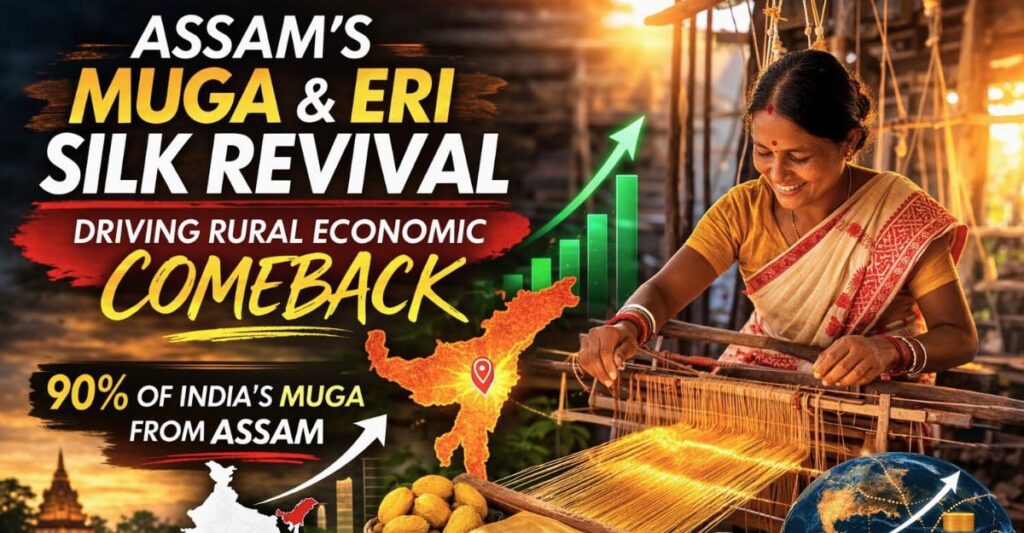
Assam’s Muga and Eri silk revival is no longer just a cultural footnote it is rapidly becoming a flagship success story for rural economic transformation in 2026. In March 2026, Chief Minister Himanta Biswa Sarma highlighted that Assam accounts for nearly 90% of India’s Muga silk production and around 65% of Eri silk output, cementing the state’s position as the undisputed global hub for these unique indigenous varieties.
This revival is delivering tangible results: higher incomes for rural households, women-led entrepreneurship, and a sustainable alternative to fast fashion. With strategic government support, the sector is shifting from traditional subsistence weaving to a modern, market-ready rural enterprise.
The Golden Legacy of Muga and Eri Silk
Muga silk, famous for its natural golden sheen that deepens with age and exceptional durability, holds a prestigious Geographical Indication (GI) tag since 2007. Produced exclusively in Assam due to its unique climate and host plants like Som and Soalu, it is often called the “golden thread of Assam.” Eri silk, popularly known as “peace silk,” is equally special — it is spun without harming the silkworm, making it fully ethical and eco-friendly.
Together, these two silks represent centuries of indigenous knowledge passed down through generations, especially among women in Upper Assam villages. They are integral to traditional Assamese attire like the Mekhela Chador and Gamosa, worn during festivals, weddings, and ceremonies.
Yet over the past decade, this heritage industry faced mounting pressure
- Fluctuating cocoon prices
- Climate-related disruptions
- Competition from synthetic substitutes
- Limited branding beyond regional markets
The Assam’s Muga & Eri silk revival seeks to address these vulnerabilities while repositioning the sector for global relevance.
Current Production: Assam’s Dominant Position
According to recent official statements, Assam produces the lion’s share of India’s premium non-mulberry silk. The state’s sericulture sector supports over 2.3 million people engaged in farming, reeling, spinning, and weaving activities. Women form the backbone of this ecosystem, managing everything from silkworm rearing to final weaving on traditional looms. 
Central Silk Board targets for 2025-26 further underscore the momentum: Muga raw silk production is aimed at 350 MT (up from 252 MT in 2023-24), while Eri production targets are even more ambitious at 6,000 MT for Assam. These figures reflect a clear policy push toward scaling output while maintaining quality.
Challenges That Triggered the Revival
Like many traditional industries, Muga and Eri silk faced serious headwinds in the last decade:
- Fluctuating cocoon prices and irregular income
- Competition from cheaper synthetic fabrics
- Climate change affecting silkworm health and yield
- Limited mechanization and market access beyond regional fairs
Younger generations were drifting away from the craft, threatening the survival of generational skills.
Government-Led Revival: Policy Meets Practice
The Assam Muga & Eri silk revival is anchored in the “Atmanirbhar” vision and supported by schemes under the North-East Region Textile Promotion Scheme (NERTPS) and Sericulture Cluster Development Programme. Key initiatives include:
- Financial assistance and subsidies for silk farmers
- Modern reeling infrastructure and skill-enhancement programs for weavers
- Branding and packaging support to improve market visibility
- Promotion at national and international trade fairs
Chief Minister Sarma has emphasized that modernization is being pursued “without compromising traditional techniques,” ensuring artisans meet contemporary demands while preserving authenticity. Empowering women weavers remains a top priority. 
Global Opportunity in Sustainable Fashion
The timing could not be better. Global luxury and ethical fashion brands are actively seeking traceable, sustainable natural fibers. Muga’s rarity and golden luster make it perfect for premium scarves, sarees, and home furnishings. Eri’s cruelty-free credentials appeal to conscious consumers in Europe, the US, and Japan.
Improved quality standards, international certifications, and consistent supply could significantly boost exports. The revival is already creating a structured value chain from cocoon to finished garment turning rural artisans into micro-entrepreneurs.
Women Empowerment & Rural Transformation
In villages across Sualkuchi (the “Manchester of Assam”) and beyond, women-led cooperatives are producing designer textiles that fetch premium prices. Income from silk weaving now funds children’s education, healthcare, and household improvements. One Muga farmer can earn ₹20-25 lakh annually through cocoon production and related activities, according to industry reports. 
This model of rural enterprise is proving that heritage industries can drive inclusive growth when supported by policy and market linkages.
The Road Ahead: Tradition, Innovation & Climate Resilience
Success depends on balancing modernization with authenticity. Challenges like climate variability require climate-resilient practices and better irrigation. Expanding certified clusters, youth training programs, and digital marketing will be crucial.
Key indicators to watch in the coming year:
- Year-on-year growth in Muga and Eri raw silk production
- Export volumes and revenue from value-added products
- Increase in youth and women participation
- Number of GI-certified and organically branded products
The implications extend beyond Assam.
India’s broader textile ambitions increasingly emphasize sustainable production and rural employment generation. If Assam demonstrates that heritage industries can be revitalized through policy focus and market integration, it could offer a replicable blueprint for other states.
The revival also highlights a larger shift in development thinking one that values local identity as an economic asset rather than a nostalgic relic.that sense, Assam’s Muga & Eri silk revival is not just about fabric. It is about reimagining rural growth in a globalized economy.The coming months will test whether momentum translates into measurable outcomes.
Key indicators to monitor include
- Year-on-year production data
- Export growth figures
- Youth participation in sericulture
- Expansion of certified silk clusters
Sustained policy backing and transparent reporting will determine whether this revival becomes structural or remains cyclical.
FAQ
1.Why is Muga silk globally significant?
Muga silk is exclusive to Assam and prized for its natural golden sheen and durability, making it attractive to luxury markets.
2.How does Eri silk differ from other silks?
Eri silk is spun without killing the silkworm, aligning with ethical and sustainable production practices.
3.Who benefits most from the revival?
Primarily rural households, especially women engaged in sericulture and weaving activities.
Conclusion
The world is watching and the golden silk of Assam is ready to shine brighter than ever.The Assam’s Muga & Eri silk revival represents both opportunity and responsibility.the current momentum is matched with infrastructure, branding, and climate resilience, the sector could redefine rural prosperity in the state.
But revival is not a one-season effort. It demands consistent investment, market intelligence, and trust-building with artisans.For now, a centuries-old golden thread is once again being positioned at the center of Assam’s economic future and the world is watching.

Leave a Reply