

Assam’s industrial ambitions have moved from promise to policy action.
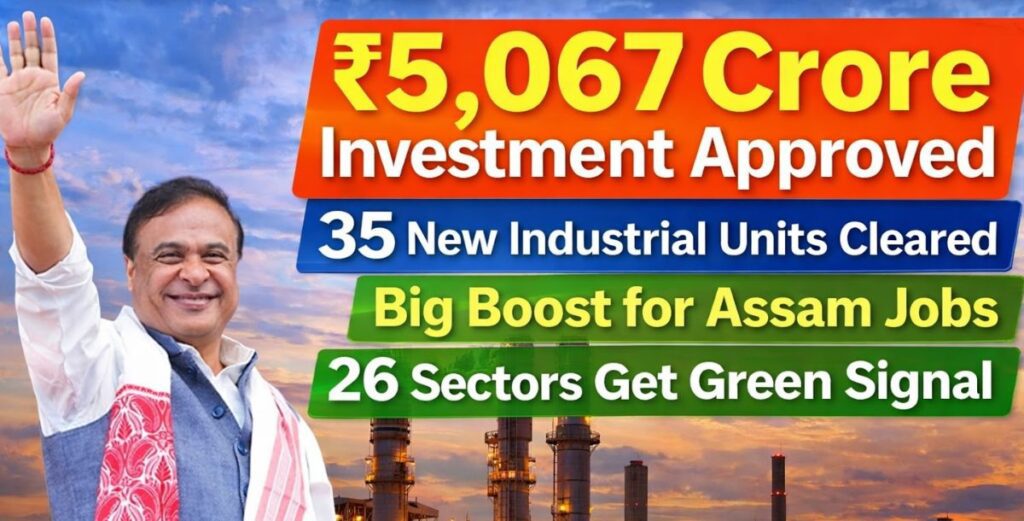
In a significant development, the state government has approved 35 new industrial units under the Assam Unnati Scheme, unlocking investments worth ₹5,067.73 crore. At a time when states across India are competing aggressively for private capital, this decision positions Assam as a serious contender in the manufacturing and investment race.More importantly, it signals something larger confidence.
A Defining Moment for Assam’s Industrial Strategy
The approvals under the Assam Unnati Scheme cover 26 different sectors, reflecting a deliberate attempt to diversify the state’s industrial base rather than depend on a single vertical.
Chief Minister Himanta Biswa Sarma described the development as a step toward accelerating Assam’s transformation into a manufacturing-driven economy. Officials involved in the process say the goal was not just to clear files, but to fast-track projects that are ready to move to the execution stage.
The emphasis, they stress, is on momentum.The timing is critical.
India is witnessing an industrial reshaping driven by supply chain realignments, policy reforms, and infrastructure upgrades. Investors are looking beyond traditional hubs. They are evaluating ease of doing business, administrative efficiency, and long-term policy stability.
Through the Assam Unnati Scheme, the state appears to be responding directly to these expectations.By approving projects collectively worth ₹5,067.73 crore, Assam is sending a message: it is prepared to compete and deliver.
What the ₹5,067 Crore Really Represents
Investment figures often appear abstract. But on the ground, ₹5,067.73 crore translates into
- Large-scale construction activity
- Machinery installation and procurement
- Direct hiring in factories and offices
- Expansion of logistics and service networks
Each industrial unit triggers multiple layers of economic movement. Contractors, suppliers, transport operators, and small vendors typically benefit alongside primary investors.
Economists often describe this as the “multiplier effect” where industrial capital circulates through the local economy, strengthening income levels beyond the factory gates.The Assam Unnati Scheme is structured to generate precisely this ripple.
Employment: The Expectation That Matters Most
For Assam’s youth, this announcement carries particular weight.Industrial growth is closely tied to employment generation. While exact job figures will depend on project execution and sector type, 35 new units across 26 sectors suggest the potential for significant direct and indirect opportunities.
Factories require skilled and semi-skilled workers. Supply chains require managers, drivers, technicians, and service providers. Surrounding communities often see growth in retail, housing, and transportation.
The government has repeatedly framed the Assam Unnati Scheme as an employment-oriented initiative. However, experts caution that timely execution will determine how quickly these opportunities materialize.
Investor Confidence and Administrative Signalling
Beyond numbers, this round of approvals strengthens perception a powerful factor in investment decisions.Industrial investors closely watch how quickly states process applications, provide land access, and ensure regulatory clarity. Delays erode confidence; speed builds it.
By moving decisively under the Assam Unnati Scheme, the state government is projecting administrative efficiency. Such signals often influence future investment cycles, as companies seek predictable governance environments.
In competitive federal economics, perception frequently shapes capital flow.Approvals mark the beginning not the end of the journey.For these 35 industrial units to deliver real impact, several conditions must align:
- Infrastructure readiness
- Stable power supply
- Skilled workforce availability
- Efficient logistics connectivity
Assam has invested in improving roads, connectivity, and policy frameworks in recent years. The success of the Assam Unnati Scheme will now depend on how smoothly these components integrate at the ground level.Industrial growth is not built on announcements alone; it is sustained through coordination and follow-through.
Building a Self-Reliant Industrial Ecosystem
The broader vision behind the Assam Unnati Scheme is to strengthen the state’s economic foundation.
A diversified industrial ecosystem reduces dependence on external markets, increases state revenue, and enhances export potential. It also strengthens supply chains within the region, positioning Assam as a gateway for broader Northeast economic activity.
If the current approvals translate into operational capacity within expected timelines, Assam could witness a structural shift in its economic profile over the next few years.Policy observers expect detailed project timelines and site-level developments to follow. Groundbreaking ceremonies, recruitment drives, and infrastructure tie-ups will offer clearer indicators of progress.
For now, the ₹5,067.73 crore approval stands as one of the largest consolidated industrial clearances in recent months under the Assam Unnati Scheme.The coming phase will determine whether this administrative momentum converts into visible industrial transformation.
Conclusion
The latest approvals under the Assam Unnati Scheme are more than a routine policy update. They reflect ambition, strategic timing, and an attempt to reposition Assam within India’s evolving industrial map.The foundation has been laid with ₹5,067.73 crore in approved investments.
What happens next execution, job creation, and sustained investor interest will define whether this moment becomes a milestone in Assam’s economic story.For now, the direction is clear. The delivery will decide the legacy.

Leave a Reply