
Writer by sanjoy 14.02.2026 time 3.00 PM Published
Assam’s First Brahmaputra Tunnel has finally received Union Cabinet approval and for millions in the Northeast, this is not just another infrastructure announcement. It could fundamentally change how people travel, trade and connect across the region.
At a time when faster logistics, border preparedness and economic expansion are national priorities, the green signal for Assam’s First Brahmaputra Tunnel marks a decisive shift. For decades, the mighty river has been both lifeline and obstacle. Now, policymakers are betting on engineering to turn that obstacle into opportunity.
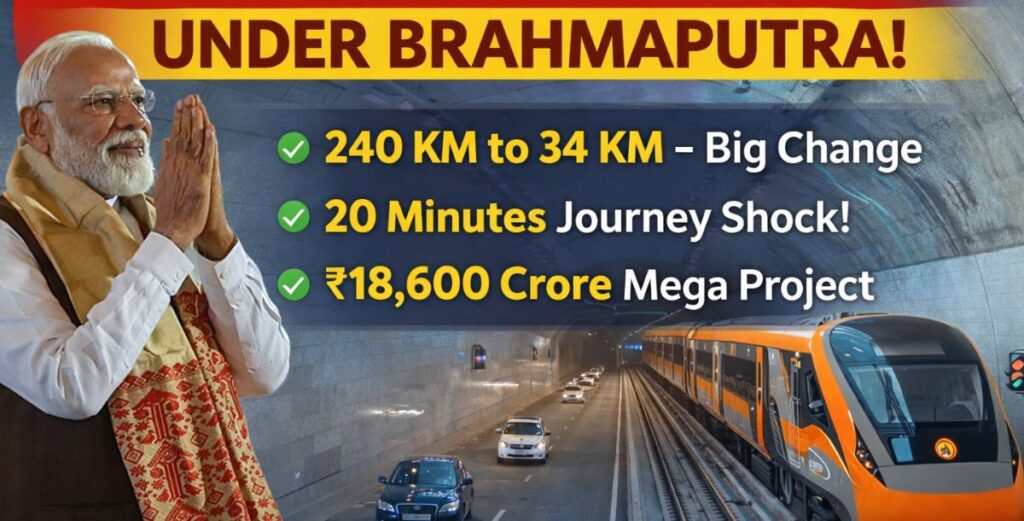
he Union Cabinet has given its nod to the country’s first underwater road-cum-rail tunnel beneath the mighty Brahmaputra River in Assam. This ambitious ₹18,662 crore project will dramatically cut travel time between Gohpur on the north bank and Numaligarh in upper Assam from nearly six hours to approximately 20 minutes, reducing the distance from a tedious 240 km detour to a direct 34 km high-speed link.
The approval marks a defining moment for Assam and the entire region, where the Brahmaputra has long acted as both a lifeline and a formidable barrier. By going under the river instead of over it, engineers are turning one of India’s greatest geographical challenges into a gateway for faster, safer, and more reliable movement of people, goods, and strategic assets.
Engineering Marvel: Twin-Tube Tunnel Under the Brahmaputra
The project involves a 33.7 km four-lane access-controlled greenfield corridor, with a 15.79 km twin-tube tunnel bored deep beneath the riverbed using advanced Tunnel Boring Machine (TBM) technology. One tube will carry a four-lane highway, while the parallel tube will accommodate railway infrastructure, making it India’s first combined road-and-rail underwater tunnel and only the second such facility in the world.
Built approximately 32 metres below the riverbed, the tunnel will feature robust engineering solutions to handle the Brahmaputra’s powerful currents, shifting sediments, high water pressure, and seismic vulnerabilities. Cross passages every 500 metres will ensure safety and emergency access. The entire project will be executed in Engineering, Procurement, and Construction (EPC) mode, with an estimated civil cost of around ₹11,982 crore and land acquisition adding another ₹717 crore.
This is no ordinary infrastructure project. The Brahmaputra’s width, depth, and dynamic nature make this one of the most complex tunneling endeavors in the country, requiring state-of-the-art technology and meticulous planning.
Game-Changing Impact on Travel and Daily Life
For residents of Assam, the benefits will be immediate and transformative. The current route forces travellers to take long, circuitous paths that can stretch up to six hours due to limited bridges and seasonal disruptions. Once operational, commuters, traders, students, and patients will zip across in under 20 minutes in a smooth, all-weather corridor.
This massive time saving nearly 95% reduction will revolutionise access to markets, hospitals, educational institutions, and workplaces. Farmers in the north bank will reach processing hubs and urban consumers faster, reducing spoilage and improving incomes. Emergency services, including ambulances, will operate with unprecedented speed, potentially saving countless lives during critical hours.
Strategic Boost to Defence and National Security
Located close to India’s international borders, the tunnel holds immense strategic value. It will provide a secure, all-weather, high-speed route for rapid mobilisation of troops, equipment, and supplies. In an era of heightened border sensitivities, this direct link strengthens defence logistics and enhances operational readiness in the Northeast.
Defence experts view the project as a vital addition to India’s border infrastructure push, complementing new roads, bridges, and airports in the region. It ensures that even during monsoons or floods when surface routes often become impassable — critical movement remains uninterrupted.
Economic Catalyst for Trade, Industry, and Tourism
Numaligarh, home to a major oil refinery and industrial hub, stands to gain enormously. Faster freight movement will slash logistics costs, improve supply chain efficiency, and make the area far more attractive for fresh investments in petrochemicals, manufacturing, and allied sectors.
The tunnel will also unlock the economic potential of both banks of the Brahmaputra. Enhanced connectivity is expected to spur industrial growth, boost agricultural trade, and integrate remote areas into the mainstream economy. Arunachal Pradesh, Nagaland, and other Northeast states will benefit indirectly through improved access to Assam’s transport network.
Tourism, a key growth sector for Assam, will receive a major fillip. Shorter travel times will encourage weekend getaways, business tourism, and exploration of cultural and natural attractions on either side of the river. Hotels, homestays, and local transport services are likely to see rising demand, creating new livelihood opportunities.
Jobs, Sustainability, and Long-Term Development
During the construction phase, the project is expected to generate thousands of direct and indirect jobs for engineers, skilled technicians, labourers, and local suppliers. Once completed, it will support sustained employment in operations, maintenance, and related services.
Environmental considerations remain paramount. Detailed impact assessments will guide construction to protect the Brahmaputra’s fragile river ecosystem, which faces challenges from erosion and climate variability. Modern tunnelling techniques aim to minimise surface disruption, while sustainability measures will be integrated to balance development with ecological preservation.
This initiative aligns perfectly with the government’s vision of transforming the Northeast from a remote frontier into a vibrant economic powerhouse. It complements other mega projects in roads, railways, waterways, and digital connectivity, creating a holistic infrastructure ecosystem.
A New Chapter in Northeast India’s Growth Story
The Brahmaputra has shaped Assam’s identity for centuries culturally, economically, and geographically. For too long, it divided communities and slowed progress. With this underwater tunnel, the river becomes a bridge rather than a barrier, symbolising unity, innovation, and forward momentum.
Chief Minister Himanta Biswa Sarma and central leaders have long emphasised the need for game-changing infrastructure in the region. The Cabinet’s approval reflects that commitment, delivering a project that is as strategically important as it is economically transformative.
As India marches towards a Viksit Bharat, this ₹18,662 crore investment in Assam demonstrates how bold engineering can overcome nature’s obstacles and accelerate inclusive development. When completed, the tunnel will not only save hours but also open endless possibilities faster trade, stronger security, better lives, and a more connected Northeast.
The approval of India’s first underwater road-cum-rail tunnel under the Brahmaputra is more than an infrastructure milestone. It is a powerful statement of confidence in Assam’s future a future where distance no longer dictates destiny, and where the Northeast stands tall as an integral engine of national growth.
FAQs
1.Where will Assam’s First Brahmaputra Tunnel be built?
It will run under the Brahmaputra River, connecting Gohpur and Numaligarh in Assam.
2.How long is the tunnel?
The road section is planned to be about 7 kilometres long, alongside a parallel rail alignment.
3.How much will it cost?
The estimated project cost is approximately ₹18,600 crore.
4.How much time will it save?
Travel time could reduce from nearly six hours to around 20 minutes once operational.
5.When will construction begin?
An official start date has not yet been publicly confirmed.
Conclusion
For generations, the Brahmaputra has shaped Assam’s identity culturally, economically and geographically.But it has also divided communities and slowed movement.
Assam’s First Brahmaputra Tunnel represents more than infrastructure. It signals intent to bridge distances, strengthen security and unlock economic potential in one of India’s most dynamic yet under-connected regions.If executed on schedule and with environmental care, this project could redefine how the Northeast connects with itself and with the rest of India.






Leave a Reply