
Writer by sanjoy 15.02.2026 Time 11.00 AM Published
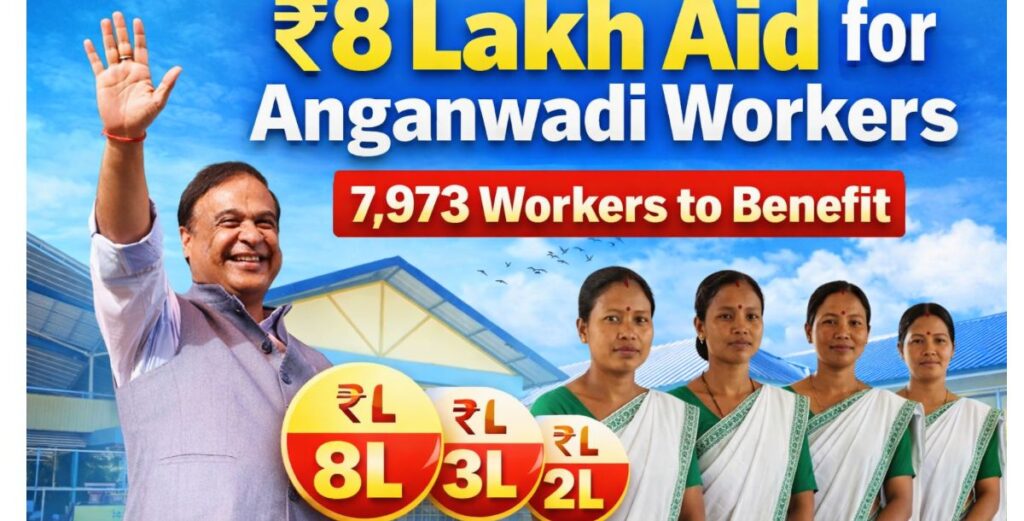
At a time when early childhood care is under national focus, Assam Announces ₹8 Lakh Aid for Anganwadi Workers, a decision that could directly impact thousands of families relying on grassroots childcare services. The announcement signals not just financial relief, but a policy shift that places frontline women workers at the centre of Assam’s development narrative.
Chief Minister Himanta Biswa Sarma confirmed that eligible Anganwadi workers, mini workers, and helpers will receive substantial lump-sum financial assistance. For many who have spent decades serving rural communities, the move is being seen as long-overdue recognition.
boost to India’s early childhood development ecosystem, the Assam government has announced a one-time financial assistance package for thousands of Anganwadi workers, mini workers, and helpers. Chief Minister Himanta Biswa Sarma confirmed that eligible full-time Anganwadi workers will receive ₹8 lakh each, mini Anganwadi workers ₹3 lakh, and helpers ₹2 lakh. This welfare initiative is expected to directly benefit 7,973 grassroots workers across the state, recognising their tireless service in nurturing the state’s youngest citizens.
The announcement comes at a crucial time when national attention is sharply focused on strengthening foundational learning, nutrition, and maternal-child health. For decades, Anganwadi centres run under the Integrated Child Development Services (ICDS) scheme have served as the first point of contact for millions of children in rural and semi-urban Assam. These frontline women workers often operate on modest honorariums while shouldering immense responsibilities. This lump-sum aid is not just monetary relief; it is a powerful acknowledgement of their invisible yet invaluable contribution to building a healthier, more educated future generation.
Understanding the Scale and Structure of the Assistance
The financial package is structured to reflect the varying roles and responsibilities within the Anganwadi system:
- ₹8 lakh for full Anganwadi workers
- ₹3 lakh for mini Anganwadi workers
- ₹2 lakh for Anganwadi helpers
With nearly 8,000 beneficiaries, the scheme is poised to inject substantial financial stability into households that have long supported community-level childcare. Unlike regular salary hikes or incremental incentives seen in other states, this one-time grant provides a meaningful capital infusion that workers can use for family needs such as housing improvements, children’s education, health emergencies, or even starting small enterprises.
Officials describe the move as both a welfare measure and a strategic investment in human resources. In remote districts of Assamwhere connectivity challenges and limited job opportunities are common this assistance could dramatically improve retention rates and morale among workers who often double as nutritionists, preschool teachers, immunisation coordinators, and community counsellors.
The Critical Role of Anganwadi Centres in Assam’s Development Story
Anganwadi centres form the bedrock of India’s flagship ICDS programme, launched in 1975. In Assam, with its vast rural population and diverse ethnic communities, these centres deliver six core services: supplementary nutrition, pre-school non-formal education, nutrition and health education, immunisation support, health check-ups, and referral services.
Every day, Anganwadi workers prepare nutritious meals, monitor child growth, counsel expectant mothers, and ensure timely vaccinations. In many villages, the local Anganwadi centre is the only reliable government touchpoint for young families. Workers frequently walk long distances, maintain detailed registers, and build deep personal bonds with children and mothers often becoming the first educators in a child’s life.
The first six years of life are scientifically proven to be the most critical for cognitive, emotional, and physical development. By investing in those who shape these formative years, Assam is aligning its policy with long-term human capital goals. Stronger, more motivated Anganwadi teams directly translate into better learning outcomes, reduced malnutrition, and improved maternal health indicators key metrics in the state’s overall development index.
Parallel Push for Modern Infrastructure
The financial aid is part of a larger vision. Chief Minister Sarma has simultaneously highlighted ongoing efforts to upgrade Anganwadi infrastructure across the state. New centres are being constructed with modern amenities, including child-friendly classrooms, improved sanitation, safe cooking areas, and better learning environments. This dual approach empowering people and upgrading physical spaces addresses both the software and hardware of early childhood care.
Development experts have long argued that motivated staff and quality infrastructure must go hand in hand. A well-equipped centre run by a financially secure and respected worker creates a virtuous cycle: higher attendance, better service delivery, and greater community trust. In Assam’s context, where many centres still operate from temporary or inadequate structures, this combined strategy could mark a turning point.
Ripple Effects on Families, Communities, and Women Empowerment
The impact of this initiative extends far beyond the workers themselves. Rural families relying on Anganwadi services will benefit from greater continuity and consistency in care. When workers feel valued and secure, children receive more consistent nutrition and education—laying a stronger foundation for school readiness.
Moreover, the scheme carries a strong gender empowerment dimension. Over 99% of Anganwadi workers and helpers in India are women. By providing substantial financial recognition to these “Baideos” (sisters, as they are affectionately called in Assam), the government is reinforcing women’s economic role in grassroots governance. This aligns with broader state initiatives like Orunodoi, which provide direct cash transfers to women-headed households.
Public policy observers note that such recognition can improve service quality and reduce attrition. In an era when many states are grappling with vacant Anganwadi posts and overburdened staff, Assam’s proactive step could serve as a model for others.
Implementation Roadmap and Expectations
While the announcement has been warmly welcomed, success will depend on swift and transparent execution. Detailed guidelines on eligibility, application processes, and disbursement timelines are awaited. The government is expected to issue official notifications soon, ensuring that funds reach beneficiaries without unnecessary delays.
Stakeholders are hopeful that this initiative will be followed by periodic reviews and potential expansion in future budgets. As Assam continues to prioritise education and health under its “Mission Basundhara” and other flagship programmes, investing in Anganwadi workers signals a clear commitment to inclusive growth.
Investment in Assam’s Future
When Chief Minister Himanta Biswa Sarma announced this aid, he did more than release funds he placed the spotlight on the silent warriors shaping Assam’s next generation. In the long term, every rupee spent on Anganwadi workers is an investment in healthier children, stronger families, and a more equitable society.
As the state moves towards modernising its early childhood care framework, this decision stands out as both compassionate and strategic. It recognises that real development begins not in grand policy documents, but in the humble corners of village Anganwadi centres where dedicated women turn dreams of a better tomorrow into daily reality for lakhs of Assam’s children.
With efficient implementation, this ₹8 lakh aid package has the potential to become one of the most impactful grassroots welfare measures in recent years, strengthening the very foundation on which Assam’s future is being built none child, one centre, and one empowered woman at a time.
FAQ
1.Who will receive ₹8 lakh?
Eligible full Anganwadi workers in Assam.
2.What about mini workers?
Mini Anganwadi workers will receive ₹3 lakh.
3.How much will helpers get?
Anganwadi helpers will receive ₹2 lakh.
4.How many people benefit?
7,973 government workers and helpers.
5.When will funds be distributed?
Official timelines are expected through government notifications.
Conclusion
When Assam Announces ₹8 Lakh Aid for Anganwadi Workers, it does more than release funds it acknowledges the invisible labour shaping children’s earliest years.If implemented efficiently, this initiative could strengthen morale, improve service continuity, and reinforce Assam’s early childhood development framework.
In the long run, investing in those who teach a child’s first lesson may prove one of the state’s most impactful decisions.





Leave a Reply