

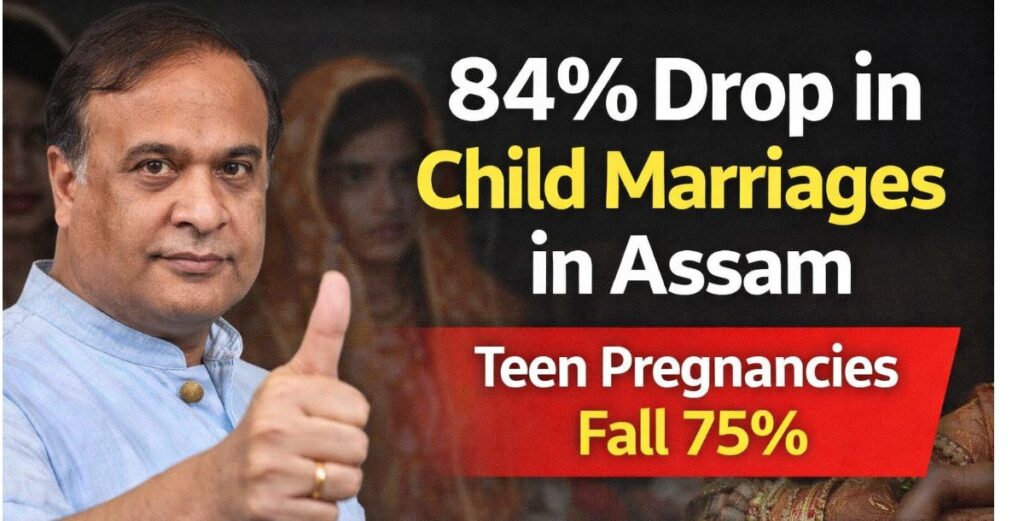
development that stands out as one of the most encouraging social stories from India in recent years, Assam has recorded a sharp 84% decline in child marriages involving girls below 18. Alongside this, teenage pregnancies have fallen by 75%, according to state government data and independent surveys.
This significant progress comes at a time when child marriage continues to affect communities across several parts of the country. Assam’s achievement is not just about numbers it reflects a determined push by the state administration under Chief Minister Himanta Biswa Sarma to protect young girls, keep them in school, and break deep-rooted cycles of early marriage.
What the Numbers Reveal
Recent reports, including surveys by non-governmental organizations tracking five states, show Assam leading the nation with the steepest decline in child marriages. While the national average decline stands at around 69% for girls, Assam has achieved an 84% reduction among girls below 18 and up to 91% among boys below 21 in the last three years.
Health authorities have also noted a parallel 75% drop in teenage pregnancies, directly linked to fewer early marriages. When girls stay in school longer and delay marriage, their health outcomes improve dramatically, reducing risks of complications associated with early motherhood. 
These figures are based on strengthened reporting and monitoring systems introduced in recent years. In hotspot rural districts with historically high rates, the administration tightened surveillance and acted swiftly.
How Assam Turned the Tide
The decline did not happen by chance. It resulted from a multi-pronged strategy combining strict law enforcement with community awareness campaigns.
- Visible Crackdowns: Police registered cases under the Prohibition of Child Marriage Act and intervened in planned ceremonies. In several instances, authorities stopped weddings before they could take place. Over 8,600 arrests were reported in coordinated drives since 2023, sending a clear message that the law would be enforced without exception.
- Door-to-Door Mobilization: ASHA workers, school teachers, and district health teams conducted extensive village-level meetings. They educated families about the legal marriage age (18 for girls), health risks of early pregnancy, and the long-term benefits of education for girls.
- Community Engagement: Village heads and local leaders were involved to build social pressure against the practice. Schools reported improved attendance among adolescent girls in many areas, while conversations about girls’ rights became more common in rural settings.
One official involved in the operations described the approach as deliberately visible: the goal was to create deterrence while encouraging voluntary change through awareness. 
Additional measures included financial incentives for girls’ education, such as schemes like Nijut Moina, which support families to keep daughters in school longer. These economic supports address one of the root causes — poverty and the perception of early marriage as a form of financial or social security.
The Human Cost of Child Marriage —
Child marriage has long been intertwined with poverty, cultural customs, and insecurity in many regions. When girls marry young, they often drop out of school, face higher risks of maternal health complications, remain financially dependent, and miss opportunities for higher education or employment.
In contrast, delaying marriage allows girls to complete secondary education, build skills, and aspire to better futures. Teachers in government schools across Assam have observed tangible improvements in girls’ participation. Health workers note that families are increasingly discussing the importance of education over early wedlock.
Experts emphasize that while enforcement provides immediate results, lasting change requires sustained efforts. Social reform specialists highlight the need for continued awareness programs, economic support for vulnerable families, education incentives, and community ownership. Without these, gains risk plateauing. 
A Model for Other States?
Assam’s focused campaign — blending police action, administrative coordination, and grassroots outreach — has drawn attention beyond the state. Some reports suggest the state is on track toward even more ambitious goals, with monitoring continuing actively.
If the downward trend holds, Assam could emerge as a replicable case study for other regions struggling with similar challenges. The combination of political will, inter-departmental coordination, and community involvement appears to be key.
However, challenges remain. Deeply ingrained social attitudes do not change overnight. Families in economically vulnerable areas may still view early marriage as protection. Ongoing vigilance, robust reporting systems, and support schemes will be essential to ensure the progress is not temporary.
State authorities continue to monitor districts closely. The real test will be whether families begin delaying marriages voluntarily as awareness grows and economic conditions improve.
For now, the sharp decline offers cautious but genuine hope. It shows that when enforcement, education, and empathy converge, societies can shift harmful patterns and open better pathways for the next generation of girls.
Assam’s story is a reminder that protecting childhood and investing in girls’ education yields benefits far beyond statistics — it strengthens families, communities, and the state’s overall development.
FAQ
1.How much decline has been reported?
An 84% reduction in marriages involving girls below 18.
2.What about teenage pregnancies?
Authorities report a 75% drop.
3.What drove the decline?
Strict legal enforcement combined with awareness campaigns.
4.Is the campaign ongoing?
Yes, monitoring and enforcement efforts are continuing.
Conclusion
The fact that Assam Reports Sharp Drop in Child Marriage Cases offers cautious hope in a policy area that has long resisted change.Statistics alone do not transform societies. But when enforcement, awareness, and political will converge, patterns can shift.
Whether this marks a lasting social reform or a temporary correction will depend on what happens next.For now, the numbers suggest something important: momentum is possible.

Leave a Reply