
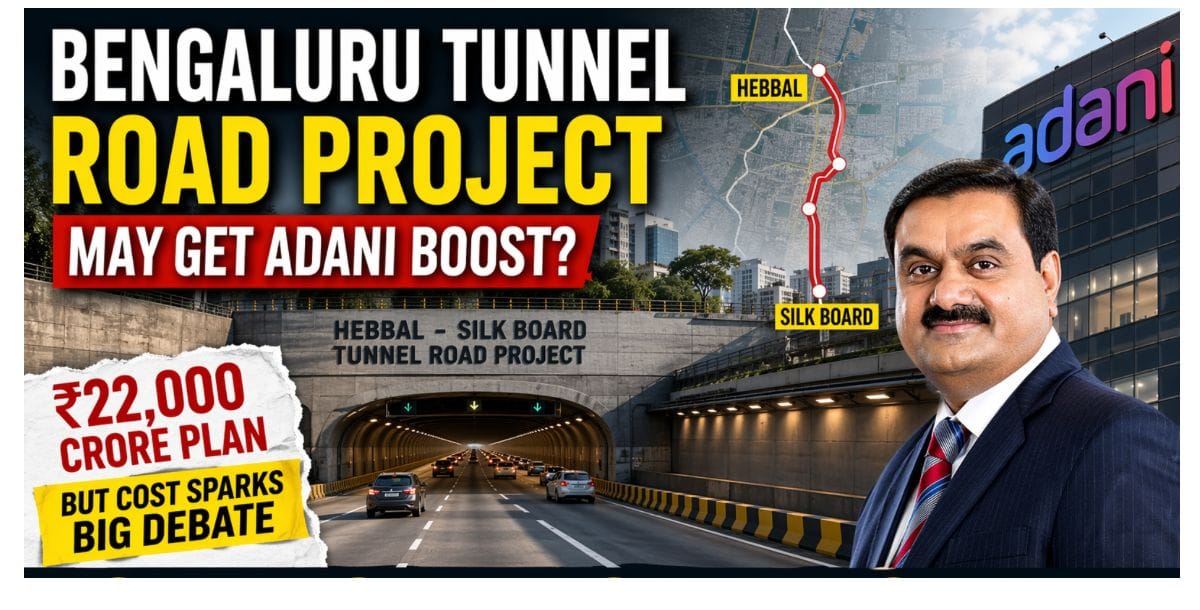
Bengaluru’s long-awaited tunnel road project is once again at the center of attention, as the Adani Group emerges as the lowest bidder for the ambitious infrastructure plan. While this development could accelerate one of the city’s most critical traffic solutions, it has also sparked a growing debate over cost, feasibility, and long-term impact.
The project, which aims to ease traffic congestion in one of India’s busiest cities, is now facing intense scrutiny from policymakers, experts, and the public alike.
Understanding the Bengaluru Tunnel Road Project
The proposed tunnel road is designed to connect key traffic corridors in Bengaluru, particularly the highly congested stretch between Hebbal and Silk Board Junction.
- Daily traffic bottlenecks
- Long commuting hours
- High economic productivity loss
The tunnel project aims to address these issues by creating an underground high-speed road network that allows vehicles to bypass surface-level congestion entirely.
- Estimated length: Approximately 16–17 kilometers
- Project model: Public-Private Partnership (PPP)
- Objective: Reduce travel time and decongest major roads
- Expected benefit: Faster connectivity across key zones
For a city that has struggled for years with infrastructure lagging behind population growth, this project is seen as a potential game-changer.
Adani Group Emerges as the Lowest Bidder
In a significant development, the Adani Group has submitted the lowest financial bid for the project, estimated at around ₹22,000 crore.At first glance, being the lowest bidder might suggest a smooth path forward. However, the situation is far more complicated.
- Government’s initial project estimate: Around ₹17,000–₹18,000 crore
- Adani bid: Approximately 25 percent higher
- Other bidders: Even higher proposals
This creates a paradox. While Adani is technically the lowest bidder, the cost itself exceeds initial projections by a large margin.This gap has triggered serious concerns within government circles and among urban planning experts
Why the Project is Becoming Controversial
The Bengaluru tunnel project is no longer just an infrastructure initiative. It has evolved into a broader debate involving economics, governance, and urban sustainability.
1. Cost Escalation Concerns
The biggest concern is the rising cost of the project. A jump of several thousand crores raises questions about:
- Budget feasibility
- Financial planning accuracy
- Long-term repayment burden
approved at this higher cost, the financial strain could eventually affect taxpayers or lead to higher user charges
2. Public Burden and Toll Concerns
Under the PPP model, a large portion of the project cost will be recovered through user fees.
- Commuters may have to pay toll charges
- Daily travel expenses could increase
- Accessibility might be limited for lower-income users
The idea of paying to avoid traffic raises important questions about fairness and inclusivity in public infrastructure.Large-scale tunneling projects come with environmental implications.Key concerns include
- Impact on groundwater systems
- Construction-related pollution
- Long-term ecological balance
Urban planners are also debating whether such a project aligns with sustainable city development or merely shifts problems underground.
4. Effectiveness in Reducing Traffic
While tunnel roads offer faster movement for vehicles, experts are divided on whether they truly solve congestion.Some concerns include
- Increased vehicle dependency
- Induced demand (more people choosing cars)
- Neglect of public transport solutions
Without parallel investment in mass transit systems, the tunnel may provide only temporary relief.
Government Response and Review Process
Recognizing the seriousness of these concerns, the Karnataka government has initiated a review process.
- Evaluate all submitted bids
- Reassess project cost estimates
- Analyze financial feasibility
- Examine long-term sustainability
This indicates that the project is not yet finalized and could undergo significant changes before approval.
Funding Structure and Financial Model
The Bengaluru tunnel project is expected to follow a Public-Private Partnership model, which typically involves shared financial responsibility.
- Government contribution: Around 40 percent
- Private investment: Around 60 percent
- Cost recovery: Likely through toll systems
This model reduces immediate pressure on government finances but introduces long-term user-based costs.The success of such a model depends heavily on accurate traffic projections and revenue planning.
Bengaluru is often referred to as India’s technology capital, but its infrastructure challenges have become equally well-known.
- Average commute times among the highest in India
- Frequent traffic jams across major routes
- Economic productivity losses due to delays
The tunnel project aims to directly address these issues by offering a faster alternative route for commuters.If implemented effectively, the tunnel road could deliver several benefits:
1. Reduced Travel Time
Commuters could save significant time by avoiding surface-level congestion.
2. Improved Productivity
- Less stress for workers
- Increased efficiency
- Better work-life balance
3. Boost to Urban Infrastructure
- Set a benchmark for other cities
- Encourage further infrastructure investment
- Improve Bengaluru’s global image
Risks That Cannot Be IgnoredDespite its potential, the project carries notable risks.Cost overruns could
- Increase debt burden
- Lead to higher toll charges
- Create long-term financial strain
- Exclude a section of society
- Create inequality in road access
- Focusing heavily on road infrastructure might
- Delay public transport development
- Increase dependence on private vehicles
The future of the project will depend on several key decisions:
- Final review by the government committee
- Possible cost renegotiations
- Environmental and feasibility clearances
- Cabinet-level approval
Only after these steps will the project move toward implementation.Urban development experts emphasize that infrastructure projects must balance ambition with practicality.
- Financial sustainability
- Environmental responsibility
- Inclusive accessibility
Without these factors, even well-intentioned projects can face long-term challenges.
Conclusion
The Bengaluru tunnel road project represents both opportunity and risk. With the Adani Group emerging as the lowest bidder, the project has gained momentum, but rising costs and public concerns have added layers of complexity.
For a city struggling with traffic congestion, the need for solutions is urgent. However, the path forward must be carefully planned to ensure that the solution does not create new problems.
The coming months will be crucial in determining whether this ambitious project becomes a landmark achievement or a subject of prolonged debate.