

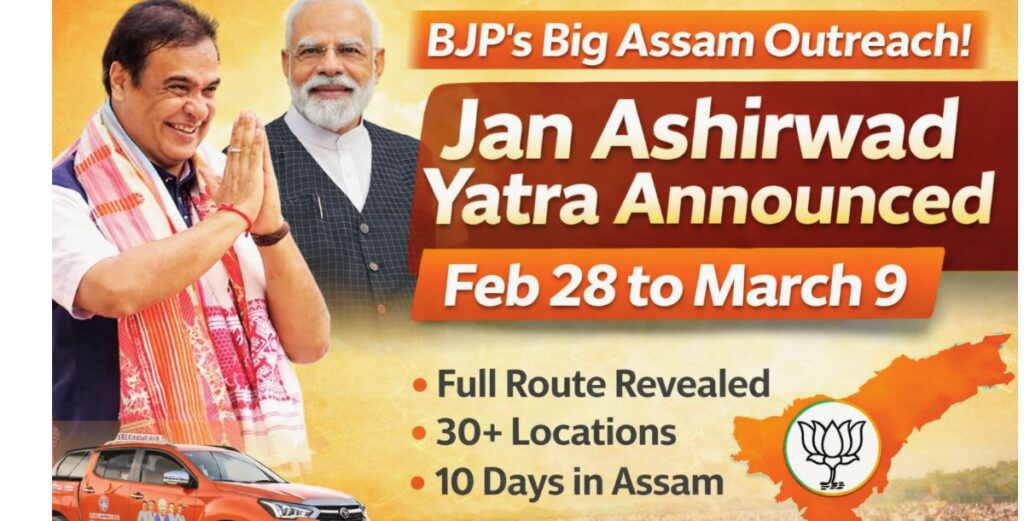
In Assam, elections rarely begin with a formal announcement. They begin with movement convoys on highways, roadside gatherings, handshakes in small markets.From February 28, the BJP’s Jan Ashirwad Yatra will set that movement in motion across the state, marking a crucial moment in Assam’s evolving political season.
The outreach drive, scheduled until March 9 in its first phase, is more than a series of rallies. The Jan Ashirwad Yatra is designed as a ground-level engagement campaign one that blends political messaging with direct voter interaction at a time when public mood is still taking shape.
For the ruling party, this is about consolidating trust. For voters, it’s an opportunity to test political promises against lived realities.What the Jan Ashirwad Yatra Represents
Organised by the Bharatiya Janata Party, the Jan Ashirwad Yatra is structured as a mass-contact programme. In simple terms, it’s politics without barriers leaders meeting citizens face-to-face, not just through speeches but through presence. Assam’s political culture, such yatras carry symbolic weight. They signal readiness. They energize workers. They create visibility in regions where booth-level networks determine outcomes.
The BJP’s Jan Ashirwad Yatra is expected to combine roadshows, public meetings, and interactions with local communities from tea garden workers to small business owners.
District-Wise Rollout: A Carefully Chosen Route
The first phase of the Jan Ashirwad Yatra covers more than 30 locations across Upper, Central, and Lower Assam — a spread that reflects strategic planning rather than random selection.
February 28: Teok, Jorhat, Tezpur, Nazira, Baghpura
March 1: Jagiroad, Morigaon, Raha, Nagaon, Batadrava
March 2: Gohpur, Biswanath, Bongaigaon, Naoboicha
March 5: Majuli, Charaideo, Jonai
March 6: Hojai, Dhing, Lahorighat, Duliajan
March 7: Sarupathar, Golaghat, Khumtai, Dergaon
March 8: Margherita, Digboi, Makum, Tinsukia
March 9: Sualkuchi, Rangia, Chaygaon, Nalbari, Barpeta
The geography matters. These districts reflect economic diversity agriculture belts, riverine islands, oil-producing regions, and urban centres.A yatra of this scale requires weeks of preparation, coordination, and booth-level mobilization. Party workers have already begun groundwork in many areas.
Development
The BJP’s Jan Ashirwad Yatra is expected to revolve around development infrastructure upgrades, welfare scheme delivery, employment initiatives, and central assistance to Assam.
Over the past few years, the state government has emphasized road expansion, bridge connectivity, and social welfare coverage. The yatra provides a platform to reinforce those achievements directly before voters.
Political strategists often say that perception becomes reality in elections. A campaign like the Jan Ashirwad Yatra allows the party to shape perception through storytelling citing completed projects and ongoing plans while countering criticism.
The Jan Ashirwad Yatra arrives at a critical political juncture. With electoral cycles approaching, early outreach builds narrative control. Assam, local conversations matter deeply. A leader visiting a constituency weeks before official campaign announcements can generate goodwill that lingers.
Analysts note that mass contact programmes
- Strengthen grassroots networks
- Boost cadre morale
- Influence undecided voter
- Reinforce emotional connect
The BJP’s Jan Ashirwad Yatra fits that playbook precisely.
Assam’s Political Landscape: A Competitive Terrain
Assam has become central to political calculations in the Northeast. The BJP’s earlier electoral gains here reshaped regional alignments.But governance narratives must constantly be renewed. Voters today are more informed and more vocal about local issues employment, inflation, rural infrastructure, flood management.
Campaigns like the Jan Ashirwad Yatra serve a dual purpose: projecting achievements while listening to ground concerns.
Opposition parties are also increasing district-level activity. The coming weeks may see counter-campaigns, sharper messaging, and intensified political debateBeyond speeches and slogans, the real indicators of the Jan Ashirwad Yatra’s impact will be:
- Crowd engagement levels
- Local issue discussions during meetings
- Participation of senior leaders
- Follow-up announcements
The phrase “first phase” suggests continuity. Additional rounds could follow based on public response.For voters, these events are not merely political theatre. They offer rare access to decision-makers. Constituency-specific concerns roads, schools, hospitals often surface most clearly during such interactions.
FAQs
1.What is the Jan Ashirwad Yatra?
A statewide BJP outreach campaign focused on voter engagement and development messaging.
2.When does it begin?
February 28, running until March 9 in its first phase.
3.How many locations are covered?
More than 30 towns and constituencies across Assam.
4.What is its main objective?
Grassroots mobilization, public interaction, and reinforcement of governance narratives.
5.Will there be more phases?
The campaign is described as a first phase, indicating possible expansion.
Conclusion
The BJP’s Jan Ashirwad Yatra marks the beginning of a new political chapter in Assam’s calendar.When leaders step onto district roads and speak directly to citizens, politics shifts from headlines to handshakes. Whether this outreach strengthens electoral momentum will unfold in time.
For now, one thing is clear Assam’s political rhythm has quickened, and the journey has just begun.

Leave a Reply