Published: May 29, 2026 | Category: Space News | Reading Time: 7 min
The Night Cape Canaveral Shook
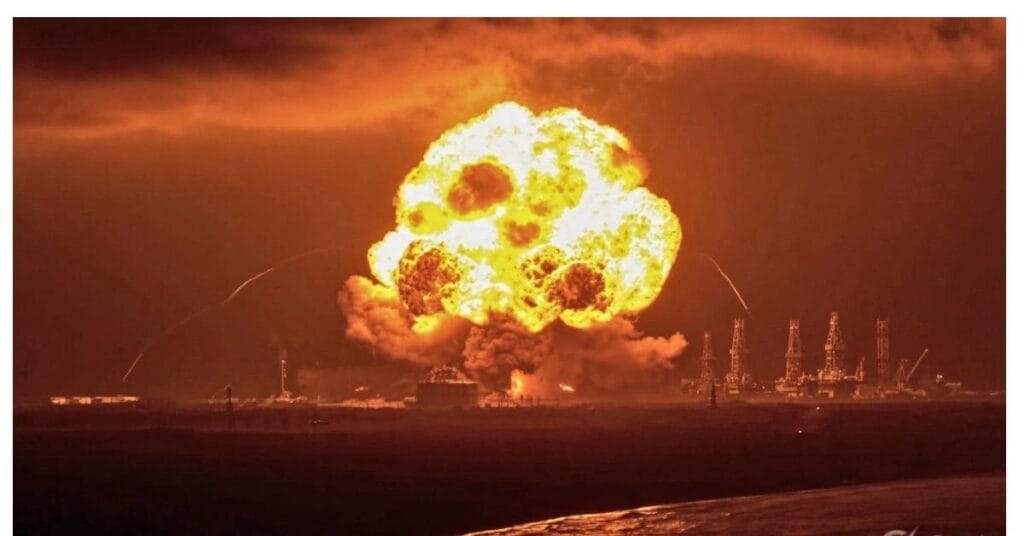
At exactly 9:00 p.m. EDT on May 28, 2026, residents in Cape Canaveral and Cocoa Beach, Florida felt their homes shake. blue origin explosion They stepped outside to find the sky painted orange. Social media flooded within seconds with videos of an enormous fireball rising from the coast.
What they were witnessing was one of the most dramatic and costly failures in the history of American private spaceflight — the complete destruction of Blue Origin’s New Glenn rocket on its launch pad at Cape Canaveral Space Force Station. No one was injured. But the damage — to the rocket, the launch pad, and perhaps to Blue Origin’s ambitions — was severe.
This is the full story of what happened, why it matters, and what comes next for Jeff Bezos’ space company.
What Is Blue Origin — and Who Owns It?
Before diving into the explosion, it helps to understand the company behind the rocket.
Blue Origin is owned by Jeff Bezos, blue origin explosion the founder and former CEO of Amazon. He established the company on September 8, 2000, with a stated mission to enable “a future where millions of people are living and working in space for the benefit of Earth and its inhabitants.” Unlike SpaceX, which went public in filings and raised venture capital early, Blue Origin has been almost entirely self-funded by Bezos himself — to the tune of more than $10 billion over 25 years.
The company is headquartered in Kent, Washington, employs around 11,000 people, and operates multiple production facilities and field offices across the United States. Its current CEO is Dave Limp, a former Amazon executive who took the reins in 2023 to accelerate the company’s competitive push against SpaceX.
Blue Origin’s two primary rockets are:
- New Shepard — a suborbital vehicle used for space tourism and research payloads
- New Glenn — a heavy-lift orbital rocket, the company’s biggest and most ambitious project
It is the New Glenn that exploded on May 28, 2026.
What Is the New Glenn Rocket?
The New Glenn is a massive, 320-foot-tall rocket designed to carry heavy payloads to orbit. Named after John Glenn, the first American to orbit Earth, it is powered by seven methane-fueled BE-4 engines in its first stage — the same engine type that also powers United Launch Alliance’s Vulcan Centaur rocket.
New Glenn made its first orbital flight in January 2025, a significant milestone after years of delays. By April 2026, it had successfully completed three missions. The third mission even demonstrated impressive reusability — the booster returned and landed on a drone ship for the second time. That said, the upper stage suffered a cryogenic failure during that mission, resulting in the loss of the satellite payload.
The fourth mission was intended to be a turning point: the first of 24 contracted launches for Amazon’s “Leo” satellite internet constellation, a direct competitor to SpaceX’s Starlink network. No satellites were on board during the May 28 test.
Exactly What Happened: The New Glenn Explosion, Explained
The incident occurred during what is known as a static fire test — sometimes called a “hotfire” test. In this procedure, the rocket’s engines are ignited while the vehicle remains tethered to the ground. It is a standard pre-launch verification step, designed to confirm that all propulsion systems are working correctly before a rocket actually lifts off.
Engineers at Launch Complex 36 were counting down to a brief test firing of the New Glenn’s seven BE-4 first stage engines. The vehicle was fully fueled with methane and liquid oxygen — a combustible combination — in preparation for a June launch carrying Amazon Leo satellites.
blue origin explosion As the engines appeared to begin firing, something went catastrophically wrong at the base of the rocket. Within moments, a rapidly growing fire engulfed the 188-foot-tall first stage. The 86-foot-tall upper stage began to tilt. And then — in a moment captured in videos that quickly circled the globe — the vehicle exploded in a roiling fireball that lit up the Florida night sky.
The rocket was completely destroyed. When smoke cleared, the launch pad infrastructure, including the transporter-erector used to move the rocket to the pad and raise it to the launch position, appeared to have been heavily damaged or destroyed. At least one of the lightning protection towers at LC-36 was also destroyed.
It was the first major on-pad explosion at Cape Canaveral since September 2016, when a SpaceX Falcon 9 rocket blew up at Space Launch Complex 40 due to a rupture of a high-pressure helium tank. That incident kept SpaceX’s pad out of action for more than a year.
Jeff Bezos Responds: “Very Rough Day”
In the hours following the explosion, both Blue Origin and Jeff Bezos posted statements on X (formerly Twitter).
Blue Origin’s official statement confirmed the facts and little else: “We experienced an anomaly during today’s hotfire test. All personnel have been accounted for. We will provide updates as we learn more.”
Bezos was more personal: “All personnel are accounted for and safe. It’s too early to know the root cause but we’re already working to find it. Very rough day, but we’ll rebuild whatever needs rebuilding and get back to flying. It’s worth it.”
NASA Administrator Jared Isaacman also weighed in, stating that the space agency was aware of the anomaly and acknowledging the difficulty of developing new heavy-lift launch capability. He noted NASA would work with partners to assess impacts on Artemis and Moon Base programs.
Florida Congressman Mike Haridopolos confirmed he had spoken directly with NASA Administrator Isaacman about the explosion.
What Was at Stake: Amazon Leo and the Satellite Race
To understand the full weight of this explosion, you have to understand what the New Glenn was supposed to do.
Amazon is building a satellite internet network called Project Kuiper, referred to here as “Leo,” intended to compete directly with SpaceX’s Starlink — which generated nearly $12 billion in revenue in 2025 alone. Amazon had contracted Blue Origin for 24 launches, making the New Glenn critical infrastructure for Amazon’s space ambitions.
The fourth New Glenn mission was set to be the very first of those 24 contracted launches. Amazon confirmed no Leo satellites were on board during the May 28 test, so no satellite payload was lost. But the mission itself — and the launch schedule supporting a multi-billion-dollar project — has been dealt a serious blow.
For comparison, a competing United Launch Alliance Atlas V rocket was still scheduled to launch the following day (May 29) from a different pad, carrying a separate batch of Amazon Leo satellites. US Space Force officials confirmed the explosion would not affect launches by other companies from other pads.
How Serious Is the Damage?
Extremely serious — and here is why.
Unlike SpaceX, which operates multiple launch pads across Cape Canaveral and Vandenberg Space Force Base in California, Blue Origin has only one New Glenn launch pad: the one that was destroyed.
When SpaceX’s Falcon 9 exploded on its pad in 2016, the company was able to shift operations to another pad and returned to flight in roughly three and a half months, though the pad itself was out of service for more than a year. Blue Origin does not have that flexibility. There is no backup pad. Every day the pad is being repaired is a day no New Glenn can fly.
The FAA confirmed the static fire test was not within the scope of FAA-licensed activities, so no new FAA investigation was triggered. However, the FAA stated it would verify that Blue Origin implements corrective actions before the next New Glenn launch.
There is also a potential secondary consequence: if the explosion is traced back to a problem with the BE-4 methane engine, it could affect United Launch Alliance’s Vulcan Centaur rocket, which uses the same engine. That would widen the damage beyond Blue Origin alone.
Blue Origin vs. SpaceX: Where Things Stand
The explosion raises fresh questions about the competitive gap between Blue Origin and SpaceX.blue origin explosion
SpaceX, founded by Elon Musk in 2002, has built a commanding lead across virtually every metric in commercial spaceflight. The company was responsible for approximately 90% of the world’s payload mass to orbit in 2025. It had 140 to 145 launches planned for 2026. SpaceX’s Starlink is a fully operational, revenue-generating business. The company was valued at approximately $800 billion in a secondary share sale in December 2025.
Blue Origin, by contrast, planned eight to twelve launches in 2026. It made its first major orbital payload delivery only in November 2025. The company has never released public financial information, and estimates of its valuation range between $50 billion and $100 billion — a fraction of SpaceX’s scale.
Bezos himself has invested at least $10 billion and believes Blue Origin may one day surpass Amazon in scale. Recent reporting suggests the company is exploring outside funding for the first time, with CEO Dave Limp acknowledging that external capital would be necessary to ramp up launches and better compete for government and commercial contracts.
The May 2026 explosion is a significant setback on that path.
Blue Origin Better Than SpaceX?
This is one of the most searched questions about both companies — and the honest answer, based on 2026 evidence, is: not yet, but it is actively trying to close the gap.
SpaceX has more missions, more infrastructure, more revenue, and a longer track record of operational reliability. Blue Origin has demonstrated promising reusability with New Glenn and holds substantial government contracts, including work supporting NASA’s Artemis and Moon Base programs. Its BE-4 engine is a genuinely world-class piece of hardware — the same reason ULA chose it for the Vulcan Centaur.
Where Blue Origin has historically struggled is pace. Critics have long argued the company moved too slowly compared to SpaceX. The May 2026 explosion reinforces that the path from promising technology to reliable operational launch provider is long, expensive, and unforgiving.
Can You Buy Blue Origin Stock?
Blue Origin is a private company and is not publicly traded on any stock exchange. There is no Blue Origin stock ticker. If you have seen references to “Blue Origin stock,” they may refer to indirect exposure through Amazon (AMZN), though Bezos’s Blue Origin is legally separate from Amazon.
Bezos has been the sole financial backer of Blue Origin since its founding. Reports suggest the company is beginning to explore outside investors — but as of May 2026, no public offering has been announced.
What Happens Next
Blue Origin faces a difficult road ahead. The company must:
- Identify the root cause of the static fire failure
- Assess and rebuild the damaged launch pad infrastructure at LC-36
- Determine whether the BE-4 engine played a role — and if so, assess implications for ULA’s Vulcan program
- Rebuild stakeholder confidence, particularly with Amazon, ahead of the Leo satellite launch contract
- Do all of this while competitors continue to fly
Bezos’s words — “we’ll rebuild whatever needs rebuilding and get back to flying” — are exactly what you would expect from a founder defending his company. What matters now is how quickly and transparently Blue Origin executes on that promise.
The space industry is, as NASA Administrator Isaacman put it, “unforgiving.” History shows that even the most capable companies — SpaceX included — can suffer spectacular failures and recover. The question for Blue Origin is not whether it can recover, but how long recovery will take, and whether it can afford the time.
Key Facts at a Glance
| Detail | Information |
|---|---|
| Date of explosion | May 28, 2026, at ~9:00 p.m. EDT |
| Location | Launch Complex 36, Cape Canaveral Space Force Station, Florida |
| Rocket | New Glenn (mission 4) |
| Test type | Static fire (hotfire) engine test |
| Engines | 7 × BE-4 methane-fueled engines |
| Injuries | None — all personnel accounted for |
| Payload on board | None (Amazon Leo satellites were not loaded) |
| Owner | Jeff Bezos (Blue Origin is a private company) |
| CEO | Dave Limp |
| Founded | September 8, 2000 |
FAQ
Q1.Blue Origin owned by Jeff Bezos? Yes. Blue Origin was founded by Jeff Bezos in 2000 and remains privately owned. Bezos is the sole financial backer and has invested more than $10 billion in the company.
Q2.How much does it cost to fly on Blue Origin? Blue Origin’s New Shepard suborbital tourist flights have not had publicly listed ticket prices, but seats have reportedly sold for hundreds of thousands of dollars. The crewed tourism program has been on hold in recent years following a 2022 anomaly with an uncrewed flight.
Q3.Blue Origin better than SpaceX? As of 2026, SpaceX maintains a significant lead in launch frequency, revenue, and operational reliability. Blue Origin has made meaningful progress with the New Glenn rocket, but the May 2026 explosion underscores the gap that remains.
Q4.What does Elon Musk say about Blue Origin? Musk has historically been critical of Blue Origin’s pace, famously giving it the nickname “Blue Balls” for years of delays. The two companies compete directly for government contracts, commercial launch business, and satellite internet market share.
Q5.What exactly happened to the Blue Origin rocket on May 28, 2026?
Blue Origin’s New Glenn rocket exploded on its launch pad at Launch Complex 36, Cape Canaveral Space Force Station, Florida, at approximately 9:00 p.m. EDT on May 28, 2026. Engineers were conducting a static fire test — a standard pre-launch procedure where the rocket’s engines are ignited while the vehicle remains tethered to the ground. As the seven BE-4 methane-fueled engines began to fire, something went catastrophically wrong at the base of the rocket.
This article is based on verified reporting from NASA, Blue Origin, the US Space Force, and major news outlets. All facts are current as of May 29, 2026.