By an Education Desk Reporter | Last Updated: May 2026 Estimated Reading Time: 7 minutes
“I checked my answer three times. The formula was right. The steps were right. But the marks didn’t match.” — Class 12 student, Delhi, after receiving Physics board result
That single sentence captures what thousands of CBSE students felt this year when their Physics answer sheets came back with scores that simply didn’t add up. If you’re one of them — or a parent sitting across from a confused, heartbroken teenager — this article is written for you first. Not for algorithms. Not for clicks. For you.
Let’s break down exactly what happened, why it happened, and most importantly, what you can do about it right now.
What Is the CBSE Physics Answer Sheet Mismatch Issue?
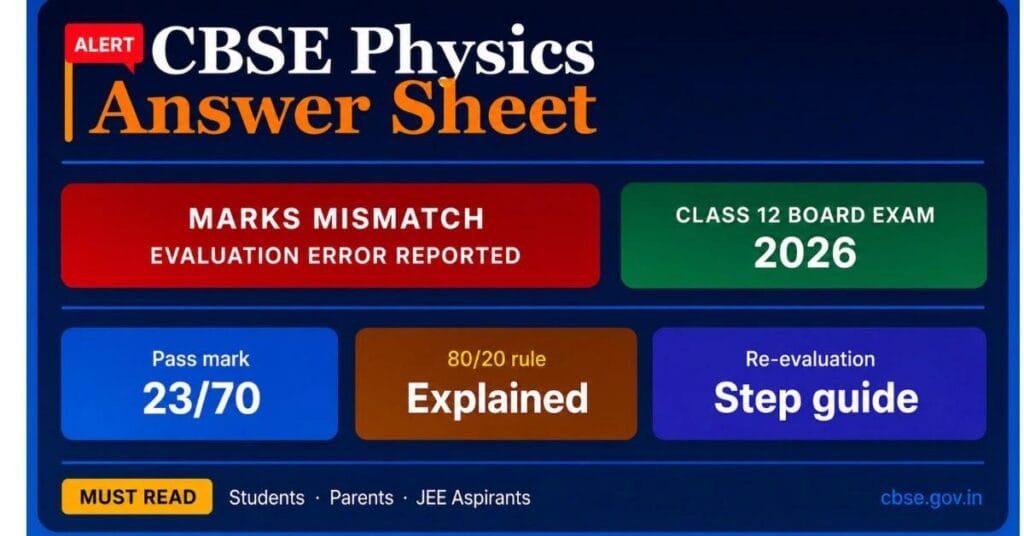
The CBSE Physics answer sheet mismatch refers to a situation where students — primarily from the Class 12 board examination — reported significant discrepancies between their expected scores and the marks they actually received on their evaluated answer sheets.
These discrepancies fall into several reported categories:
- Correct answers marked wrong — particularly in derivation-based and numerical questions where steps were complete but partial marks were not awarded
- Missing marks in diagram questions — where labeled diagrams were present but examiners allegedly did not credit them
- Totalling errors — where individual question marks added up correctly on the sheet but the total transferred to the front page was incorrect
- Answer not evaluated — entire pages or questions left unmarked in rare but reported cases
- Wrong answer key application — in some reported instances, especially in multi-set papers (Set 1, Set 2, Set 3), the wrong answer key was allegedly used during evaluation, causing correctly answered questions to be marked wrong
This is not a new concern — CBSE evaluation disputes surface every year — but the scale and nature of reports in 2025-26 have brought it into sharp focus, with social media amplifying student voices like never before.
Why Does This Happen? The Real Reasons Behind Evaluation Errors
Understanding the root cause matters. It’s not about blaming teachers or the board blindly — the CBSE evaluation system is genuinely under pressure.
1. The Scale Problem
CBSE conducts one of the largest school examination systems in the world. Over 1.4 million students appear for Class 12 board exams annually. Physics alone generates millions of answer booklets. Each booklet must be evaluated, cross-checked, and processed within a tight 30–40 day window before results are declared.
When scale is this massive, even a 0.1% error rate translates into thousands of affected students.
2. Examiner Fatigue and Inconsistency
Examiners are typically school teachers assigned marking duties. They evaluate hundreds of papers per day. Fatigue, inconsistent interpretation of marking schemes, and varying standards between different evaluation centres can lead to uneven marking — especially in a subject like Physics where partial credit judgment is subjective.
3. Multi-Set Paper Confusion
CBSE issues multiple sets of question papers (Set 1, Set 2, Set 3 — sometimes more) to prevent cheating. Each set has slightly different questions or rearranged question order. If an examiner or evaluation centre applies the wrong answer key to the wrong set, the result is systematic mismarking across an entire batch of students.
4. Answer Sheet Digitisation Gaps
While CBSE has moved toward digitised evaluation at many centres — where scanned images of answer sheets are marked online — the system is not uniform across all regions. In transition zones, manual handling increases the chance of totalling errors, skipped pages, or misidentified booklets.
Real Student Experiences: What the Data and Voices Say
Students across online forums, Reddit’s r/CBSE, and Twitter/X reported strikingly similar patterns in 2026
“My Physics teacher looked at my answer and said it deserved full marks. CBSE gave me 3 out of 5. Applied for verification. Got back same marks.”
“Applied for photocopy. Saw the paper. The examiner had literally skipped question 18. It was fully answered. 5 marks gone.”
“Set 3 student here. My numerical answers matched the Set 1 key perfectly — not the Set 3 key. Something is off.”
These aren’t isolated voices. They represent a pattern that education journalists, coaching institutes, and independent educators have documented across multiple exam cycles.
Your Complete Action Plan: Step-by-Step
If you believe your CBSE Physics marks are incorrect, here is exactly what you need to do — in order.
Step 1: Apply for Photocopy of Answer Sheet
This is your most powerful first move. CBSE allows students to obtain a scanned copy of their evaluated answer sheet by paying a nominal fee through the official CBSE results portal.
Why this matters: You cannot challenge what you cannot see. Once you have the photocopy, you can identify:
- Unevaluated questions
- Incorrect totalling
- Missing partial marks
- Stamped but not scored diagrams
Timeline: Apply within the window announced by CBSE after results (typically 10–15 days after result declaration).
Step 2: Get an Expert Review
Once you have the photocopy, do not rely solely on your own assessment. Take it to:
- Your Physics teacher
- A coaching institute teacher
- Any qualified Physics educator who can give an objective opinion
Document their written assessment. This becomes evidence if you escalate.
Step 3: Apply for Re-verification
Re-verification checks:
- Whether all answers are evaluated
- Whether marks are correctly totalled
- Whether the total on each page matches the grand total
Re-verification does not re-evaluate subjective quality — it’s a technical check. Fee applies. Apply through the official CBSE portal.
Step 4: Apply for Re-evaluation (If Applicable)
CBSE’s re-evaluation policy has evolved. Currently, re-evaluation (actual re-marking) is available for certain classes and subjects. Check the current CBSE circular for Physics Class 12 specifically, as policies can change year to year.
Important: If your photocopy reveals a clear factual error (unevaluated question, totalling mistake), mention this specifically in your re-evaluation application. It strengthens your case significantly.
Step 5: Escalate if Necessary
If re-verification and re-evaluation do not resolve a clear error, students (or parents on their behalf) can:
- Write formally to the Regional CBSE Office
- Approach the Controller of Examinations, CBSE HQ, New Delhi
- Seek guidance from a legal expert in education law if marks impact admissions
What CBSE’s Official Position Has Been
CBSE has, in official communications over the years, maintained that:
- The evaluation process follows a structured marking scheme
- Chief examiners oversee regional evaluation centres
- Re-verification and re-evaluation mechanisms exist specifically to address legitimate grievances
- Moderation policies ensure fairness across sets
However, student advocates and education experts have consistently called for:
- Greater transparency in the evaluation process
- Independent audit of answer sheet evaluation
- Faster grievance resolution timelines
- Clearer partial marking guidelines communicated to examiners
What Parents Need to Know Right Now
If your child is affected, here is the most important thing to understand: staying calm and acting systematically wins more marks back than panic.
- Do not let your child’s distress cloud the process. Treat it like a professional dispute, not an emotional crisis.
- Keep copies of every application, every receipt, every communication with CBSE.
- Document dates meticulously — CBSE grievance windows are short and missing them forfeits your right.
- If admissions are at stake (JEE counselling, CUET cutoffs), simultaneously apply to colleges provisionally while the dispute is being resolved. Many universities allow provisional admission pending board result rectification.
Does This Affect JEE and CUET Admissions?
This is the question that keeps students awake at night — and it deserves a direct answer.
JEE Main and Advanced use their own exam scores, not CBSE board marks, for rank calculation. However, CBSE Class 12 marks are used for eligibility verification. A mismatch that drops you below the 75% aggregate threshold (required for JEE Advanced IIT admission) could be critical.
CUET (Common University Entrance Test) uses CUET scores for admissions but many universities still use Class 12 marks for tie-breaking or eligibility. A Physics mark discrepancy can matter here.
Direct admission courses (like B.Sc. Physics, engineering without JEE at private universities) often use board percentages directly. A 3–5 mark difference can change your college entirely.
This is exactly why resolving a genuine mismatch is not just about fairness — it has real, life-altering stakes.
Systemic Fixes CBSE Should Make
Several education policy experts and former CBSE officials have suggested structural reforms:
- AI-assisted totalling verification — automated cross-checking of per-question marks vs. total before results are finalised
- Mandatory second examiner review for borderline scripts (within 10 marks of a grade cutoff)
- Standardised partial-marking training for Physics examiners, particularly for derivation and numerical questions
- Real-time evaluation dashboards for regional offices to flag statistical outliers
- Student-facing transparency reports showing evaluation centre averages vs. national averages
Until these reforms are in place, the burden unfortunately falls on students to self-advocate.
(FAQ)
Q1.27 out of 80 a Pass or Fail in CBSE?
Short answer: It depends on your internal assessment marks — but 27/80 alone is not a pass.
Here is how CBSE Physics marking works for Class 12:
- The theory paper is out of 70 marks (not 80 — see the 80/20 rule below for context)
- The practical/internal assessment is out of 30 marks
- The combined passing requirement is 33% of the total 100 marks, which means you need at least 33 marks out of 100 overall
However — and this is the part most students miss — CBSE also requires a minimum of 33% in theory separately. That means you need at least 23 out of 70 in the theory paper to pass, regardless of how well you did in practicals.
Now, if we’re talking about a paper marked out of 80 (which applies in some specific exam structures or older formats):
- 33% of 80 = 26.4 marks, which rounds up to 27
- So 27 out of 80 is right at the passing borderline — technically a pass, but extremely close to the cutoff
What this means for answer sheet mismatches: If your Physics theory marks are hovering near 23–27, even a 2–3 mark evaluation error can be the difference between passing and failing. This is exactly why getting your photocopy and applying for re-verification is non-negotiable if you’re near these numbers.
Q2.Which Is the Toughest Physics Paper in CBSE History?
The CBSE Class 12 Physics paper of 2023 is widely considered the toughest in recent memory — and students, teachers, and coaching institutes were near-unanimous in that verdict.
Here’s what made it exceptionally difficult:
- Lengthy numerical problems that required multi-step calculations with limited time
- Conceptual application questions that went beyond rote learning — students who had only memorised derivations struggled badly
- Optics and Modern Physics sections were reported as unusually complex, with questions combining two or more concepts in a single problem
- Case-study based questions (a relatively newer format CBSE introduced) were considered confusing and time-consuming
Other papers that consistently rank as difficult across student feedback include:
- 2019 Physics paper — known for its lengthy Section B and tricky assertion-reason questions
- 2016 Physics paper — heavy on derivations and conceptual numericals
- 2020 (pre-COVID) Physics paper — students reported the paper felt rushed and the marking scheme was harsh
What’s interesting is that “toughest paper” years often also see the highest number of re-evaluation applications — because when papers are genuinely hard, examiner discretion on partial marks increases, and so does the potential for inconsistency.
If you appeared in a year with a notoriously difficult paper and your marks feel off, that context actually supports your case for re-verification.Q
Q3.What Is the 80/20 Rule in CBSE?
The CBSE 80/20 rule refers to the split between theory (board exam) marks and internal assessment marks for most subjects.
Under this structure:
- 80 marks come from the external board examination (the written exam you sit in the examination hall)
- 20 marks come from internal assessment — this includes practicals, projects, periodic tests, and notebooks evaluated by your own school
So when someone says “Physics is 80/20 in CBSE,” they mean the total 100 marks are divided this way.
However — important update for Class 12 Physics specifically:
CBSE restructured Class 12 Physics to a 70/30 split rather than 80/20:
- 70 marks — Theory board exam
- 30 marks — Practical examination (conducted by external examiners at your school)
This is a source of genuine confusion because different sources cite different numbers. The 80/20 terminology is more commonly associated with Class 10, where many subjects follow that pattern. For Class 12 Physics, always refer to the 70 + 30 = 100 structure.
Why does this matter for answer sheet mismatches?
Because your 70-mark theory paper is evaluated externally by CBSE-assigned examiners — meaning it’s the most vulnerable to the kinds of evaluation errors described in this article. Your 30-mark practical is evaluated locally, which has its own set of issues but is a separate process.
When reviewing your result, always check theory and practical marks separately. A mismatch in the theory component (the 70-mark paper) is what you can challenge through CBSE’s formal re-verification process.
Q4.23 out of 70 a Pass in CBSE?
Yes — 23 out of 70 is the minimum passing mark for CBSE Class 12 Physics theory.
Here is the exact calculation:
- Passing percentage in CBSE = 33%
- 33% of 70 = 23.1 marks
- CBSE rounds down in the student’s favour, making 23 the minimum pass mark
So if you scored exactly 23 in theory, you have technically passed the theory component.
But here’s the full picture — passing theory alone isn’t enough to pass the subject overall:
| Component | Total Marks | Minimum to Pass |
|---|---|---|
| Theory (Board Exam) | 70 | 23 marks |
| Practical (Internal) | 30 | 10 marks |
| Overall Subject | 100 | 33 marks combined |
You must clear both the theory minimum (23/70) and the overall minimum (33/100). So a student who scores 23 in theory but only 8 in practicals (total 31) would still fail, despite passing the theory cutoff.
The answer sheet mismatch connection: Students who score between 20–25 in theory are in the highest-risk zone. A single evaluation error — one unevaluated 3-mark question, one incorrectly totalled page — can push a student from a pass to a fail. If you or your child is in this range, do not wait. Apply for the photocopy the moment the re-evaluation window opens. The stakes are simply too high to leave it to chance.
Final Word: You Deserve Accurate Marks
If you followed the syllabus, understood the concepts, wrote the derivations, drew the diagrams — you deserve every mark that work is worth. An administrative or procedural error should not stand between you and the opportunity your hard work earned.
Apply for the photocopy. Review it carefully. Follow the process.
The system has mechanisms. Use them. And know that thousands of students have successfully had marks corrected through exactly this path.Your Physics knowledge is real. Make sure your marks reflect it.
For official grievance filing, visit: cbse.gov.in → Examinations → Verification/Re-evaluation
Grievance helpline: 1800-11-8002 (toll-free)
Tags : CBSE Physics Answer Sheet Mismatch, CBSE Class 12 Physics Marks Error, CBSE Re-evaluation 2025, CBSE Answer Sheet Photocopy, CBSE Physics Result Dispute, Class 12 Board Exam Answer Sheet, CBSE Marks Correction Process